Pixel Flow Level 41 Solution | Pixel Flow 41 Walkthrough
How to beat Pixel Flow Level 41: Video solution & walkthrough. The fastest way to pass Pixel Flow 41.
Is this the wrong level layout?🤔
Pixel Flow randomizes levels for different players. Don't worry, just upload a screenshot of your board, and our AI will find the correct video instantly.
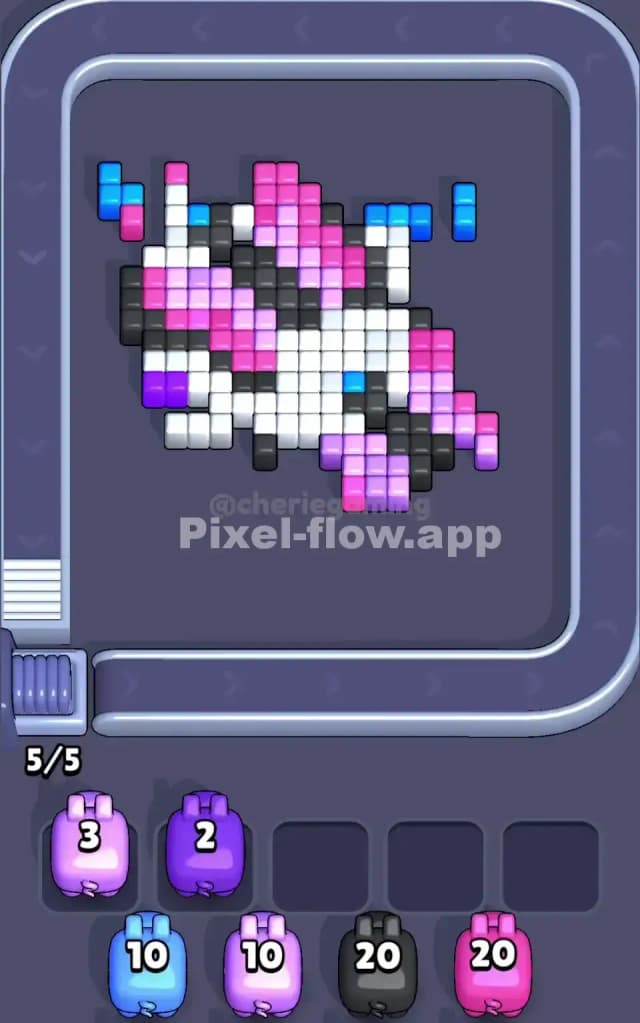

Pixel Flow Level 41 Overview
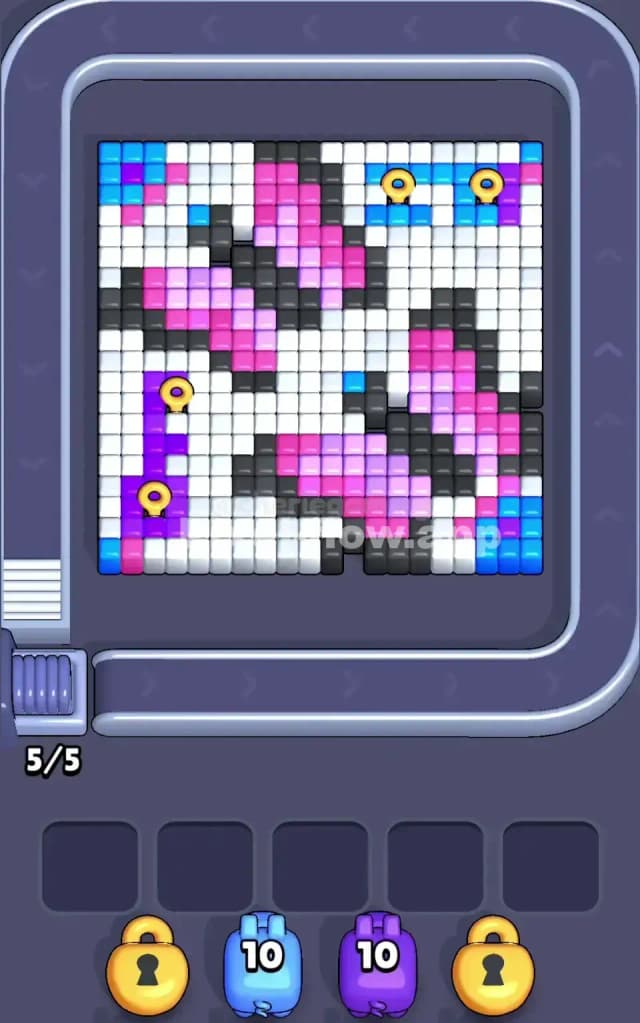
Board Layout and Color Composition
Pixel Flow Level 41 presents a complex, multi-layered voxel puzzle dominated by magenta and pink tones, with strategic pockets of white, cyan, and dark gray cubes scattered across the board. The pixel art itself forms a recognizable figure or pattern—think of it as a detailed sprite image where the foreground colors are vibrant and the background layers use cooler, muted tones. You'll notice that magenta cubes occupy roughly 40–50% of the visible surface, making them both a blessing and a curse. The white cubes form natural dividers and "safe zones," while the dark gray blocks often hide behind other colors, forcing you to clear outer layers methodically. There are also isolated cyan patches in the upper-left and lower-right corners, plus a few stray blue touches that'll matter later on. The board is deliberately packed—there's minimal wasted space, and almost every color you see has a purpose in the layering sequence.
Win Condition and Deterministic Flow
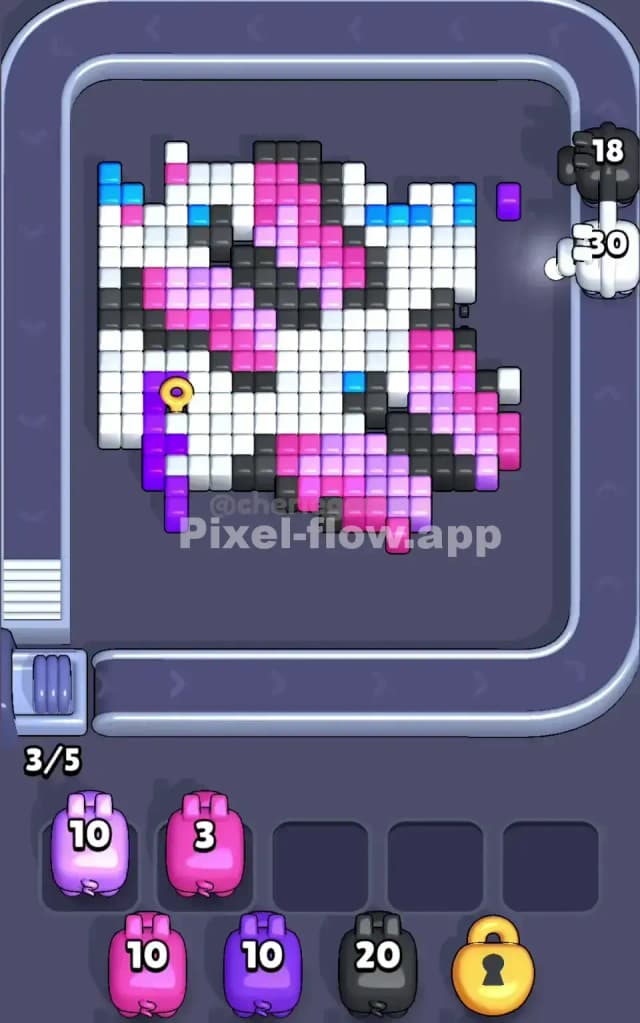
To beat Pixel Flow Level 41, you need to clear every single voxel cube from the board. The good news is that your pig queue, ammo counts, and waiting slots are entirely deterministic—meaning every run plays out the same way if you make identical choices. You're working with four pigs visible in the queue at any moment, and you can see exactly how many shots each one carries. The challenge isn't luck; it's planning ahead so that no pig gets stuck with ammo it can't spend, and no waiting slot fills up with a "dead" pig while cubes still remain on the board. Pixel Flow 41 requires you to think two or three pigs ahead, count remaining targets per color, and position your half-spent pigs strategically so they don't jam your buffer.
Why Pixel Flow Level 41 Feels So Tricky
The Magenta Bottleneck
The biggest trap in Pixel Flow Level 41 is the sheer volume of magenta cubes and how they're distributed across multiple depth layers. Here's the sneaky part: magenta pigs will happily fire at any magenta cube in their line of sight, but if you send them out in the wrong order, they'll obliterate the surface layer and leave you with a half-spent pig staring at magenta cubes that are now hidden behind white or gray barriers. Suddenly, that pig can't hit anything, drops into a waiting slot, and you've wasted ammo. The magenta problem compounds because there are often three to five magenta pigs in the queue, and their ammo counts rarely align perfectly with the visible magenta targets. You might have two pigs with 10 ammo each, but only 15 visible magenta cubes—or worse, 25 hidden ones that won't be exposed until you clear cyan and white first. This forces you to park magenta pigs in waiting slots and pray you can expose more targets before all five slots fill.
Awkward Color Patches and Hidden Layers
Pixel Flow Level 41 hides several "trap" colors that seem abundant but are actually arranged to create dead-pig scenarios. The cyan cubes in the upper region, for instance, appear isolated and sparse—just enough to make a cyan pig waste most of its ammo, leaving a few shots hanging. Similarly, the dark gray blocks form a dense central column that you'll need to chip away at gradually, but some gray is only accessible after removing white cubes, and some white is only accessible after removing gray. This circular dependency means you can't just bulldoze one color; you have to thread the needle perfectly. The white cubes are especially deceptive because they're structural—removing them opens sightlines to deeper colors, but if you remove too many too fast, magenta or blue pigs will start firing into empty space and jam up your waiting queue.
The "Click" Moment
I'll be honest—Pixel Flow Level 41 didn't feel solvable to me at first. I watched pigs drop into the waiting slots over and over, and I kept thinking the level was broken or just brutally unfair. Then it clicked: I realized I needed to use the waiting slots intentionally, not fear them. Instead of trying to clear every pig in one go, I started parking strategic pigs (especially those with small ammo pools) in slots 2–3, letting me bring in fresh pigs that could expose new colors and give those parked pigs a second chance. Once I accepted that "stuck" pigs weren't failures—they were just on pause—Pixel Flow 41 went from maddening to methodical.
Step-by-Step Strategy to Clear Pixel Flow Level 41
Opening: Establish Safe Waiting Slots
Your first moves in Pixel Flow Level 41 should be ruthlessly conservative. Start by identifying which color appears most in the visible surface layer, but don't shoot at it yet. Instead, look for isolated, single-color pigs that have low ammo counts (typically 4–6 shots) and whose targets are completely visible and unobstructed. In Pixel Flow 41, that's usually a small pocket of cyan or a corner patch of blue. Send those pigs first. Why? Because a pig with 4 ammo that clears 4 cubes and then exits cleanly doesn't clog your waiting slots. You've burned through the easy, predictable stuff without creating a traffic jam. After your first two pigs, you should have at least three empty waiting slots and a sense of what's about to come down the conveyor. Never let yourself slide into a situation where you're working with only one or two free slots—you need breathing room for the middle game.
Mid-Game: Sequence Pigs to Expose Layers
Once you've cleared a few easy pigs, Pixel Flow Level 41 demands careful layering. Here's the sequence that works: first, send out one magenta pig to break the surface magenta layer and expose the white or gray beneath—but count the visible magenta before you shoot. If you see 11 magenta cubes and the pig has 12 ammo, it's safe; it'll finish and leave. If the pig has 18 ammo and you only see 11, it'll empty into thin air and drop into a waiting slot. That's actually fine—park it in slot 2. Next, tackle the white or gray that was just exposed. Usually, a white pig or gray pig will come down the conveyor next, and you want their line of sight to be perfectly clear. If it's not, pause and let another color go first. Here's the trick: use a smaller, simpler color (like cyan or blue) to carve out sightlines for the heavier hitters (magenta, white, gray). In Pixel Flow 41, this might mean sending a blue pig to peck away at a single-layer blue patch just to expose a corridor of white behind it. That small sacrifice opens up a cascade. After every 2–3 pigs, glance at your waiting slots. If you have more than two pigs sitting there, you've gone too fast, and you need to recalibrate.
End-Game: Empty the Buffer Cleanly
The final stretch of Pixel Flow Level 41 is where precision matters most. By the time you're down to the last 15–20 cubes, every remaining pig in the queue is critical. Count the exact number of cubes left per color, then count the ammo on the remaining pigs. If you have 8 magenta cubes left and a magenta pig with 10 ammo, you know it'll drop into a waiting slot with 2 ammo wasted—unless you can expose more magenta by clearing other colors first. This is why you might send a gray or white pig before the final magenta, even if it seems backwards. Your goal is to arrange the pigs so that each one exhausts its ammo exactly (or nearly exactly) before dropping. In the final two or three pigs, you should have zero waiting slots in use; if a pig drops, it means you've cleared all remaining targets and can accept it floating there harmlessly. Once the board is empty, Pixel Flow Level 41 is solved—no waiting slots matter anymore.
The Logic Behind This Pixel Flow Level 41 Plan
Exploiting Determinism, Not Fighting It
The beauty of Pixel Flow Level 41 is that it's 100% deterministic. Every pig has a fixed ammo count, every cube is in a fixed position, and the pig queue never randomizes. Instead of reacting emotionally ("Oh no, another magenta pig!"), you count. You ask: how many magenta cubes are visible right now? How many will be exposed if I clear the white layer? How much ammo do the next three magenta pigs have in total? When you shift into this analytical mindset, Pixel Flow Level 41 stops feeling like a puzzle and starts feeling like a logic puzzle you can actually solve. The strategy doesn't fight the game's rules; it leans into them. You're not hoping pigs work out—you're orchestrating them like a conductor.
The Waiting Slot Philosophy
Most players approach Pixel Flow Level 41 as though waiting slots are a failure state to avoid. I argue the opposite: they're a tool. A pig parked in a waiting slot isn't lost; it's benched. If you can later expose more of its color, it'll get a second chance when you send the next pig of a different color and then circle back. This reframes the entire puzzle. Instead of "How do I clear all pigs immediately?", you ask "How do I sequence this so that pigs clear in the optimal order, with waiting slots acting as a temporary holding pattern?" In Pixel Flow Level 41, this means you might intentionally park a magenta pig with 6 ammo in slot 3, knowing full well that three pigs later, after you've cleared white and gray, you'll have exposed a fresh batch of magenta cubes and can bring in another magenta pig to continue cleaning. The waiting slots become your safety net, not your enemy.
Staying Calm Under Pressure
Finally, beat Pixel Flow Level 41 by slowing down. Yes, you can watch the conveyor churn, but before every single shot, take one breath. Ask yourself: is this pig's target fully visible? Can I count the exact number of cubes it'll hit? Do I have a plan for the next pig after this one? If you can answer all three questions confidently, shoot. If not, pause and reassess. Rushing through Pixel Flow Level 41 is how you end up with four stuck pigs and no path forward. Patience, counting, and planning two moves ahead—that's the difference between frustration and triumph.