
Pixel Flow Level 315 Solution | Pixel Flow 315 Walkthrough
How to beat Pixel Flow Level 315: Video solution & walkthrough. The fastest way to pass Pixel Flow 315.
Is this the wrong level layout?🤔
Pixel Flow randomizes levels for different players. Don't worry, just upload a screenshot of your board, and our AI will find the correct video instantly.



Pixel Flow Level 315 Walkthrough
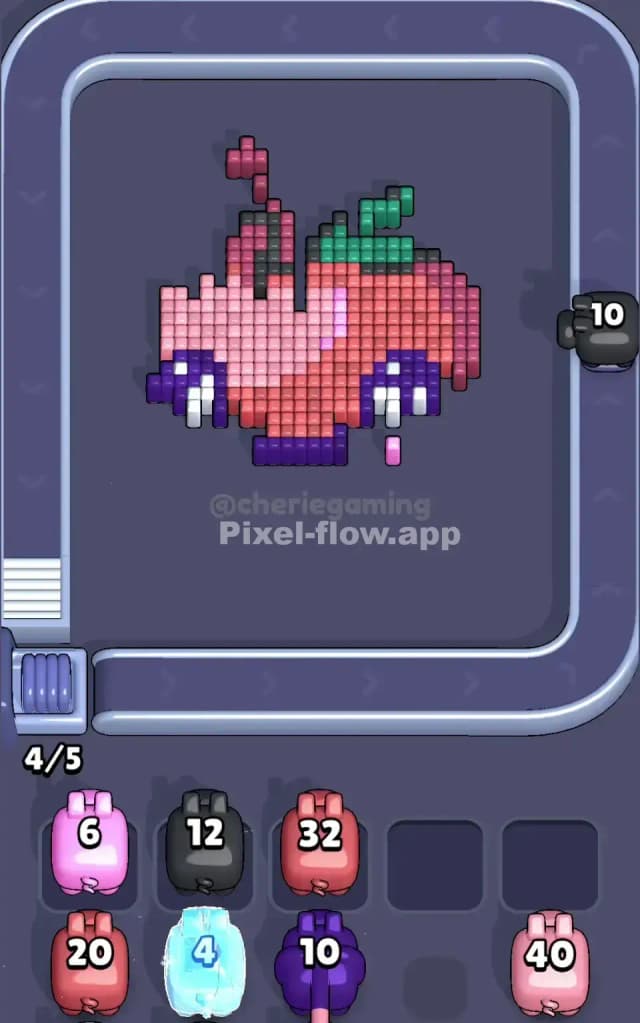
This level features a large, "kawaii" style apple with a cute smiling face. It’s dense. Very dense. The colors are packed tightly together, meaning you don't have many obvious "easy access" points initially. The apple is mostly red and pink, outlined in black, with a prominent green leaf on top.
The rules are standard: clear the outer layers to expose the voxels underneath. If your pigs run out of targets and you fill all five waiting slots, you lose. Is this a very hard level? No. It is moderate. The difficulty comes from managing the sheer volume of red and pink without clogging your slots with useless colors like blue or purple too early.
Pixel Flow Level 315 Overview
The artwork is a chunky, smiling apple. It feels heavy on the left side due to a large light-pink highlight that acts as a reflection. The right side is a darker, standard apple red.
- Top: A dark stem and a large green leaf. This leaf is critical because it sits on top of the red body layer.
- Face: Two large eyes (purple/blue with white sparkles) and a smiling mouth (purple/blue). These are buried deep inside the red/pink layers.
- Outline: A thick black border wraps around the entire bottom and sides. This is your barrier. You often cannot hit the red pixels until you shave off this black rind.
The asymmetry here is key: The left side is "lighter" (pink), and the right side is "darker" (red). You need to be careful not to confuse the light pink highlight pigs with the standard red pigs.
Step by step solution walkthrough for Pixel Flow Level 315
First Color Zone to Erase in Pixel Flow Level 315
Start with the Black Outline.
Narratively, you are peeling the skin off the fruit. Logically, the black voxels form a protective shell around the bottom and sides of the apple. Until these are gone, your red and pink pigs will waste time dropping into slots because they can't reach the inner fruit.
- Look for the Black Pigs (20 or 12 ammo).
- Deploy them immediately. They will chew through the bottom border and the side outlines.
- Once the black outline is thinned out, you will expose the vast red and pink interior.
Alternative Start: If no black pigs are available on the belt, go for the Green Leaf. The green blocks are distinct and sit right on top. Clearing them opens up the top section of the apple for your red pigs to start working downwards.
How to pass Pixel Flow Level 315 without power ups or boosters
Mid-way through, the apple will look half-eaten. The black outline should be gone. The green leaf should be erased. Now comes the danger zone.
You will see a mix of Light Pink (the highlight on the left) and Darker Red (the main body). The game loves to throw Purple or Dark Blue pigs at you during this phase—these correspond to the eyes and mouth.
Do NOT pick the Purple/Blue pigs yet.
Here is the trap: The eyes and mouth are on a deeper layer. If you pick a purple pig now, it will have zero targets. It will drop into a slot. Pick another one? Another slot filled. Suddenly you have 3 slots clogged with eye-color pigs, and you lose.
The Strategy:
- Focus strictly on Red and Light Pink. These are the high-volume colors. Prioritize the pig color that matches the largest visible surface area. Usually, this is the Red on the right side.
- Clear the Cheeks. There are pink "blush" marks on the cheeks. These are often on the same layer as the main skin. Clear them as soon as you have a matching pig to expose the layer beneath.
- Ignore the Face. Do not try to snipe the eyes until the red surrounding them is completely gone.
Last Details You Clean Up in Pixel Flow Level 315
In the final few moves, you are left with the core of the apple. The red skin is gone. The pink highlight is gone.
What remains are the "deep" features:
- The Eyes: Deep purple/blue blocks with white sparkles.
- The Mouth: A small curve of blue/purple.
- The Stem: Sometimes a few dark grey blocks linger here.
Now is the time to unleash those Purple/Blue pigs you ignored earlier. They will rapidly clear the face features. The very last blocks are usually the white sparkles in the eyes or a stray pixel from the stem that was hiding behind the leaf. Keep one slot open for a high-ammo cleanup pig (like a generic white or leftover red) just in case a stray block was missed on the periphery.