
If you’re stuck on a brutal Pixel Flow level where you know the board is solvable but the timer keeps bullying you… you’re not alone. I’ve been there—one cube left, 2 seconds on the clock, and then the game hits you with that “nice try” energy. Infuriating.
Here’s the truth: you’re not losing because you’re “too slow.” You’re losing because your throughput collapses.
And throughput—more than reflexes, more than “tapping faster,” more than luck—is the ultimate secret to beating hard levels fast in Pixel Flow.

Most puzzle games reward speed as “do actions quickly.” Pixel Flow is different. Pixel Flow rewards continuous output:
That loop is the whole game.
When you time out, it’s usually because the loop breaks and you start doing non-clearing actions:
You feel busy… but you’re not producing clears. Your timer isn’t impressed by effort. It only cares about exits per minute.
Here’s the one-line secret I play by on hard timed levels:
Every action should either (1) empty a pig, or (2) set up the next pig to empty immediately.
If a move doesn’t do one of those, it’s probably a time-waster.
This mindset changes everything, because Pixel Flow is built around three mechanics that punish “random progress”:
Pigs only destroy cubes that match their color. No match? No progress. You can’t brute-force.
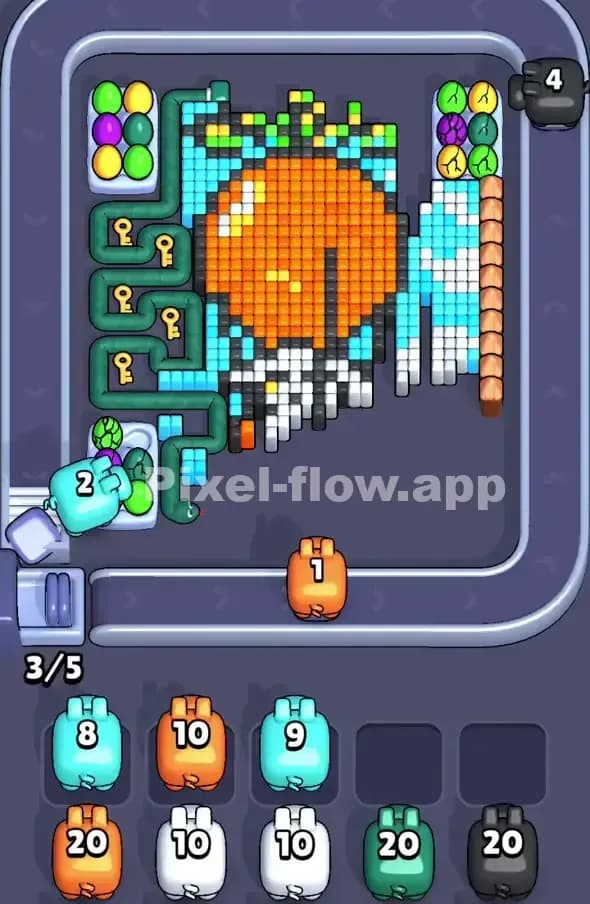
That number above the pig’s head is basically your tempo meter. If you burn ammo efficiently, pigs leave quickly and your conveyor stays clean. If you don’t, pigs stick around and clog the system.
Slots save you, but they also create the most common losing pattern: slot jam → no room → forced inefficiency → timer death.
So the “ultimate secret” isn’t a trick. It’s a priority system: Keep the conveyor producing exits.
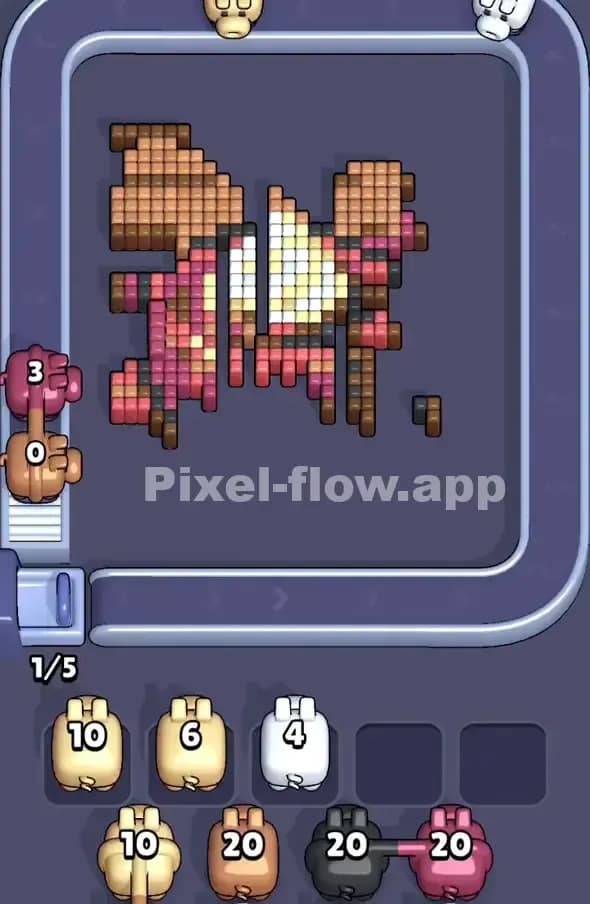
A “dead pig” is when a pig has ammo left but no valid targets on the board.
What happens then?
Get enough dead pigs and your waiting slots become a graveyard. That’s not just dangerous—it’s slow. Because now every decision is defensive and messy instead of clean and flowing.
Hard level speed comes from preventing dead pigs, not reacting to them.
Before your first tap (seriously), do this quick scan:
What colors are truly accessible right now? Not “somewhere in the structure”—I mean currently exposed cubes.
What’s the next 2–3 pigs in the queue? If the next pig is Blue and there are zero exposed Blue cubes, you need to start preparing now, not after you panic-park it.
Where is the “shell” color? Many boards are layered like an onion: outer layer blocks the useful core. Identify which color is the shell you must peel first.
How many waiting slots can you safely spend? My default for timed hard levels: use 2 slots max unless the board shape screams otherwise.
This scan takes seconds and prevents the classic “I played for 25 seconds and now my slots are full” disaster.

If you want the most unfair advantage in Pixel Flow, it’s this: ammo budgeting.
Never spend big ammo to clear tiny value.
If a pig has 8 ammo and you can only feed it 2 matching cubes before it gets stuck, you’re basically paying 8 seconds of your run to create a future slot problem.
What you want instead is clean ammo dumps: pigs that can spend most (or all) of their ammo and exit immediately.
Think of ammo like currency. Spend it where it produces exits.
Waiting slots are your emergency brake, not your garage.
Here’s the rule that keeps runs alive:
If you fill 3–5 slots early, you’ll spend the rest of the level doing administrative work: cycling pigs, unjamming, and praying. That kills speed.
Only park a pig if one of these is true:
If you’re parking pigs because “I don’t know what else to do”… that’s the timer taking your lunch money.
Pixel Flow’s boards often hide the real solution under a shell. The temptation is to chase the color you need deep inside the structure. That’s how you lose.
You peel in a way that creates big, clean surfaces of one color—surfaces that let future pigs spend ammo quickly.
You pick at the board and create crumbs:
Crumbs are slow because pigs burn time searching for value and you’re forced into micro-management.
Your goal is not “remove cubes.” Your goal is “build exits.”
When you’re winning, the game feels like this:
pig enters → clears → exits → next pig enters → clears → exits
When you’re losing, it feels like this:
pig enters → hits nothing → slot → pig enters → hits nothing → slot → panic → timer
The fix is tempo discipline:
If you find yourself tapping quickly without thinking, stop. Spam taps create random peeling, random exposure, random jams.
Instead, play in micro-cycles:
It feels slower… and it’s way faster.
Boosters are best used for one job: restoring throughput.
If you use a booster and you still don’t get pig exits soon after, you probably wasted it.
Here’s how I think about them:
Use it to delete one blocker that prevents a pig from cashing out and exiting.
Use it when the board is a mixed-color mess and you need to reset the surface into something “peelable” again.
This is secretly a speed tool. One mis-tap can create crumbs and ruin your next 15 seconds. Undo preserves tempo.
If the incoming pig order is absolutely incompatible with what the board can expose in time, refreshing can be smarter than burning 30 seconds trying to “make it work.”
And yes—sometimes the fastest play is restarting early instead of dragging a doomed run into a slow death.
The last 10–20% is where players suddenly slow down because:
So you must intentionally set up the finish:
You’re not racing the timer. You’re racing your own jam.
Protect throughput. Avoid dead pigs. Use slots like a timing tool. Peel for exits.
Do that, and those “impossible” timed levels suddenly feel… honestly? Kind of free.