Pixel Flow Level 263 Solution Walkthrough | Pixel Flow 263
How to solve Pixel Flow level 263? Get instant solution for Pixel Flow 263 with our step by step solution & video walkthrough.


Pixel Flow Level 263 Overview
The Board Layout and Color Distribution
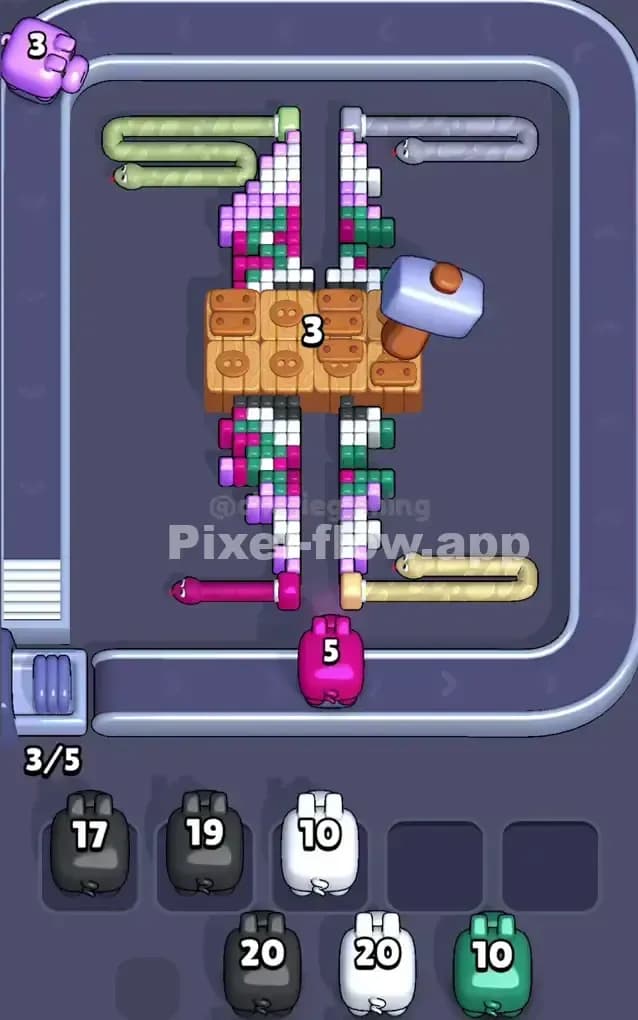
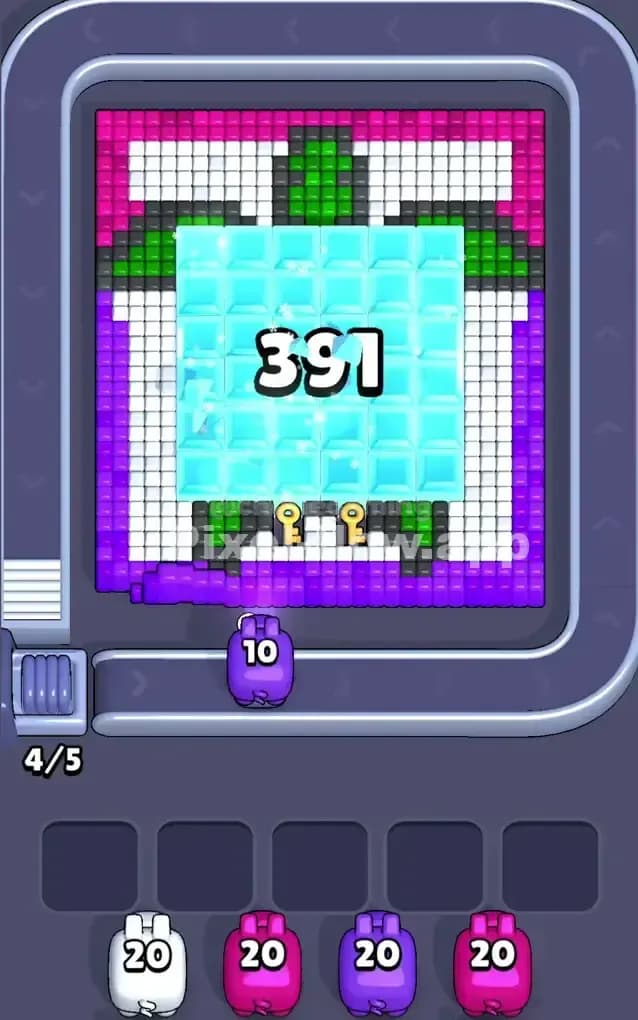
Pixel Flow Level 263 presents a challenging four-quadrant puzzle with a central brown voxel structure dominating the middle of the screen. The board is divided into four turquoise sky-blue sections (labeled 220, 200, 240, and 180), each representing a different zone. At the heart of the puzzle sits a substantial brown block formation—your first major obstacle—surrounded by thick bands of magenta, lavender, green, and white cubes that form distinct layers. The color palette is fairly balanced, with magenta and lavender occupying prominent positions on the left side, green and white anchoring the right flank, and brown dominating the center. This symmetrical-looking layout is deceptive; the actual challenge lies in how these colors are distributed across multiple depth layers.
Win Condition and Deterministic Sequencing
To beat Pixel Flow Level 263, you must eliminate every single voxel cube on the board—no exceptions. The incoming pig queue is fixed and predetermined; each pig carries a specific color and a fixed ammo count, and they always arrive in the same order. Your magenta pig arrives with 20 ammo, your lavender pig with 20, your green pig with 20, and your white pig with 20. Because the sequence is deterministic, success in Pixel Flow Level 263 depends entirely on your ability to plan ahead, manage your waiting slots intelligently, and expose deeper layers at exactly the right moment. There's no luck involved—only strategy and foresight.
Why Pixel Flow Level 263 Feels So Tricky
The Brown Block Bottleneck
The elephant in the room is that enormous brown formation sitting dead center. Brown has no dedicated pig in your queue, which means you cannot shoot it directly. This is intentional game design, and it's the primary reason Pixel Flow Level 263 can feel overwhelming at first glance. You're forced to clear the surrounding colored cubes first, and only after you've dismantled the magenta, lavender, green, and white layers will the brown block become accessible or irrelevant to your overall victory condition. If you rush blindly, you'll waste ammo on cubes you don't need to clear, leaving your pigs stuck in the waiting slots with ammunition they can't spend. That's a guaranteed loss.
Awkward Color Patches and Misaligned Ammo
The second trap in Pixel Flow Level 263 is that the visible cube count doesn't always match your pig ammo perfectly. You see 20 magenta cubes visible on the left side, and your magenta pig arrives with exactly 20 ammo—which sounds perfect until you realize there might be additional magenta cubes hidden behind other layers. If you burn through your magenta pig's ammo and there are still magenta cubes deeper in, you're left with no way to expose them. Similarly, the lavender, green, and white distributions are uneven and partially obscured. The level demands that you anticipate what lies beneath and coordinate your pig order so that earlier pigs expose the cubes that later pigs will need to target.
Personal Friction Point
Honestly, my first ten attempts at Pixel Flow Level 263 felt like I was fighting the board blindly. I'd send in my magenta pig, watch it empty its ammo into obvious targets, then see my lavender pig get stuck in the waiting slots because there were no visible lavender cubes anymore. The frustration was real. Then I realized the trick: stop thinking about what you see, and start thinking about what you need to expose. Once I mapped out the probable layer structure and worked backward from the goal, Pixel Flow Level 263 clicked. It transformed from chaotic to logical.
Step-by-Step Strategy to Clear Pixel Flow Level 263
Opening: Targeting the Left Flank First
Start by sending your magenta pig down the conveyor belt without hesitation. Magenta occupies a large, cohesive zone on the left side of the board, and clearing it early accomplishes two critical goals: you're eliminating a visible, high-ammo pig's targets efficiently, and you're exposing the inner layers that the lavender pig will need. Don't worry about the brown block yet—it's a red herring. Magenta will shoot 20 times into the left quadrant, peeling back the outermost layer and revealing what's underneath. After your magenta pig finishes and either moves off the belt or lands in a waiting slot, you should have at least 3 free slots remaining. This breathing room is crucial for Pixel Flow Level 263.
Mid-Game: Layer Exposure and Pig Parking Strategy
Once magenta has done its work, send your lavender pig immediately. Lavender will find its targets in the freshly exposed areas on the left-center region, and its 20 ammo should correspond to the newly visible lavender cubes. The trick here is watching your waiting slots closely. If after lavender finishes you still have 2+ free slots, you're tracking perfectly. If you're down to 1 free slot, you need to be more cautious. Your green pig comes next and should target the right side of the board; green occupies a substantial zone, and its 20 ammo will again expose deeper layers. During this phase, keep your eyes on the queue indicator (the 4/5 counter shows how many slots are occupied). Never let all five slots fill unless you're absolutely certain your remaining pigs can spend their ammo. The worst-case scenario in Pixel Flow Level 263 is a completely full waiting buffer with half-spent pigs unable to fire.
End-Game: The White Pig and Final Cleanup
Your white pig arrives last with 20 ammo. By this point, Pixel Flow Level 263 should be nearly transparent—the outer layers are gone, inner colors are exposed, and you're mopping up the final scattered cubes. White should find its 20 targets easily. The critical moment is ensuring that after white fires, there are no remaining cubes and no pigs stuck in waiting slots. If you've sequenced correctly, your final pig will fire, empty the board, and you'll see the victory screen. If you miscounted or underestimated a layer, you might find yourself with a pig in a waiting slot, no valid targets on the board, and a failed level. This is why the planning phase—before you send your first pig—is everything in Pixel Flow Level 263.
The Logic Behind This Pixel Flow Level 263 Plan
Exploiting Determinism and Ammo Counts
The entire strategy for Pixel Flow Level 263 rests on one fundamental truth: the game is deterministic, and the pig order and ammo are fixed. You're not reacting to randomness; you're solving a puzzle with known inputs. By starting with magenta and following the left-to-right exposure pattern, you're working with the board's natural layer structure rather than against it. Each pig's 20-ammo count isn't arbitrary—it roughly corresponds to one "shell" of colors around the central brown block. Once you understand that every pig is designed to consume exactly one layer, Pixel Flow Level 263 becomes a matter of careful observation and sequencing, not luck.
Staying Calm and Counting Ahead
The winning mindset for Pixel Flow Level 263 is deliberate and patient. Before you launch your first pig, mentally map the board: which colors are on top, which regions will open up next, and where the bottlenecks are. As each pig fires, count its shots and predict where the next visible targets will be. Watch the waiting slots like a hawk—never assume you have room for another pig without actually checking the counter. When you're two pigs away from victory, begin planning the final sequence: will your last pig have enough ammo for the remaining cubes? Is there any color you might have miscounted? This forward-thinking approach transforms Pixel Flow Level 263 from a frustrating gauntlet into a solvable challenge. You'll clear it not by luck, but by understanding the puzzle's rules and respecting the deterministic architecture of the level.