Pixel Flow Level 262 Solution | Pixel Flow 262 Walkthrough
How to beat Pixel Flow Level 262: Video solution & walkthrough. The fastest way to pass Pixel Flow 262.
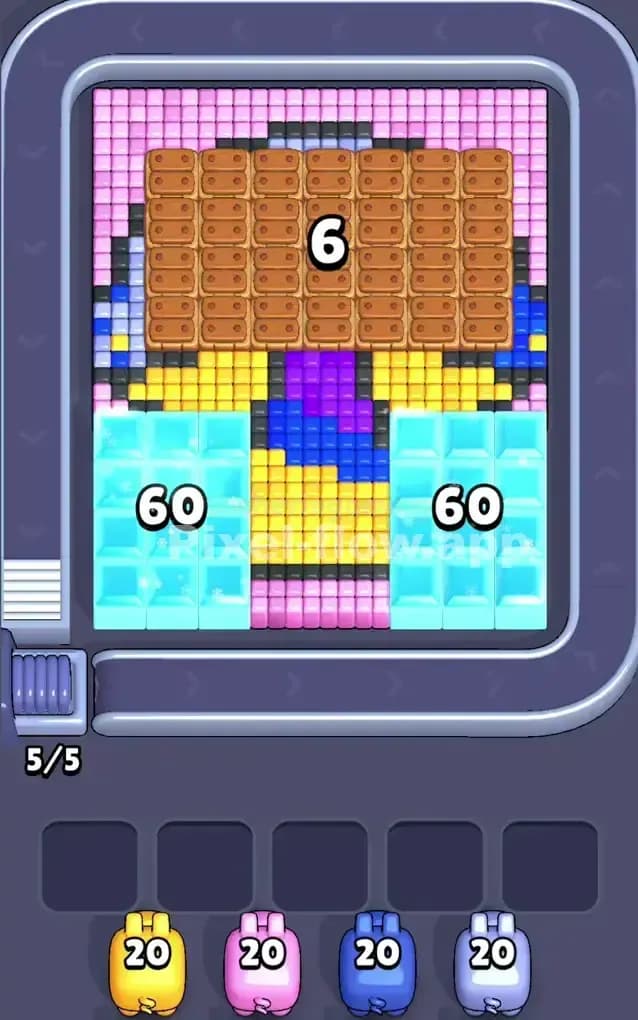
Is this the wrong level layout?🤔
Pixel Flow randomizes levels for different players. Don't worry, just upload a screenshot of your board, and our AI will find the correct video instantly.


Pixel Flow Level 262 Walkthrough
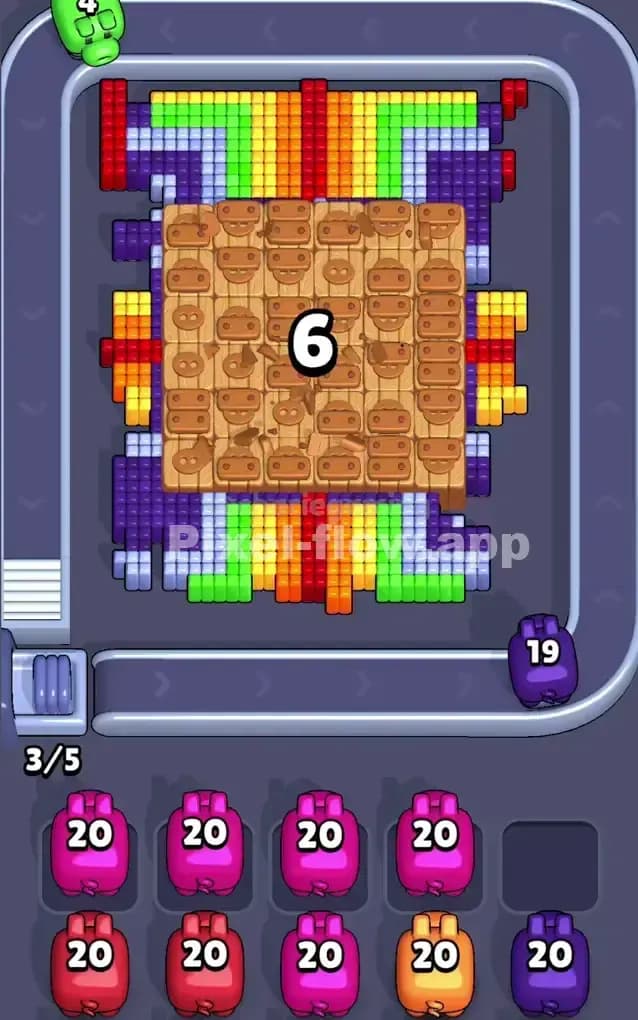
This level is all about cracking a safe. You are presented with a massive, vibrant rug of colors—purples, reds, greens, and yellows—but the center is completely dominated by a giant 8x8 block of wooden crates. These crates have a countdown timer of "10." To beat Pixel Flow Level 262, you must clear the colorful perimeter to buy time and space, then smash through that wooden blockade to reveal the hidden image underneath. Is it hard? Yes. The visual noise of the rainbow pattern makes it tricky to spot the correct layers, so I would rate this as a very hard level due to the strict ordering required.
Pixel Flow Level 262 Overview
Imagine a heavy wooden cargo pallet dropped right in the middle of a psychedelic dance floor. That’s the vibe here. The background is a swirling, symmetric pattern of rainbow stripes. It feels chaotic.
- The Outer Rim: You have deep purple borders on the far left and right.
- The Inner Swirls: Moving inward, you see stripes of light blue, green, yellow, and orange. These form right angles, like picture frames nesting inside each other.
- The Danger Zone: The center isn't just color; it's a solid 8x8 grid of brown crates. You cannot shoot these directly with color pigs. They likely require clearing the surrounding blocks or using specific explosive pigs if they appear (though in this specific screenshot, it seems we need to clear around them to trigger the mechanic or wait for the countdown).
The board is perfectly symmetrical, which actually makes it harder. Your eye glazes over. You might think the left purple stripe is the same depth as the right purple stripe. It isn't always. You have to watch the conveyor belt like a hawk.
Step by step solution walkthrough for Pixel Flow Level 262
First Color Zone to Erase in Pixel Flow Level 262
Start with Yellow.
Look at the bottom of the board. The yellow blocks are clearly the most accessible "front" layer on the bottom edge. There is a chunk of yellow right near the pig spawn point.
- Why Yellow? If you look closely at the bottom rows, the yellow stripes are sitting on top of the orange and red layers in that specific section.
- The Trap: Do not try to shoot the purple sides yet. They look like outer borders, but often in these "rug" patterns, the side borders are actually on a lower layer than the bottom-center blocks. If you deploy a Purple pig now, it will likely have zero targets and clog your slot.
- The Strategy: Use the Yellow pig to shave off that bottom row. This exposes the Orange and Red underneath. Once the bottom edge recedes, you open up clear shots to the vertical stripes on the left and right.
How to pass Pixel Flow Level 262 without power ups or boosters
The mid-game of Pixel Flow Level 262 is terrifying because of the Crate Block. As you clear the rainbow colors, that "10" counter ticks down on the crates.
- Respect the Crates: You cannot destroy the crates with normal color shots. You have to clear the colors touching the crates. Usually, clearing the perimeter triggers the crates to break or reveals the mechanism to destroy them. Focus entirely on the colors hugging the wooden box.
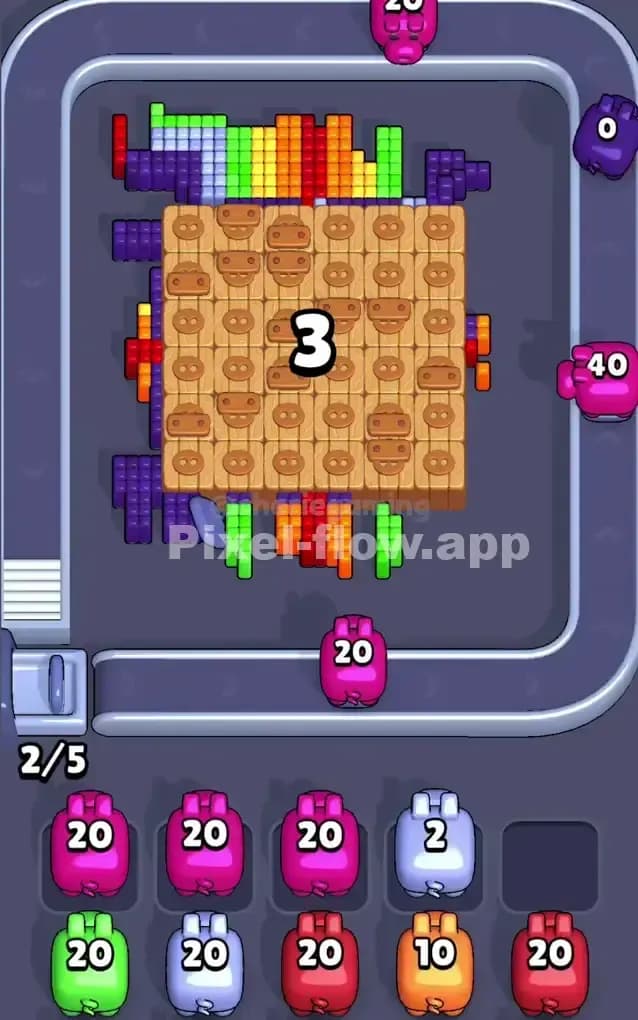
- Vertical vs. Horizontal: Notice how the Green and Light Blue stripes form "L" shapes? This is the biggest ammo waster. A Green pig might shoot the bottom part of the "L" but run out of ammo before it can hit the vertical part of the "L" because the crates block the line of sight.
- The "Parking" Solution: When the board is half-destroyed, you will have weird isolated islands of color hidden behind the crate corners. Do not span pigs rapidly. Drop one. Watch it shoot. If it parks in a slot, leave it there. Do not fill the other 4 slots. You need those empty slots to cycle through the queue to find the specific color (likely Red or Light Blue) that can hit the pixels tucking behind the crate corners.
Last Details You Clean Up in Pixel Flow Level 262
Once the giant crate block shatters (usually revealing a character or object underneath, often a long, thin shape like a snake or a worm), the board opens up.
The final cleanup is almost always the Deep Purple and Dark Blue fragments that were hiding in the deepest layer of the background.
- The Hidden Corners: Check the absolute top-left and top-right corners. There are often single blocks of Light Blue or Ice trapped there.
- The Character Reveal: In the second image provided (internal ref), we see a long pink snake/worm object. The final moves involve clearing the messy orange and purple pixels that were previously pinned underneath the heavy wooden crates. Save your high-ammo pigs for this moment, as you'll need to sweep the full length of the board to hit the head and tail of the revealed character.