Pixel Flow Level 271 Solution | Pixel Flow 271 Walkthrough
How to beat Pixel Flow Level 271: Video solution & walkthrough. The fastest way to pass Pixel Flow 271.
Is this the wrong level layout?🤔
Pixel Flow randomizes levels for different players. Don't worry, just upload a screenshot of your board, and our AI will find the correct video instantly.

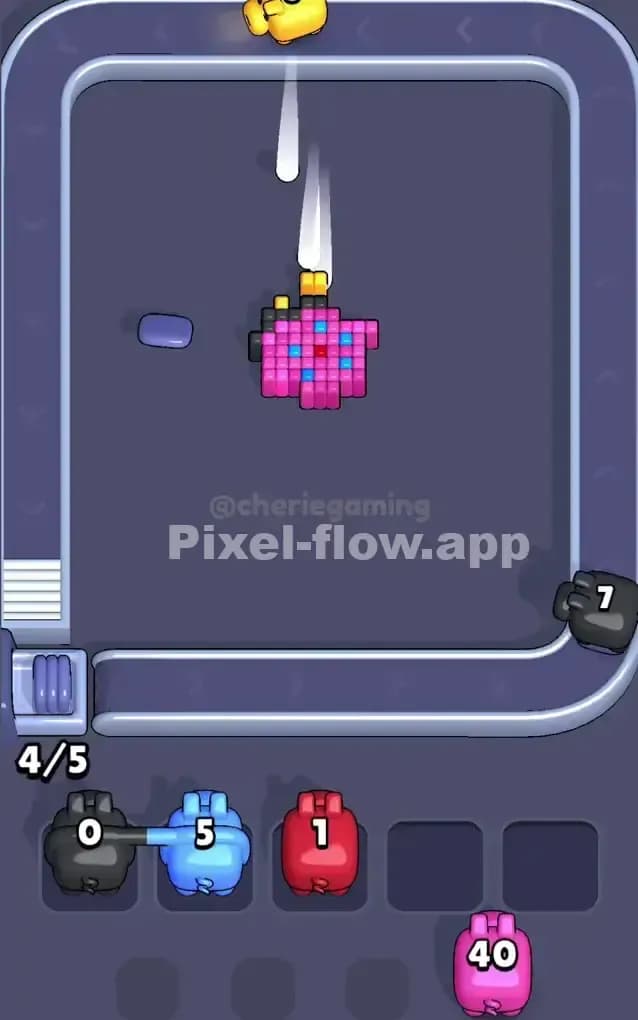
Pixel Flow Level 271 Walkthrough
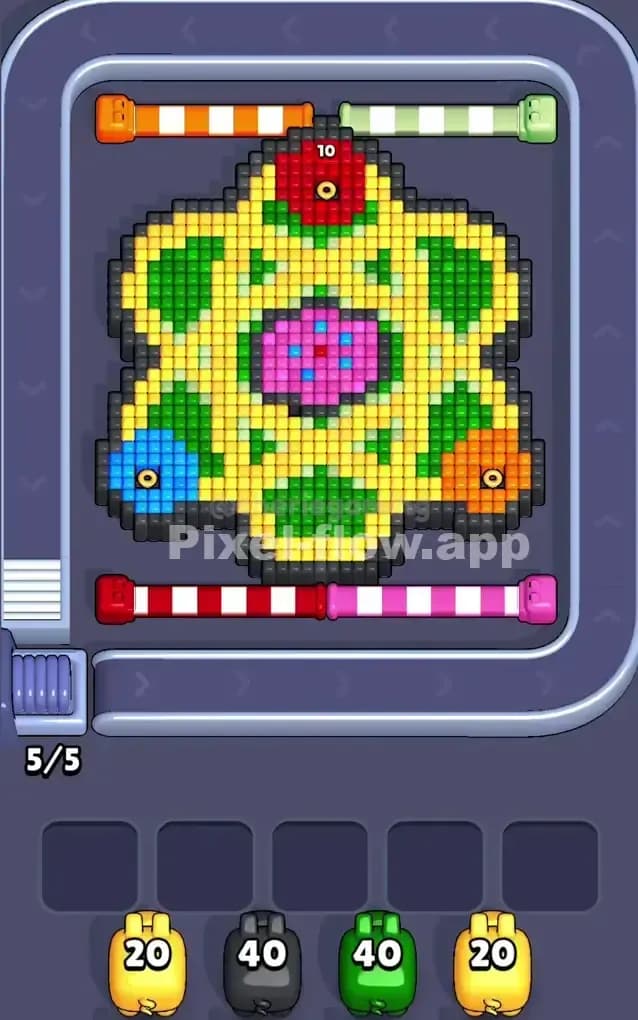
This level looks intimidating immediately. It’s a massive, six-pointed hexagonal star, dense with layers and surrounded by a thick black border. You are looking at a symmetrical geometric flower, but the colors on the tips break that symmetry. The top tip is Red, the bottom-left is Blue, and the bottom-right is Orange.
The rule for Pixel Flow Level 271 is strict: you cannot waste slots. You have five slots at the bottom. The queue gives you high-ammo pigs (Black and Green both carry 40 shots). If you pull a pig that has no valid targets on the board, or if you pull a pig that clears three blocks and then sits in your tray with 37 ammo left, you will choke your board. This is a very hard level because the high-ammo pigs require you to clear massive surface areas efficiently before the specific "tip" colors (Red, Orange, Blue) become accessible.
Pixel Flow Level 271 Overview
The artwork here resembles an ornate sheriff’s badge or a stained-glass flower. The primary visual weight comes from the bright Yellow filler that connects all the arms of the star.
Let's break down the "geography" of the board:
- The Center: A large, circular Pink core comprised of multiple layers. This is the heart of the puzzle.
- The Yellow Web: Yellow voxels fill the gaps between the center and the outer rim. This is the "glue" holding the picture together.
- The Green Triangles: Embedded within the Yellow web are three distinct Green triangles located at the top-left, top-right, and bottom points.
- The "Coin" Tips: This is the asymmetric part.
- The Top Point is Red with a gold "10" coin center.
- The Bottom-Left Point is Blue.
- The Bottom-Right Point is Orange.
- The Frame: A heavy Black border wraps the entire shape.
The pipes complicate things further. The top pipes handle Orange and Light Green pigs. The bottom pipes handle Red and Pink. You have to wait for the shape to rotate to the correct orientation to fire specific colors.
Step by step solution walkthrough for Pixel Flow Level 271
First Color Zone to Erase in Pixel Flow Level 271
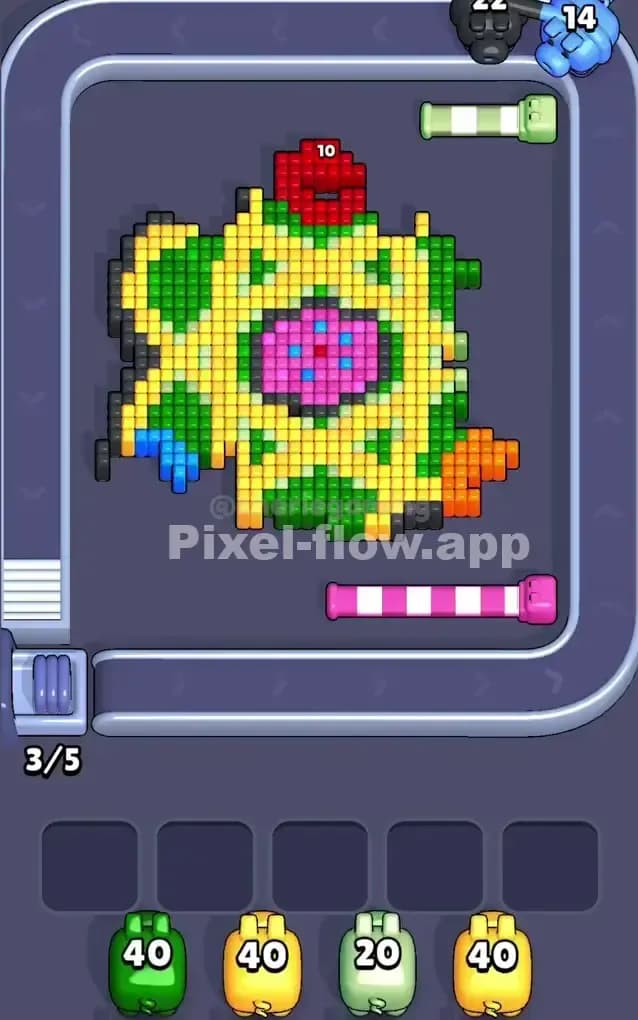
Your priority is the Yellow layer.
Look at your starting queue. You likely have Yellow pigs (20 ammo) followed by heavy hitters like Black (40) and Green (40). Narratively, the Yellow is the "skin" of the star. It covers the connection points between the center and the tips.
Logically, you have no choice. The Green zones are partially buried, and the outer "Coin" tips (Red, Blue, Orange) are too small to justify pulling a pig yet. The Yellow surface area is massive. It allows you to drain the Yellow pigs completely without them getting stuck in your waiting slots. By stripping the Yellow first, you isolate the Green triangles and the Black border, effectively breaking one giant puzzle into five smaller, manageable islands.
How to pass Pixel Flow Level 271 without power ups or boosters
Once the Yellow is gone, the board looks skeletal. You will see the Black outline standing tall like a fence, and the Pink center is exposed.
Here is the critical danger zone: The Black and Green Pigs. You will see 40-ammo Black and Green pigs in your queue. Do not pull them unless you are certain they can fire immediately.
- The Black Border: The black voxels form the outer rim. Since the shape rotates, a Black pig in a slot can usually find a target quickly. However, the Black layer is often "under" the colored tips. You might need to shave off the Red/Blue/Orange tips to fully expose the Black ring.
- The Green Triangles: These are tricky. They sit at the "even" points of the star (top-left, top-right, bottom). You must wait until the conveyer belt moves a Green pig to a pipe that aligns with these triangles. If you pull a Green pig when the star is rotated wrongly, it will sit in your slot, useless, blocking your flow.
The asymmetry destroys many runs here. The Orange tip only exists on the bottom right. The Red tip is only on top. If you have an Orange pig in your slot, but the star has rotated the Orange tip away from the active pipes, you are stuck. Patience is key. Let the pig ride the belt until it aligns with its specific colored tip.
Last Details You Clean Up in Pixel Flow Level 271
The end-game of Pixel Flow Level 271 usually revolves around the Pink Core.
After you strip the Yellow skin, the Green triangles, and the Black border, you are left with the central Pink circle. This area is deep—it has multiple layers of voxels stacked on top of each other.
Save your Pink pigs. You will likely see a Pink pig (12 or 20 ammo) appear late in the queue. Do not waste it on stray pink pixels early on. You want to drop that pig into the bottom pipe (which handles Pink) right when the center is fully exposed. The final moves will be a rapid-fire destruction of that central eye, revealing the empty slate underneath. Watch out for stray Blue or Red voxels that might have hidden behind the Black border; clear them before they clog your final slot.