
Pixel Flow Level 353 Solution | Pixel Flow 353 Walkthrough
How to beat Pixel Flow Level 353: Video solution & walkthrough. The fastest way to pass Pixel Flow 353.
Is this the wrong level layout?🤔
Pixel Flow randomizes levels for different players. Don't worry, just upload a screenshot of your board, and our AI will find the correct video instantly.



Pixel Flow Level 353 Walkthrough
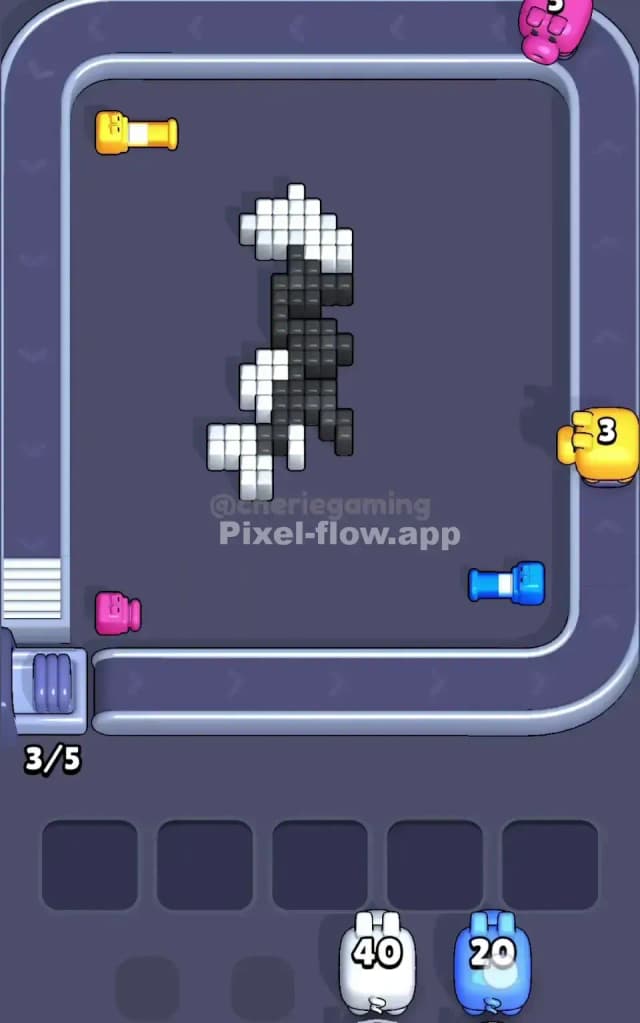
This level is a massive patience test disguised as a puzzle. You are staring at a giant, locked gate mechanism—four heavy wooden panels, each secured by a massive yellow lock requiring 80 hits. That's 320 ammo just to crack the surface. Beneath this formidable exterior hides a completely different picture: a black and white skunk. The rule here is endurance. You have to chip away at the outer shell systematically without clogging your waiting slots, because the inner layers are much simpler. Is it hard? Yes. Is it very hard? Absolutely, mostly due to the sheer volume of ammo required to break those initial locks.
Pixel Flow Level 353 Overview
Imagine a heavy fortress gate. The initial board is dominated by four large, vertical brown rectangles. These look like wooden double doors. Each "door" is framed in bright yellow and has a huge, circular lock mechanism in the center that displays the number 80. Surrounding this entire wooden structure is a border of light green tiles, possibly representing grass or a frame.
At the bottom, you have two long horizontal pipes—one blue and white, one pink and white. These are blocker pipes initially. However, once you break through the wood, the "prize" inside is a cute, blocky skunk. The skunk is primarily black and white, standing on a tiny patch of green grass. The contrast is stark: you go from a warm, brown/yellow wooden wall to a monochrome animal sprite.
The asymmetry here is vertical. The top half is just more wood and locks. The bottom half has the same wood and locks but is constrained by those horizontal pipes, which might limit where your shots land until cleared.
Step by step solution walkthrough for Pixel Flow Level 353
First Color Zone to Erase in Pixel Flow Level 353
Yellow and Brown. You have no choice. The four massive locks are yellow, and the doors are brown. These are your primary targets.
- Prioritize the Locks: If you see a yellow pig, grab it immediately. Each lock takes a huge amount of damage (80 hits). You want to direct yellow pigs to hit these lock icons specifically.
- Strip the Frames: The yellow frames around the brown wood are also valid targets for yellow pigs. Don't worry if a pig hits the frame instead of the lock; it all needs to go eventually.
- The Brown Wood: You will likely see brown pigs early on. Use them to chip away at the large wooden panels. This is the "grind" phase. You might feel like you aren't making progress because the blocks are so dense, but just keep feeding brown and yellow pigs into the grinder. Do not pick green or blue pigs yet if you can avoid it, as they will likely just sit in your slots with nothing to hit, clogging your board.
How to pass Pixel Flow Level 353 without power ups or boosters
The mid-level crisis happens when you've broken two or three of the wooden panels, but one stubborn door remains. The skunk underneath is partially visible—a mess of black and white pixels peeking through.
- Slot Management is Key: With 80-hit locks, you will have pigs sitting on the board for a long time. If you have 3 yellow pigs working on locks, you only have 2 empty slots left. If the conveyor belt offers a pink or blue pig that has no targets yet, let it pass. Do not pick it up. Only pick up pigs that can immediately start shooting.
- The Transition to the Skunk: Once the brown wood and yellow locks are gone, the palette shifts instantly. You need Black and White pigs.
- The Green Border: Don't forget the light green border surrounding the initial gate. Sometimes a green pig is useful to clear this outer ring, giving you more space and removing visual clutter.
- Pipe Management: The blue and pink pipes at the bottom are obstacles. You need blue and pink pigs to clear them. If you see a blue pig and the blue pipe is exposed, take it to clear that row. This opens up the bottom of the board for your black/white pigs to hit the skunk's feet later.
Last Details You Clean Up in Pixel Flow Level 353
The end game is all about the skunk. The wooden gate is gone. You are now looking at a black body with a white stripe and tail.
- The White Stripe: The white pixels often form a continuous vertical line down the skunk's back. White pigs are very efficient here.
- The Black Body: This is the bulk of the remaining pixels. Black pigs will do the heavy lifting.
- Hidden Greens: Watch out for the tiny green patch at the skunk's feet. It's easy to miss. If you have a green pig stuck in a slot at the end, make sure these bottom-most pixels are exposed so it can finish its job and leave.
- Final Cleanup: The last cubes are usually stray black pixels on the edges of the tail or the ears. Keep one slot open for that final black pig to wipe the board clean.