Pixel Flow Level 437 Solution | Pixel Flow 437 Walkthrough
How to beat Pixel Flow Level 437: Video solution & walkthrough. The fastest way to pass Pixel Flow 437.
Is this the wrong level layout?🤔
Pixel Flow randomizes levels for different players. Don't worry, just upload a screenshot of your board, and our AI will find the correct video instantly.
Pixel Flow Level 437 Walkthrough
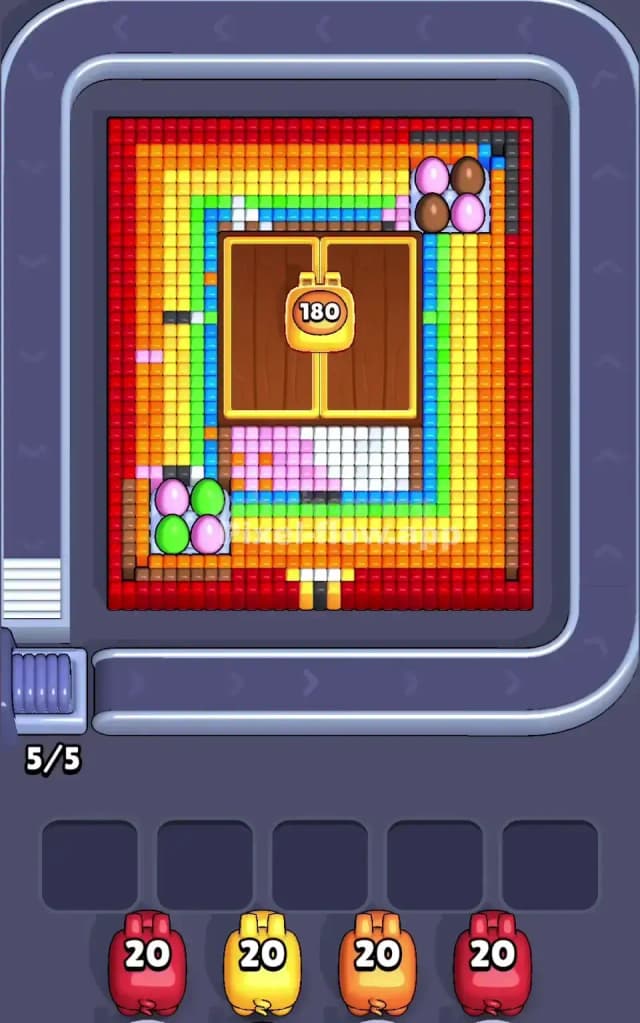
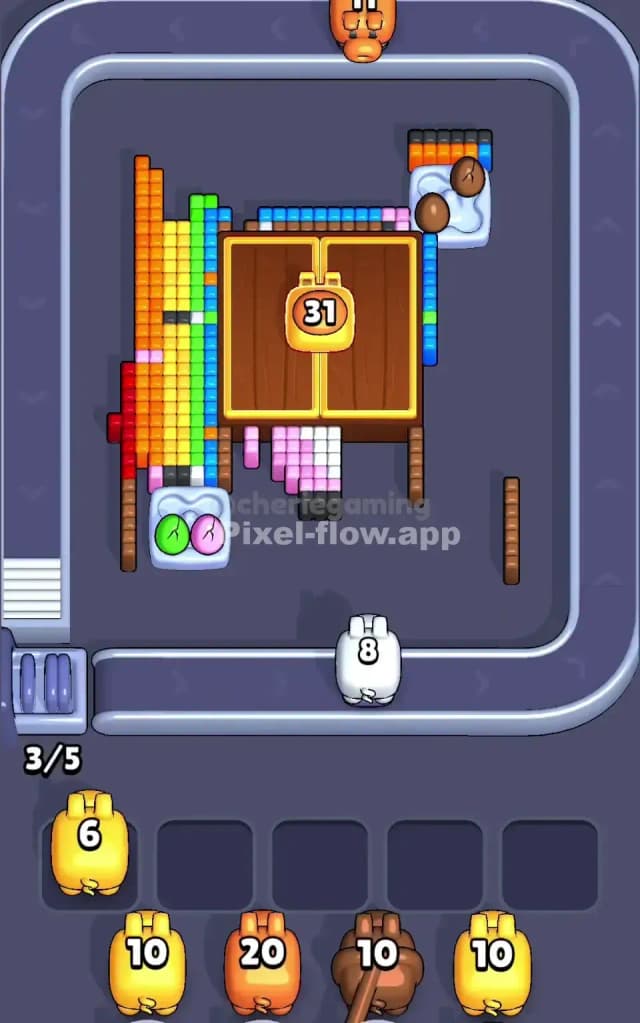
This level is a deceptive, layered puzzle that looks like a colorful room interior or perhaps a giant wardrobe sitting on a rainbow rug. The main colors are strictly organized in concentric square rings. You have a massive Red border, followed by Orange, then Yellow, protecting the inner details. The centerpiece is a large, brown double-door object with a daunting gold lock that requires a massive amount of hits to break.
The rule to beat Pixel Flow 437 is strict "onion peeling." You cannot reach the inner green or blue layers until you strip away the red and orange outer skins. Because the game will throw inner-color pigs at you before you are ready, management of your five waiting slots is critical. If you fill those slots with Blue or Pink pigs while the Red wall is still up, you will lose.
Is this a hard level? Yes. It is very hard. The sheer volume of pixels required to break that central "180" lock, combined with the strict color layering, makes it an endurance test where one wrong slotting decision can ruin the run.
Pixel Flow Level 437 Overview
Imagine looking top-down at a messy bedroom. In the center stands a massive, locked wooden wardrobe or cabinet. The floor around it is tiled in a chaotic mix of pink and white pixels, but the most striking feature is the thick, protective border surrounding the whole scene. It looks like a rainbow barrier.
The outermost wall is solid Red. Inside that is a thick band of Orange. Inside that, a bright Yellow layer. It’s only once you get past these three intense warm colors that you find the "cool" colors like Green and Blue framing the inner room.
There are two asymmetric "nests" or baskets tucked into the corners of the room, sitting just inside the rainbow walls.
- Bottom Left: A basket containing bright green and pink eggs.
- Top Right: A similar basket, but holding brown and pink eggs.
These baskets create uneven terrain. While the outer walls are uniform squares, these inner details are jagged. The biggest threat, visually and strategically, is the central brown block. It has a counter starting at 180. This isn't just a color match; it's a durability test. You have to hit this central block repeatedly, likely with Brown pigs or by clearing adjacent blocks, to whittle that number down to zero. It acts as a shield, preventing your shots from crossing from one side of the board to the other.
Step by step solution walkthrough for Pixel Flow Level 437
First Color Zone to Erase in Pixel Flow Level 437
Your priority is absolute: Red.
Narratively, you have to break down the exterior wall before you can enter the room. Logically, the Red pigs are the only ones that have immediate, 100% valid targets on all four sides of the board. The conveyor belt wraps around the entire square. Whether a Red pig is on the left, right, top, or bottom, it has a clear line of sight to the red border.
Do not touch the Yellow or Orange pigs yet unless the game forces you to. If a Red pig appears on the belt, tap it immediately. It will shave off the outer skin. If you see a Green or Blue pig early on, let them loop around the conveyor belt. Do not put them in your holding slots. They are dead weight. A Blue pig has zero targets until three layers of walls are gone. If you slot two or three of them, you choke your ability to cycle through to the Red pigs you actually need.
Once the Red rim is fractured, move immediately to Orange. The logic remains the same. The Orange layer is a solid square ring. Clear it to expose the Yellow. This methodical stripping of layers is the only way to open up lines of sight for the complex inner colors.
How to pass Pixel Flow Level 437 without power ups or boosters
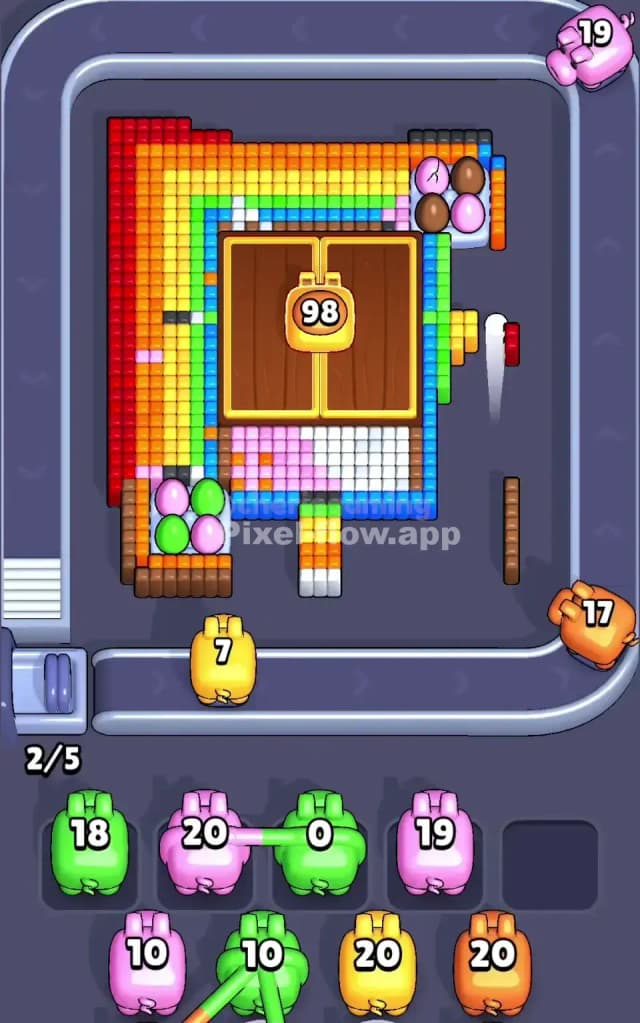
The mid-game of Pixel Flow Level 437 is dangerous. At this stage, the Red and Orange borders are mostly gone. You are left with the Yellow square and the exposed inner room. This is where the game tries to trick you.
You will start seeing a mix of Pink, White, and Brown pigs. The temptation is to grab a Brown pig to start hitting that central door (the 180 block). However, check your lines of sight. If the Yellow wall is still standing on the side where the Brown pig is, that pig is useless.
Focus entirely on Yellow. It is the last "easy" layer. It’s a continuous loop. Clearing it opens up the Green and Blue partial layers.
When the board is half-destroyed, you will notice the central door's counter dropping (e.g., from 180 to 31). This usually happens as you clear the Brown pixels associated with the door frame or the baskets. Be very careful with the White pigs. The white pixels are located on the "floor" beneath the central doors. They are often blocked by the doors themselves or the surrounding Green/Blue trim. Only slot a White pig if you clearly see a path to the white floor tiles. If the path is blocked by a Blue line, you must find and use a Blue pig first.
Hierarchy without power-ups:
- Yellow (finish the border).
- Green/Blue (remove the inner frame).
- Pink/Brown (clear the egg baskets and door frame).
- White (floor tiles, usually last).
Last Details You Clean Up in Pixel Flow Level 437
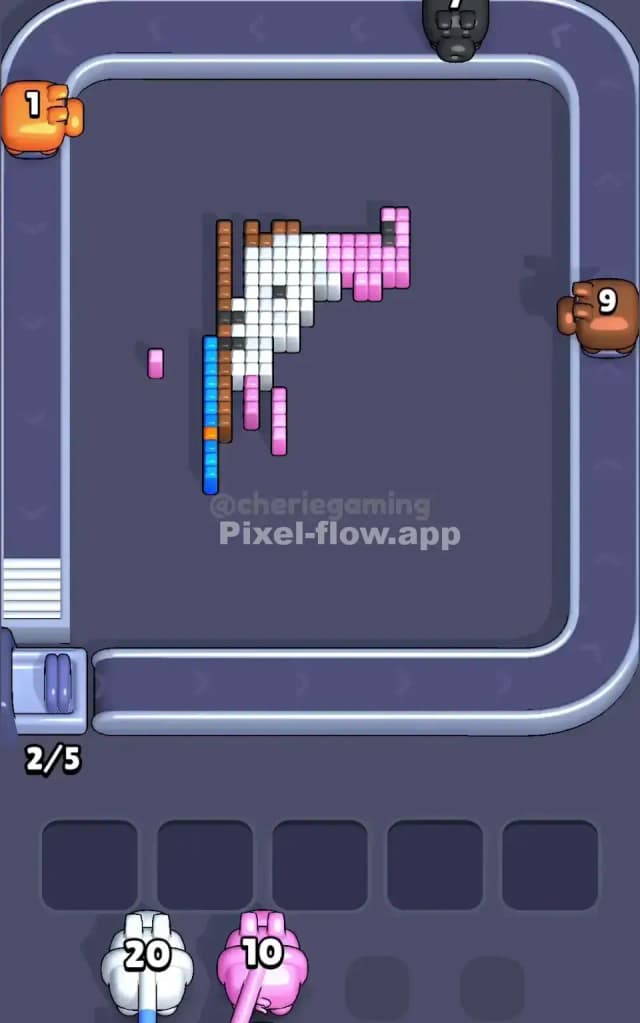
The end-game is messy. You are likely left with the stubborn Brown central doors and the scattered Pink pixels from the egg baskets.
The "180" counter on the door is your final boss. You need to dump every available Brown pig into this object. By now, the rest of the board should be empty space, giving your pigs clear shots from any angle. If you have done your job right, the Green and Blue frames are gone, so your shots won't get intercepted.
Watch out for the Pink pixels in the eggs. They are small targets. Sometimes a pig will fire at an egg, miss slightly, and hit the wall behind it if the angle is bad (though usually, pixels fly straight). Ensure you don't have a straggler Green pixel hiding in the bottom left basket corner. That single pixel can block a shot intended for the white floor.
The final move will be shattering that golden lock. Once the brown doors vanish, you usually have a few White or Pink tiles hidden underneath or behind them that need a final cleanup. Keep one slot open for that surprise final color.