Pixel Flow Level 479 Solution Walkthrough | Pixel Flow 479

How to solve Pixel Flow level 479? Get instant solution for Pixel Flow 479 with our step by step solution & video walkthrough.

Share Pixel Flow Level 479 Guide:
Pixel Flow Level 479 Gameplay
Pixel Flow Level 479 Solution 1
Pixel Flow Level 479 Solution 2
Pixel Flow Level 479 Solution 3

Pixel Flow Level 479 Overview

The Board Layout and Core Challenge

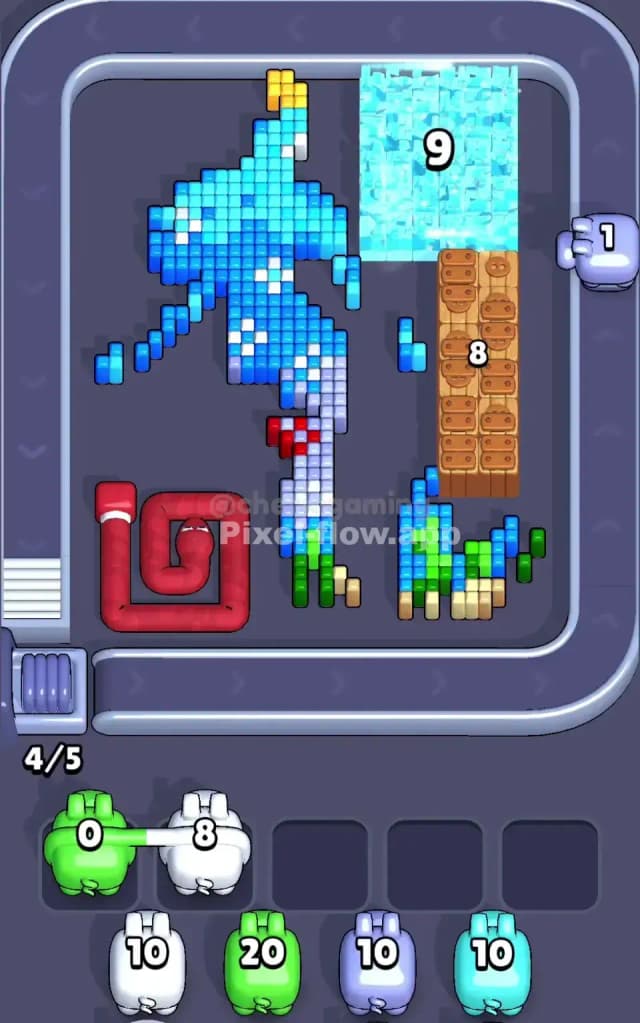
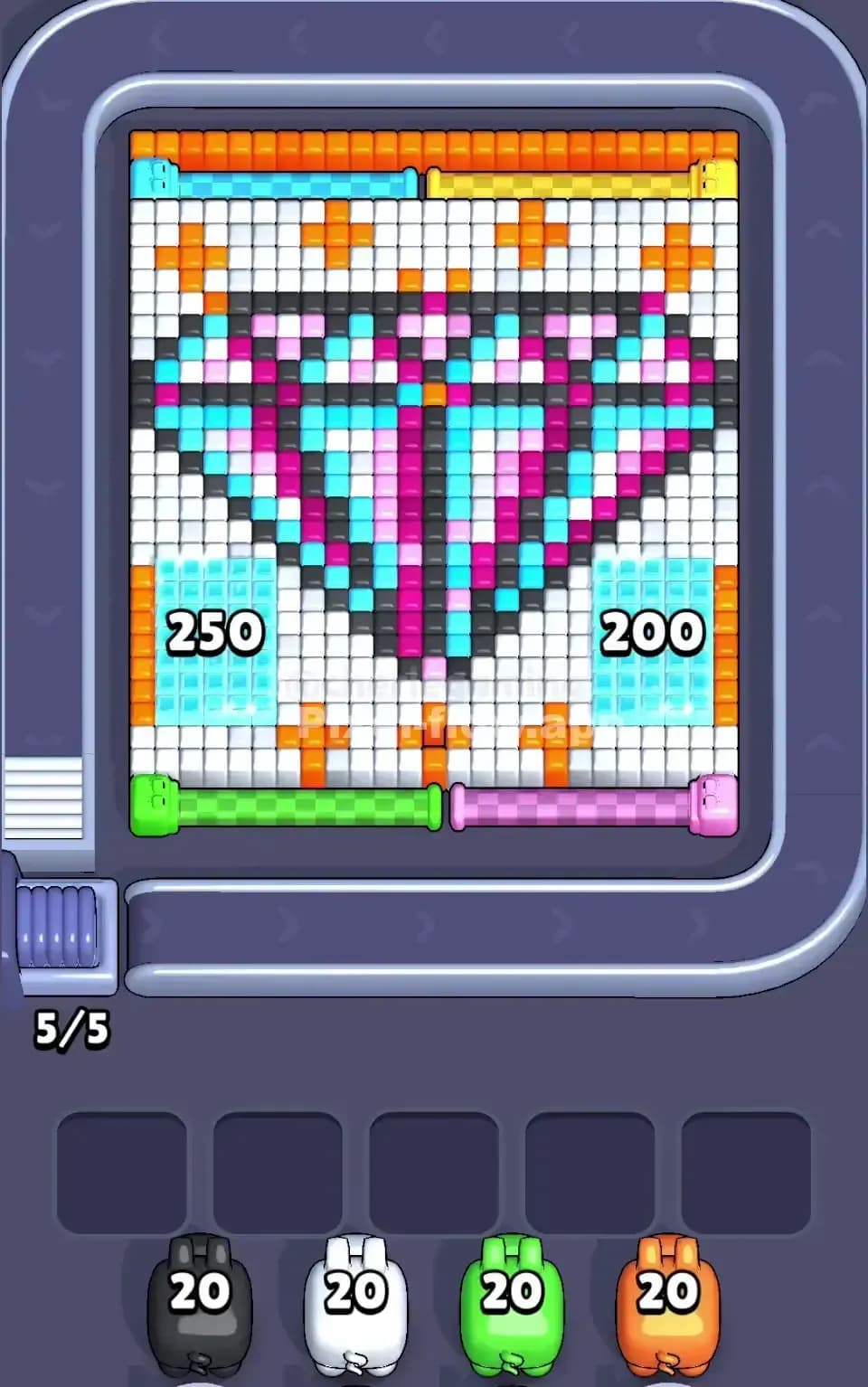
Pixel Flow Level 479 presents a sprawling underwater or aquatic scene dominated by cyan and light blue tones, with strategic pockets of brown, red, and green forming a complex multi-layered puzzle. The main subject appears to be a large jellyfish or squid-like creature made up of hundreds of cyan cubes, anchored by a central body with tentacle-like projections spreading across much of the board. This massive cyan block is your biggest visual feature, but it's far from your only concern—there are substantial secondary regions of lighter cyan forming geometric shapes on the left and upper right, plus a brown wooden structure on the right side and scattered green and red accent cubes in the lower-middle section that hint at hidden complexity beneath the surface.

The win condition is straightforward but demanding: you must clear every single cube on the board by strategically deploying the four pigs queued at the bottom. Each pig carries a fixed ammo count (shown on the queue), and they'll automatically fire at matching-colored cubes as they descend the conveyor. The order in which you release pigs is entirely under your control, but once a pig reaches the board, it becomes part of your execution—there's no taking it back. This deterministic nature means Pixel Flow Level 479 rewards careful planning over reflexes.

Understanding the Waiting Slots and Failure Condition

Your five waiting slots are your safety valve and your potential doom. When a pig depletes its ammo or runs out of valid targets of its color, it drops into one of these slots and stays there until you pull it back to the queue to reset. The trap? If you fill all five slots with "stuck" pigs that still have unused ammo but no cubes of their color visible on the board, you're locked into an unwinnable state. Pixel Flow Level 479 is specifically designed to tempt you into this failure by hiding colors beneath layers—you'll see a pig with ammo left, panic, and end up jamming your buffer instead of trusting the deeper strategy.


Why Pixel Flow Level 479 Feels So Tricky

The Cyan Bottleneck and Hidden Layers

Here's the thing that makes Pixel Flow Level 479 so deceptively hard: the cyan cubes are everywhere, and they're not all sitting on the surface. You'll notice the jellyfish tentacles and the geometric shapes on the left demand a massive cyan ammo investment, but beneath and between those regions are pockets of other colors—red, green, and brown—that you can't reach until you've cleared specific cyan zones. The two cyan pigs in your queue each carry 10 ammo, which sounds like plenty until you realize the visible cyan cubes alone probably exceed 20 in count, and that doesn't account for any buried beneath the red and green accents. This creates a grinding sensation where you feel like you're making progress but the cyan never seems to end.

The Red and Green Problem Spots

The red cubes forming a rough diamond or flower shape in the center-lower area are your second major headache. There aren't many red cubes visible—maybe four or five—but their positioning right in the middle of the board means they're likely covering something important underneath. Similarly, the green cubes clustered at the bottom look decorative until you realize they're probably the key to unlocking a brown region or exposing final cyan layers. The danger here is that if you deploy pigs carelessly, you might blast through red and green too quickly, exposing empty space or locking yourself into a situation where a brown or cyan pig arrives with no valid targets.

The Brown Structure Puzzle

That brown wooden block on the right side is a wild card. It's clearly a minor region compared to the cyan dominance, but brown pigs are notoriously easy to get stuck—they don't appear frequently in queues, and the brown cubes are often clustered in tight, hard-to-predict patterns. Pixel Flow Level 479 has brown as a secondary concern, which means you could easily overlook it while focusing on cyan and suddenly realize your brown pig is sitting in a waiting slot with ammo that has nowhere to go because you buried the brown region under cyan debris.

Why This Level Clicked for Me

I'll admit it: I spent the first three attempts reacting to whatever pig came next, and I jammed the buffer with a cyan pig that still had two ammo left but couldn't see any blue cubes through the jumble of red and green. The frustration hit hard until I realized I was thinking like a solver instead of a strategist. Pixel Flow Level 479 demands that you map out the dependencies—which colors block which regions—before you start firing. Once I accepted that the level was telling me a story through its layer structure, everything clicked, and I started planning pig sequences instead of just plunking them down.


Step-by-Step Strategy to Clear Pixel Flow Level 479

Opening: Start with the Cyan Tentacles, Reserve Your Slots

Your first move should be to deploy a cyan pig and focus it on the outer tentacle projections of the jellyfish. These are the most exposed cyan cubes and the furthest from the center, so clearing them safely exposes the mid-layer structure without committing too much ammo to the central body. During this phase, treat your five waiting slots as a precious resource—let this first cyan pig spend 7–8 of its 10 ammo, firing conservatively. If it ends up with 2–3 ammo remaining and no visible cyan targets, intentionally drop it into a waiting slot rather than panicking and pulling it back. This is counter-intuitive, but keeping a slot "occupied" now prevents you from accidentally overfilling later when a pig runs dry unexpectedly.

After the first cyan pass, you should have 3–4 waiting slots still empty. This breathing room is crucial for Pixel Flow Level 479. Now pull your brown pig or secondary color if available. Before deploying it, take 10 seconds to count the visible cubes of that color on the board. If you see fewer target cubes than the pig's ammo, it will get stuck—and that's information you can use to decide whether to deploy it now or wait until a layer shift exposes more targets.

Mid-Game: Sequence Pigs to Expose Layers and Manage Ammo Overflow

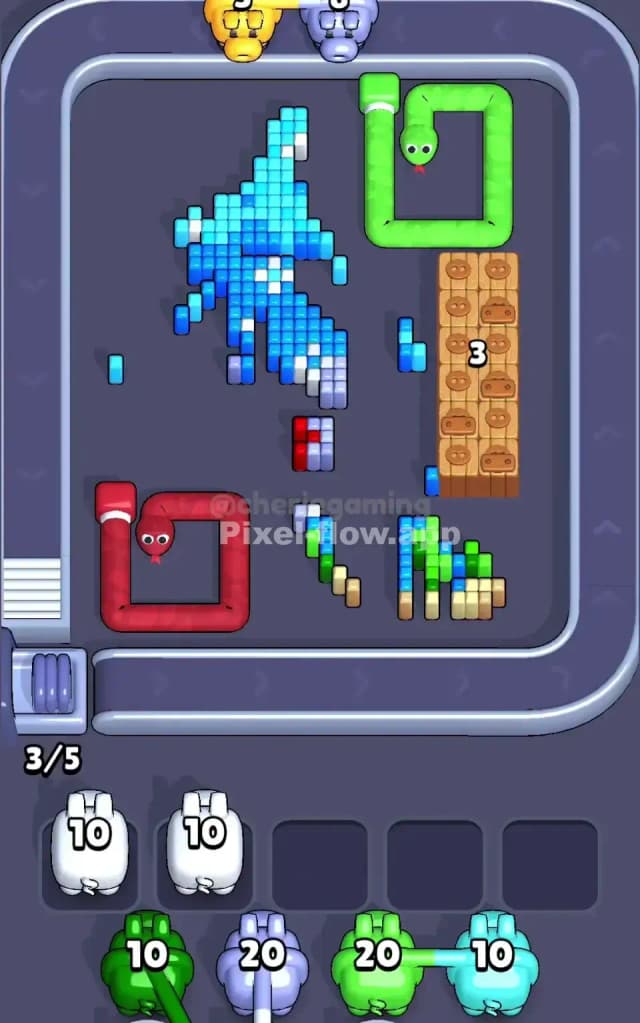
This is where Pixel Flow Level 479 separates methodical players from frustrated ones. After your opening cyan pass, the board has shifted slightly—some red and green cubes are now more exposed because of the tentacle clearance. Your next move is not necessarily to deploy the second cyan pig immediately. Instead, look at the red and green accents. If they're clearly hiding something (you can sense the bulge and shape behind them), deploy a non-cyan color first to punch through that layer.

Let's say you deploy the brown pig next. It arrives, shoots the brown structure, and uses 8 of its 10 ammo. If it still has 2 remaining and no brown cubes are visible, calmly place it in a waiting slot. This is planned buffer usage, not failure. You've just cleared the brown region, and now the cyan beneath it is exposed. Immediately pull your second cyan pig and deploy it—it'll now target the newly revealed cyan cubes with fresh targeting clarity.

By mid-game in Pixel Flow Level 479, you should have 1–2 waiting slots full and still be making visible progress on the board. If you're down to only 1 empty waiting slot and there are still more than 30 cubes on the board, you've deployed too many pigs too carelessly. Pause, reassess, and resist the urge to "just try one more pig" if you haven't thought through what it's targeting.

End-Game: Finish with Precision and Clean the Buffer

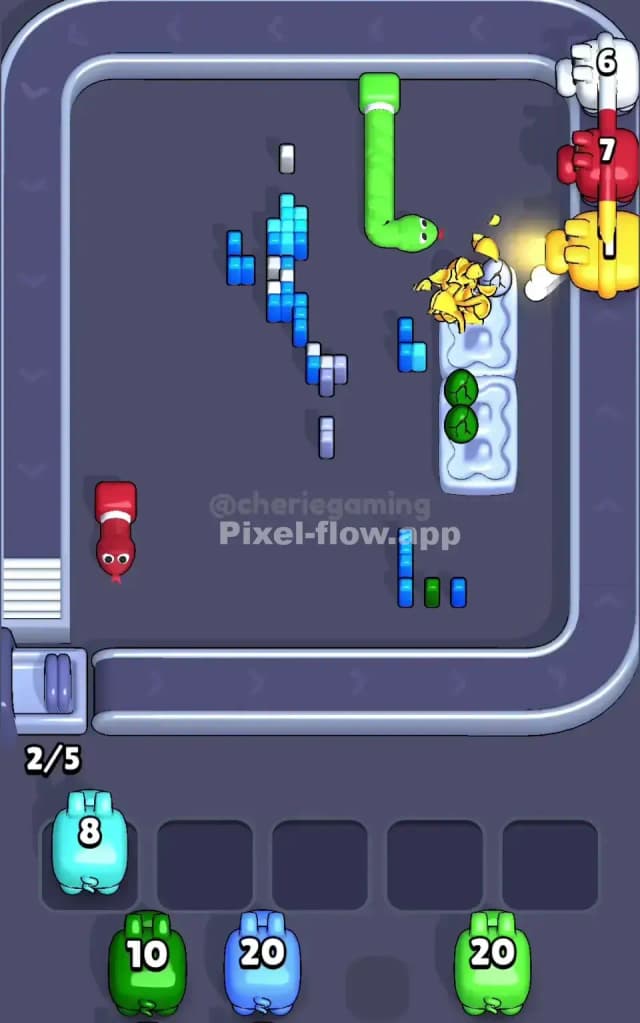
As you approach the final third of Pixel Flow Level 479, the board is mostly cleared except for scattered red, green, or cyan cubes left behind by incomplete passes. Your waiting slots probably have 2–3 pigs in them. Here's the critical moment: before deploying your last pig or two from the queue, pull one waiting-slot pig back into active deployment. This resets it and gives it fresh targeting priority. Choose the one closest to empty (lowest remaining ammo) so it can finish cleanly without getting stuck again.

For the very final cubes on Pixel Flow Level 479, you want to engineer a situation where the last pig on the conveyor completely empties its ammo and captures the final cube simultaneously. This is satisfying and ensures you haven't left any stragglers. If your second-to-last move leaves a single cyan cube visible and you have no cyan pig in the queue, you've miscalculated—but this is why planning two pigs ahead matters.


The Logic Behind This Pixel Flow Level 479 Plan

Why Pig Order Beats Reaction

The reason this strategy works for Pixel Flow Level 479 is that it flips the mindset from "react to what the game gives me" to "orchestrate the sequence I need." Every pig's ammo count is fixed, every color region is deterministic, and every layer follows a logical structure. By planning which color to expose first, you control what subsequent pigs will see. Deploying cyan early clears visual clutter and reveals hidden regions. Deploying brown or green early punches through blocking layers so cyan can finish efficiently. This isn't luck—it's architecture.

Staying Calm and Counting Ahead

The psychological key to Pixel Flow Level 479 is resisting panic when a pig gets stuck. Your waiting slots are designed to absorb pigs that run out of ammo—it's not a failure state if you planned for it. The real failure is overfilling all five slots with pigs that still have ammo but can't see their color because you deployed them in the wrong order. So during each pig's turn, count its remaining ammo audibly or mentally, glance at the board for visible targets of that color, and make a deliberate choice: finish it now or park it for later. This two-or-three-pigs-ahead thinking is what transforms Pixel Flow Level 479 from a frustrating scramble into a satisfying puzzle to solve.