Pixel Flow Level 54 Solution Walkthrough | Pixel Flow 54
How to solve Pixel Flow level 54? Get instant solution for Pixel Flow 54 with our step by step solution & video walkthrough.


Pixel Flow Level 54 Overview
Starting Board Layout and Color Distribution
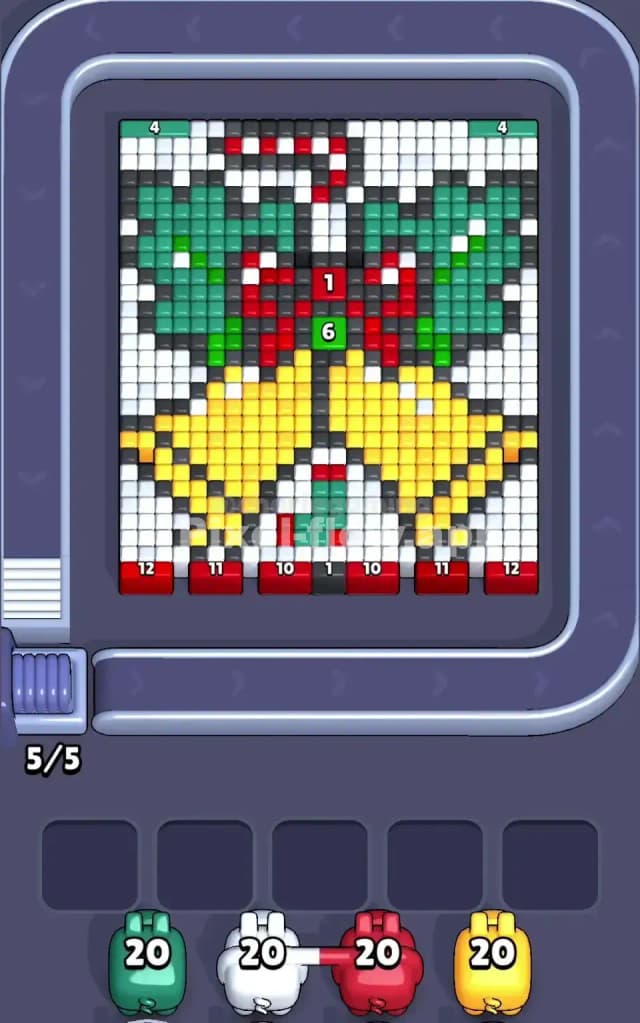
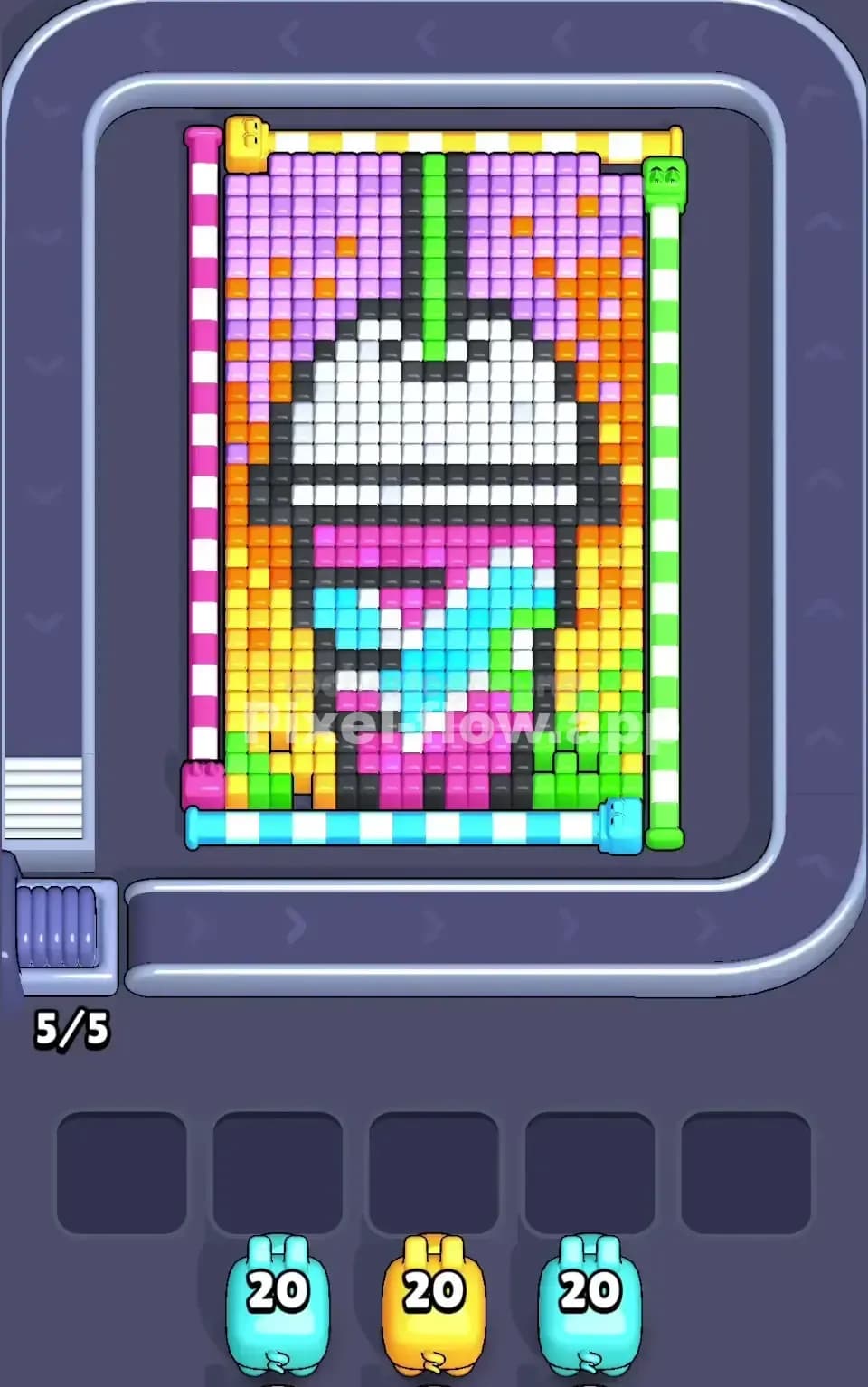
Pixel Flow Level 54 presents a gorgeous pixel-art butterfly as the main subject, rendered in vibrant layers of color. The dominant colors you're working with are yellow (forming the butterfly's wings), red (creating detail and shading throughout the body), green (visible as accent colors and layered depth), and white (used for highlights and structural clarity). The board starts fully populated with voxel cubes, and you'll notice the waiting slots at the bottom display four pigs, each carrying 20 ammo: green (20), white (20), red (20), and yellow (20). This balanced setup means you have 80 total shots to deploy across the entire board, so every action counts.
The butterfly's symmetric wings dominate the middle and lower sections, while the body and finer details occupy the center and upper areas. Dark gray cubes act as background fill and structural support, which means they won't be targeted by any pig—they're essentially permanent fixtures. The layering is subtle but deliberate: as you clear the yellow wing sections, you'll expose red underneath; clearing red reveals green and white patches; and finally, the green layer conceals additional complexity that only becomes apparent once you've thinned the upper regions.
Win Condition and Deterministic Gameplay
Your goal in Pixel Flow Level 54 is straightforward: clear every colored voxel cube on the board, leaving only the dark gray background intact. The beauty of this puzzle is that pig order and ammo counts never change—they're fully deterministic. Once you understand which pig fires when and how much ammunition each has, you can plan your moves with surgical precision. Unlike many puzzle games where RNG or luck plays a role, Pixel Flow Level 54 rewards pure strategy and foresight. This means if you fail once, you can absolutely nail it the second time by applying what you've learned.
Why Pixel Flow Level 54 Feels So Tricky
The Yellow Bottleneck and Waiting Slot Pressure
The biggest threat in Pixel Flow Level 54 is the sheer volume of yellow cubes forming the butterfly wings. There are easily 40+ yellow voxels spread across the board, but the yellow pig only carries 20 ammo. That's an immediate problem: you cannot clear all yellow in one pass. This means the yellow pig will fire once, deplete its 20 ammo without finishing the job, and then drop into a waiting slot as a "stuck" pig. If you're not careful, you'll fill all five waiting slots with pigs that can't shoot anymore, and then you're locked in failure. The yellow bottleneck forces you to interleave other pigs' turns strategically, exposing new yellow targets as you clear overlying colors.
Awkward Red Patches and Mid-Board Congestion
Red is another tricky color in Pixel Flow Level 54 because it doesn't form one cohesive block. Instead, red cubes scatter throughout the butterfly's body and wings in irregular clusters. Some red is buried deep beneath yellow; other red sits at the surface. If you fire the red pig too early, you'll waste ammo on accessible red while leaving deeper pockets untouched. The mid-board congestion is real—there's a dense cluster of red, white, and green around the butterfly's body (marked by the "1" and "6" indicators on the board) where colors overlap and interlock. Clearing this region carelessly can actually trap remaining cubes behind a wall of non-target colors, making them unreachable. I've definitely felt that frustration before, watching the board light up with "no valid targets" because I shot recklessly.
Green's Hidden Complexity and Surface Deception
Green appears abundant on the initial board, especially along the sides and lower wings. However, much of the visible green is actually surface-level camouflage. Once you've cleared yellow and red, you'll discover that green has significant depth—there are green cubes stacked two or three layers deep in certain regions. The green pig carries only 20 ammo, which sounds reasonable until you realize it needs to fire multiple times to excavate those layers. Additionally, green and white are often adjacent or interlocking, so firing green exposes new white targets, and vice versa. It's a cascading dependency that requires careful sequencing.
Personal Breakthrough Moment
Honestly, Pixel Flow Level 54 frustrated me for a solid handful of attempts. I kept treating it like a straightforward "clear one color at a time" puzzle, but that strategy led to waiting-slot jams almost every run. The turning point came when I stopped thinking about colors in isolation and started visualizing the board as a 3D layer-cake. Once I accepted that I'd need to cycle pigs in and out of the waiting slots strategically—letting some fire partway, drop into a slot, and then activate them again later—suddenly the puzzle clicked. The key was patience and planning two or three pig-moves ahead rather than reacting to each firing.
Step-by-Step Strategy to Clear Pixel Flow Level 54
Opening: Green First, Preserve Waiting Slots
Start Pixel Flow Level 54 by firing the green pig first. Why green? Because green cubes are distributed along the outer edges and sides of the board, meaning they're accessible from the very beginning without requiring any prior clearing. The green pig's 20 ammo is enough to eliminate most surface-level green, and this immediately opens up spaces and exposes deeper colors beneath. Crucially, this first move keeps your waiting slots mostly empty, giving you breathing room to maneuver.
Fire green until no valid targets remain—you'll likely have 3–5 ammo left over. Once green runs dry, it'll drop into a waiting slot (the leftmost empty slot). At this point, you should have 4 waiting slots still available. Don't panic; this is intentional. Now fire the white pig. White also appears in scattered clusters, and the white pig's 20 ammo can clear a good portion of visible white without hitting a wall. Again, let white expend its ammo fully before dropping into the next waiting slot.
Mid-Game: Red and Yellow Sequencing for Layer Exposure
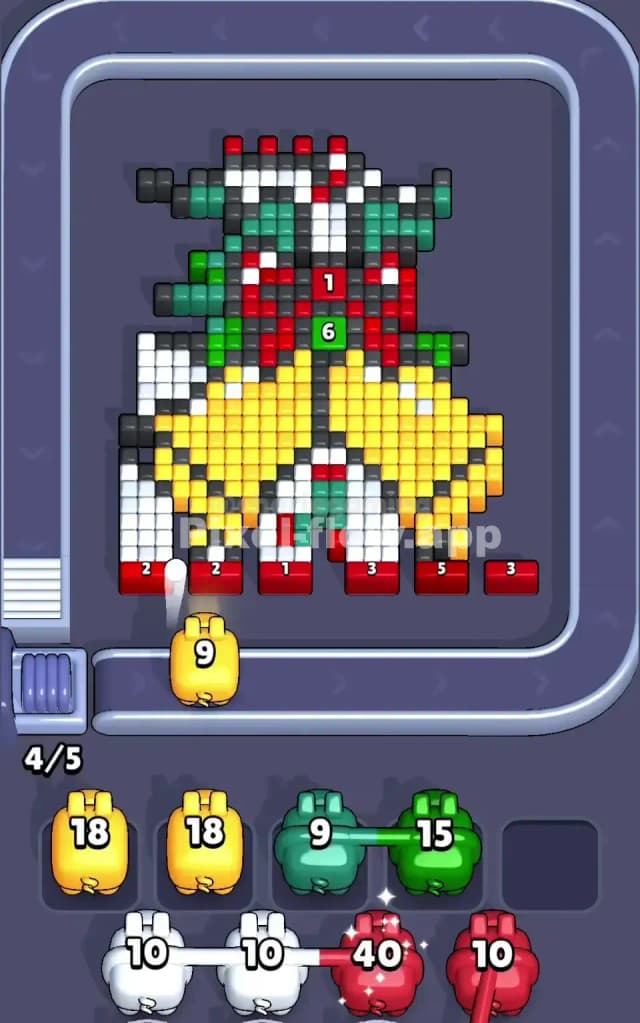
After green and white have fired and parked themselves in waiting slots, you're left with red and yellow in the active queue. This is where Pixel Flow Level 54's real puzzle emerges. Fire the red pig next, targeting the upper-body region and accessible red clusters. The red pig will burn through ammo fairly quickly because red is scattered, and you'll expose new yellow and green patches underneath. Once red is exhausted and drops into a slot, you now have three "stuck" pigs waiting.
Now activate yellow. Yellow will fire at the butterfly's wings and exposed yellow patches. Here's the critical insight: the yellow pig only has 20 ammo, but you've got easily 40+ yellow voxels on the board. Yellow will run out mid-clearance and drop into a waiting slot. Don't despair. Once yellow is waiting, look at your board. You've now got four pigs in waiting slots and no active pigs. This is your moment to re-activate one of the waiting pigs.
Click on the first waiting pig (probably green, if it's been sitting longest) to bring it back into the active queue. Fire it at the newly exposed targets—green cubes that were buried beneath yellow. This cycle of letting pigs fire, drop into waiting, and re-activate is the heartbeat of Pixel Flow Level 54. Keep doing this rotation: fire an active pig until it runs dry, let it drop, re-activate a waiting pig, repeat.
End-Game: Closing the Buffer Cleanly
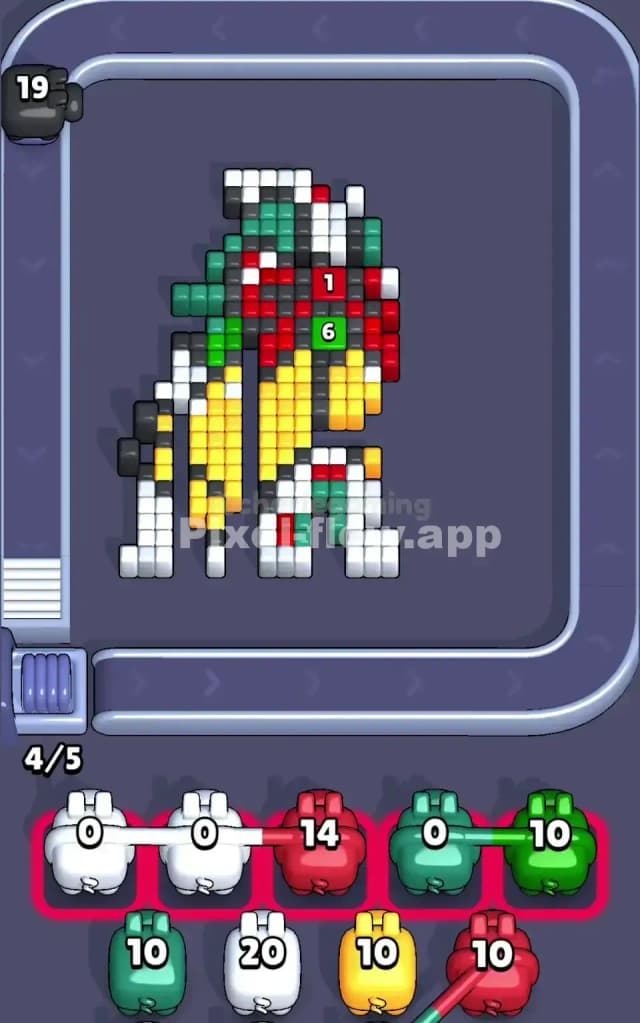
As you approach the final stretch of Pixel Flow Level 54, you'll notice the board thinning out. By now, you've fired each pig multiple times across several waiting-slot cycles. The trick in the endgame is sequencing your last few shots so that every pig empties its ammo completely or nearly completely, leaving no pigs stuck with unused ammo when the board clears.
Pay close attention to the remaining cube counts. If you have, say, 5 yellow cubes left but the yellow pig has 8 ammo remaining, you need to either expose more yellow (by firing a different color first) or accept that yellow will sit idle. Ideally, you want to end Pixel Flow Level 54 with all pigs having fired every last shot. To achieve this, count backwards: identify the final color cluster, estimate how many cubes remain, and fire pigs in the sequence that leaves zero orphaned ammo. The endgame often feels tense because you're juggling limited waiting slots and diminishing targets, but a calm, methodical approach wins every time.
The Logic Behind This Pixel Flow Level 54 Plan
Strategic Exploitation of Pig Order and Ammo Efficiency
The power of this Pixel Flow Level 54 strategy lies in recognizing that pig order is fixed but the board state is fluid. You can't change the pig order, but you can manipulate when each pig fires by cycling them through waiting slots. By starting with green and white—the pigs that target outer, accessible colors—you immediately create space and depth on the board. Then, as you fire red and yellow, you expose new targets for the earlier pigs. This isn't random; it's a carefully architected sequence that ensures no pig wastes ammo on blank spaces or inaccessible targets.
Ammo efficiency is paramount in Pixel Flow Level 54. With only 80 total shots available and 80+ colored cubes on the board, you're operating on a razor-thin margin. Every shot must count. The waiting-slot cycle allows you to maximize efficiency: instead of letting a pig fire into a wall of non-target colors, you can park it, switch to a different pig that has valid targets, clear some obstacles, and then re-activate the first pig to take advantage of the newly exposed board. This approach turns a potential jam into a solving engine.
Staying Calm Under Pressure: Ammo Counting and Multi-Move Planning
The mental discipline required for Pixel Flow Level 54 is genuine. As you progress, you'll feel pressure mounting—waiting slots filling up, ammo counts dwindling, and the board still peppered with unsolved colors. The antidote is to slow down and count. Before firing any pig, glance at the board and ask: "How many valid targets does this pig have? How much ammo does it have?" If the answers don't align perfectly, that's a signal to fire a different pig first or re-activate a waiting pig.
Plan two or three pig-moves ahead. Don't just think about the next shot; think about the shot after that and the one after that. For example, if firing red will expose five new yellow targets, and you know yellow has enough ammo to clear them, then red is the right move now. Conversely, if firing yellow will trap red behind white cubes, then maybe yellow should wait. This forward-thinking discipline transforms Pixel Flow Level 54 from a chaotic scramble into a calm, choreographed ballet of pig rotations.
Watch the waiting-slot queue like a hawk. When it fills up, you're one stuck pig away from lockdown. If you see four slots occupied and the active pig is about to run out of targets, take action: fire a different waiting pig immediately, even if it's not "ideal," because the alternative is a game-over jam. Pixel Flow Level 54 rewards proactive planning and punishes reactive scrambling. Master the rhythm of counting, planning, and rotating, and this level yields to patience and precision.