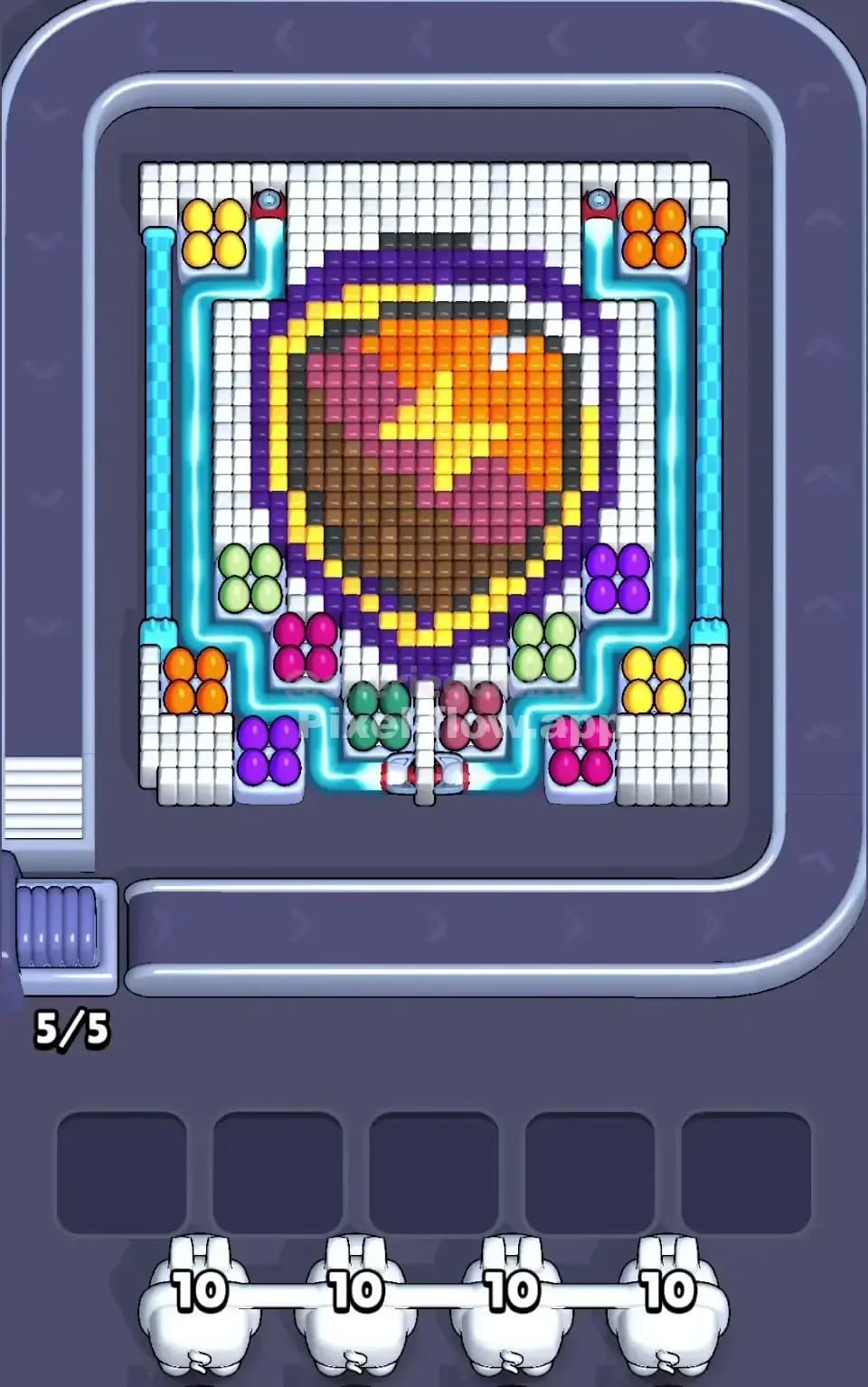
Pixel Flow Level 558 Solution | Pixel Flow 558 Walkthrough
How to beat Pixel Flow Level 558: Video solution & walkthrough. The fastest way to pass Pixel Flow 558.
Is this the wrong level layout?🤔
Pixel Flow randomizes levels for different players. Don't worry, just upload a screenshot of your board, and our AI will find the correct video instantly.

Pixel Flow Level 558 Walkthrough
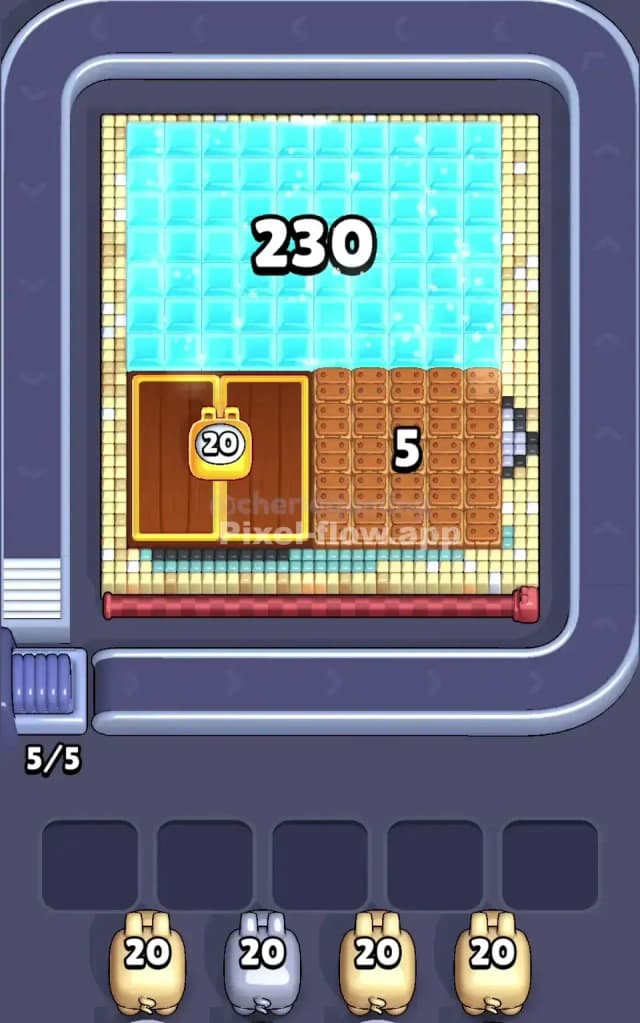
Level 558 is a deceptive beast. At first glance, you aren't looking at pixel art at all; you are staring at a fortified wall. The board is blocked by a massive, two-part barrier: a top section of bright Cyan tiles that looks like a swimming pool, and a bottom section made of heavy Brown wood. The wood is split into a locked double-door on the left (marked with a yellow "20" padlock) and a stack of reinforced crates on the right (marked with "5").
Your goal is to strip away this heavy outer shell to reveal the cute scene hiding underneath. Because of the high HP blocks (the crates) and the specific lock mechanics blocking your path, I judge this to be a very hard level. You have to manage your pig queue perfectly to avoid getting gridlocked by the outer wall.
Pixel Flow Level 558 Overview
This level tells a story in two acts. Act One is "The Heist." You are faced with that Cyan and Brown wall surrounded by a thin border of Cream/Sand colored blocks. It feels industrial and cold. The layout is highly symmetrical in shape but asymmetrical in toughness; the left side has that "20" lock, while the right side has multi-hit crates. This imbalance forces you to attack differently depending on which pigs spawn.
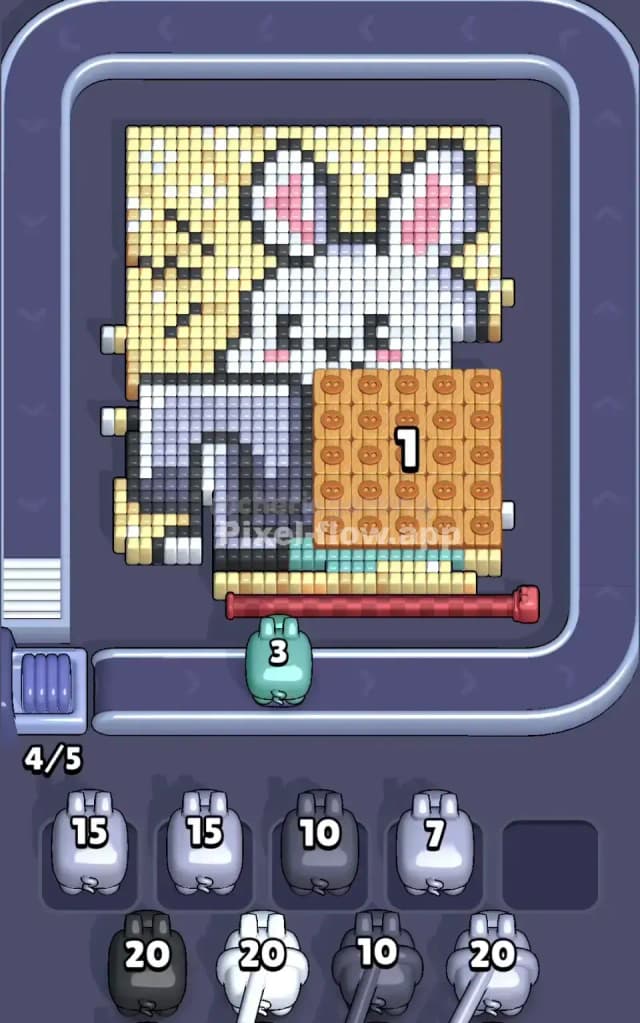
Once you smash through the wall, Act Two begins: "The Reveal." The debris clears to show a large, white Bunny Rabbit with pink ears. It’s holding a smaller, yellow creature—looks like a chick or a duck—on its back or left side. The vibe shifts instantly from a hard construction zone to a soft, cute animal portrait.
The difficulty spike comes from the transition. You will have pigs meant for the inner Bunny (White, Grey, Pink) appearing while the outer Wall (Cyan, Brown) is still standing. If you bring those Bunny-colored pigs onto the board too early, they will have nothing to shoot. They will sit in your waiting slots, blocking you from getting the Brown or Cyan pigs you desperately need to finish the demolition.
Step by step solution walkthrough for Pixel Flow Level 558
First Color Zone to Erase in Pixel Flow Level 558
Ignore the center. You physically can't touch it yet. Your priority is the Cream/Sand border.
Look at your starting lineup. You likely have several Cream pigs and maybe a Grey one. The Cream blocks form a ring around the entire Blue and Brown structure. This is your entry point.
- The Cream Logic: These pigs are safe to drop immediately because the border is the outermost layer. They will find targets easily.
- The Grey Trap: You might see a Grey pig in your conveyor belt early on. Do not drop it. The Grey blocks belong to the Bunny's shadow, which is buried deep behind the Cyan/Brown wall. If you drop the Grey pig now, it will sit in a slot doing nothing. If you fill all five slots with "useless" pigs like this, you lose. Keep that Grey pig on the belt until you break the wall.
Clear the Cream border completely. This does two things: it removes the outline, and it often triggers the spawn of the Blue and Brown pigs you need for the main wall.
How to pass Pixel Flow Level 558 without power ups or boosters
Now you face the wall. This is the grind.
- The Cyan Tiles (Top): These are usually single-hit blocks. Once you get Cyan/Light Blue pigs, let them rip. They will clear the top half of the screen quickly, exposing the Bunny's ears. This is good because it opens up "White" and "Pink" as valid target colors, freeing up your pig slots.
- The Brown Zone (Bottom): This is where runs die.
- The "5" Crates (Right): These blocks take 5 hits each. You need a lot of Brown ammo here. Do not waste Brown pigs on single blocks if you can line them up to hit these dense columns.
- The "20" Lock (Left): This gate usually requires you to clear surrounding blocks or hit it repeatedly. Focus your fire here as soon as you can.
- Ammo Conservation: As the wall crumbles, you will start seeing the White Bunny. You might be tempted to switch focus to the White blocks immediately. Don't. If you still have Brown crates left, focus on getting rid of them. The Brown pigs will stop spawning eventually. If you leave a few Brown blocks alive and the game stops giving you Brown pigs, you are stuck. Prioritize the "endangered" colors (Brown/Cyan) before switching to the abundant colors (White).
Last Details You Clean Up in Pixel Flow Level 558
By now, the wall is gone. The Bunny is exposed. The board is now a mix of White fur, Grey shadows, and the Black outline.
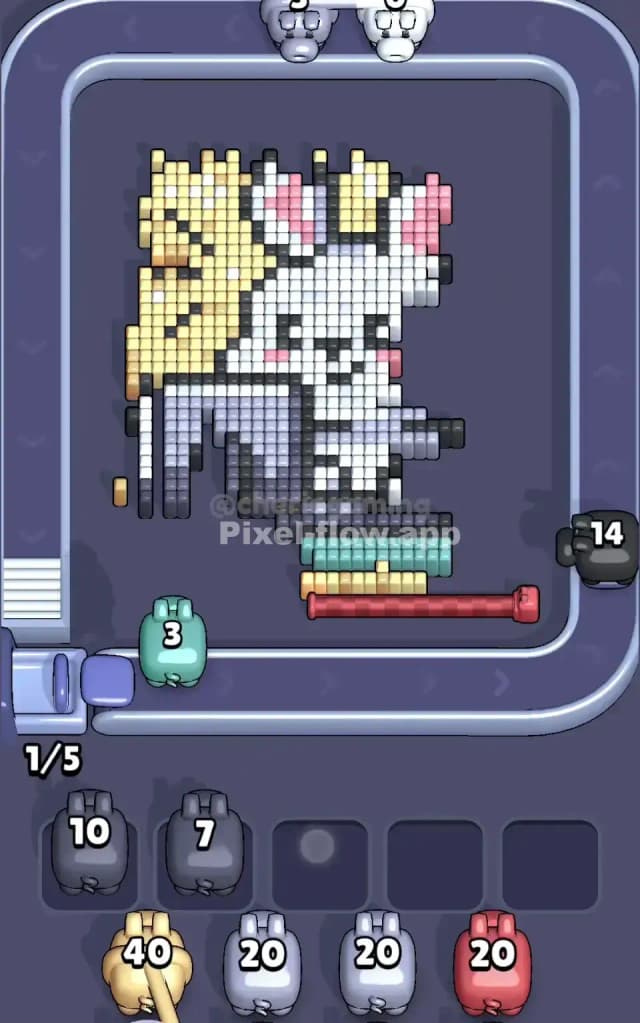
- The Yellow Chick: Remember the Cream pigs you used at the start? You might get a huge influx of them again (like the 40-ammo pig in the queue). These are for the yellow chick/duck on the left. Since this is a solid block of color, it's an easy target. Clear it to get it out of the way.
- The Grey Shadows: The Grey blocks are scattered inside the White fur. They are tricky. You often have to peel off layers of White to reach the Grey. Watch your pig order. If a Grey pig is next but the Grey blocks are covered by White, you have to wait.
- The Black Outline: As always with pixel art levels, the Black outline is the final cleanup. These blocks are usually on the bottom-most layer or tucked into corners. Save your Black pigs for the very end. They are the broom that sweeps the level clean.
Stay patient with the "5" crates, and don't clog your slots with White pigs until the wall is down. Good luck.