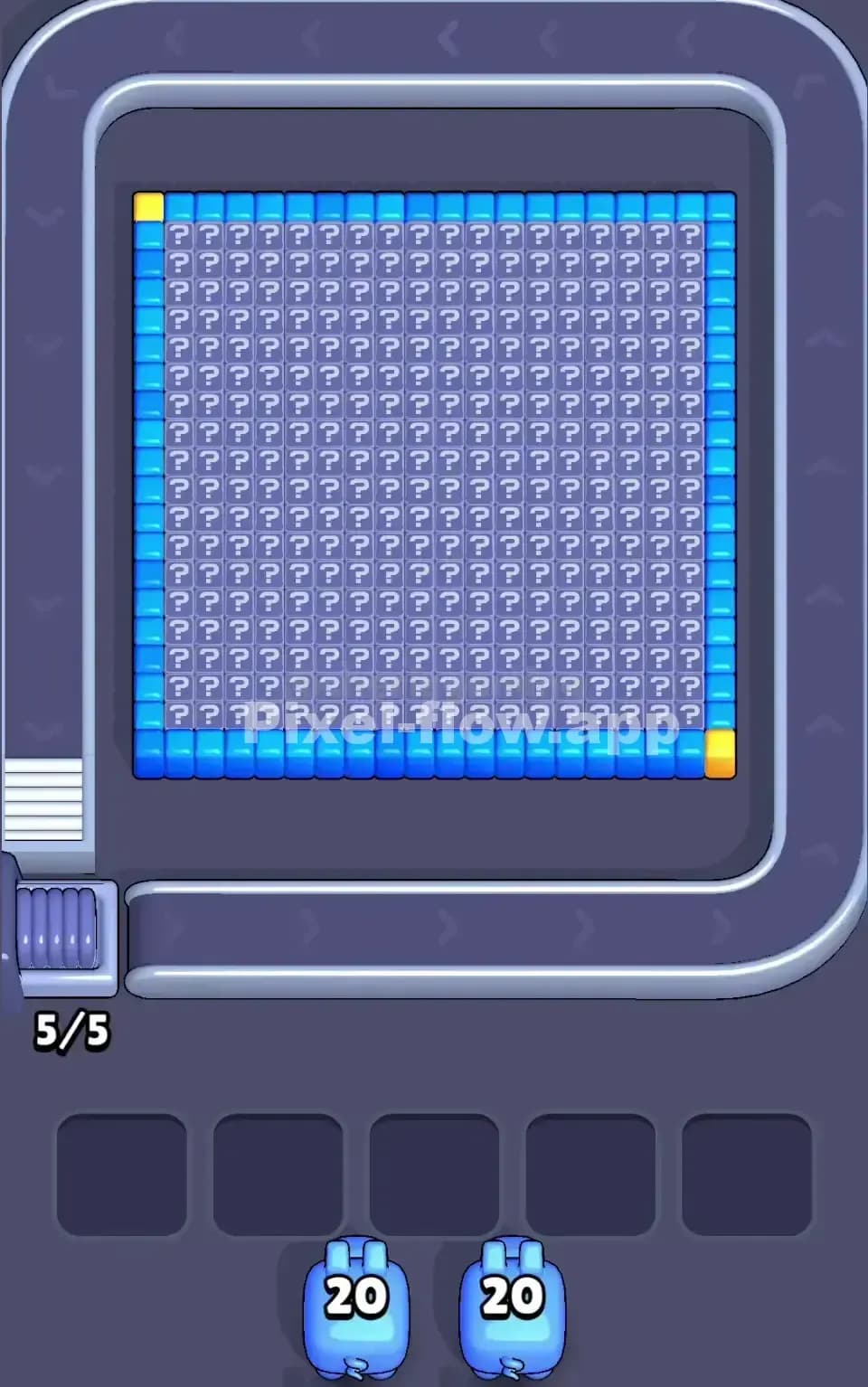
Pixel Flow Level 84 Solution | Pixel Flow 84 Walkthrough
How to beat Pixel Flow Level 84: Video solution & walkthrough. The fastest way to pass Pixel Flow 84.
Is this the wrong level layout?🤔
Pixel Flow randomizes levels for different players. Don't worry, just upload a screenshot of your board, and our AI will find the correct video instantly.


Pixel Flow Level 84 Walkthrough
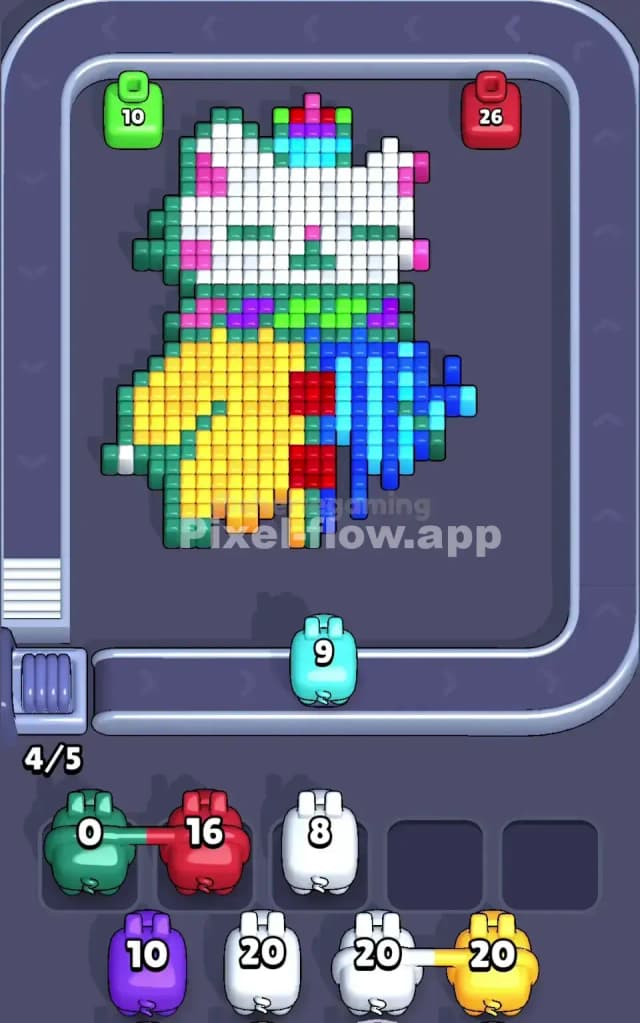
This level features a large, blocky character that looks like a "Lucky Cat" dressed in a split-colored clown suit. You have a massive white head with pink cheeks, and a body divided right down the middle: the left side is a solid chunk of yellow, and the right side is patterned with vertical blue stripes. The whole figure is framed by a thick teal-green outline that acts as the outer shell.
The rules to beat Pixel Flow Level 84 are standard but punishing due to the layout. You need to strip away the outer colors (mostly Green and White) to expose the messy, striped core of the body. You have a White Lock (requires 10 hits) blocking the bottom center, and two massive counters at the top corners for Yellow (40) and Blue (40). This is a very hard level because the vertical stripes on the right side limit your valid target area, causing pigs to pile up in your waiting slots if you aren't careful.
Pixel Flow Level 84 Overview
Imagine a giant, pixelated cat statue blocking your path. The top half is friendly enough—a wide white face with sleepy teal eyes and pink cheeks. It wears a tiny multi-colored party hat. But the body is where the chaos lives. The cat’s suit is asymmetrical, which ruins your rhythm.
On the left, the cat wears a solid yellow suit. This is your "safe zone." It’s a big, fat target where you can dump yellow ammo easily. On the right, however, the cat wears a blue-striped shirt. These vertical blue lines are separated by other colors or empty space. This is dangerous. If you have a Blue pig, you have to be precise. You can’t just spray and pray like you can on the yellow side.
Finally, notice the Green "crust." The arms, the feet, and the outer edges of the head are all coated in this dark teal green. Until you chip this green away, the inner body colors are partially shielded. The level feels heavy at the bottom because of the waiting lock, but the real threat is the verticality of those blue stripes on the right.
Step by step solution walkthrough for Pixel Flow Level 84
First Color Zone to Erase in Pixel Flow Level 84
I start by aggressively hunting Green and White. Here is the logic:
The Green pixels form the "arms" and the bottom "feet" of the cat. They are the outermost layer on the sides. By clearing the Green pigs first, you physically narrow the statue. You shave off the sides, which gives your pigs on the conveyor belt a clearer line of sight to the inner yellow and blue sections. If you leave the Green arms up, they act as blockers for angled shots.
Simultaneously, you must prioritize White. Look at the bottom center of the board. There is a White Lock with the number 10 on it. This lock prevents you from clearing the bottom-most rows efficiently. Luckily, the cat’s face is a giant wall of white pixels. Every White pig you use on the face counts toward opening that lock at the feet. Do not let White pigs sit in your waiting slots; use them immediately on the face to pop that lock early.
How to pass Pixel Flow Level 84 without power ups or boosters
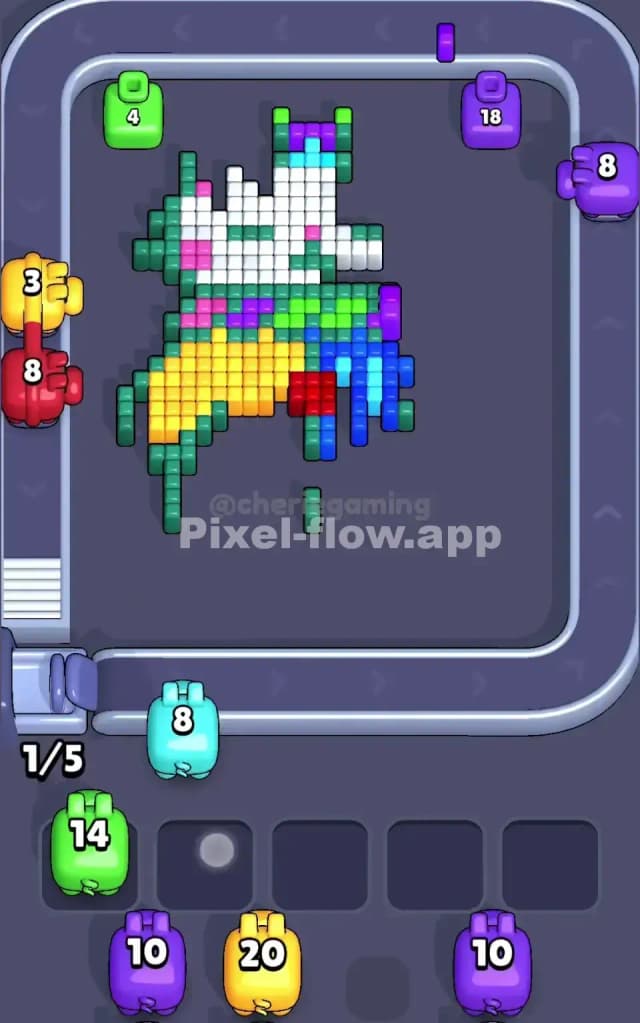
Once the white face is gone and the green arms are shaved off, you enter the mid-game crisis. The cat is half-destroyed. You are left with the headless body. This is where most players lose Pixel Flow 84.
You will see a stark difference between left and right. The left side is a massive block of Yellow. The right is those tricky Blue vertical stripes.
When the conveyor belt feeds you Yellow pigs, you can relax. You have a huge surface area on the left to unload them. However, be extremely paranoid about Blue pigs. Because the blue is arranged in thin vertical strips, a Blue pig passing on the far left or far right might not have a shot. You have to wait for the Blue pig to align perfectly with a stripe.
If you refuse to use power ups, you must manage your "Waiting Slots" (the 5 holes at the bottom) based on this asymmetry.
- Safe Dump: If your slots are filling up, prioritize matching Yellow pigs. They almost always have a target.
- High Risk: Do not let Red or Pink pigs clog your slots yet. The Red buttons on the chest are a single vertical line—a very hard target to hit. If you hold three Red pigs in your waiting slots hoping for a clear shot, you will choke your board and lose. If a Red pig appears and you can't shoot it instantly, you are in trouble. Ideally, wait until the chest is fully exposed before pulling Red pigs off the belt.
Last Details You Clean Up in Pixel Flow Level 84
The end of the level is usually a scramble for the small details. By now, the massive Yellow and Blue sections should be cleared, fulfilling the 40/40 counters at the top.
The last pixels to hide are usually the Red buttons in the center of the chest and the Cyan/Pink remnants of the party hat or collar. Because these were in the middle or top layers, they often get ignored while you focus on the big body blocks.
Watch out for the single voxels. Sometimes a single Red pixel remains floating where the chest used to be. The conveyor belt might spawn a Red pig, but if it passes the center line before you tap it, it drops into a slot. Be patient. Watch the belt. Only tap the pig when it is directly above that last stubborn pixel. Do not spam tap at the end, or you will fill your slots with ammo you cannot fire.