Pixel Flow Level 1 Solution Walkthrough | Pixel Flow 1
How to solve Pixel Flow level 1? Get instant solution for Pixel Flow 1 with our step by step solution & video walkthrough.

Pixel Flow Level 1 Overview
The Board Layout and Starting Setup
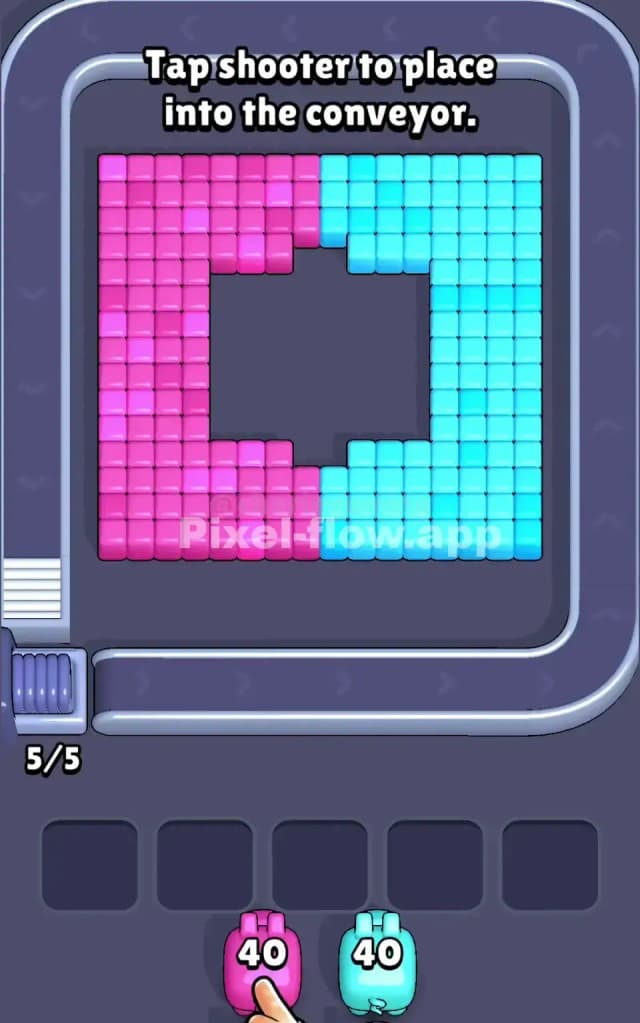
Pixel Flow Level 1 presents a visually clean but strategically demanding puzzle. The board is dominated by a symmetrical frame pattern made of two primary colors: magenta on the left side and cyan on the right side. These cubes form a distinctive rectangular outline with a hollow dark center, creating what looks like a stylized frame or border design. You're starting with two pigs in the queue—a magenta pig with 40 ammo and a cyan pig with 40 ammo—both waiting to hop onto the conveyor belt. The waiting slots below the board are completely empty, giving you plenty of breathing room to work with as you begin clearing Pixel Flow Level 1.
The symmetry is deceptive, though. While the left and right sides look nearly identical in size and distribution, the actual number of cubes on each side isn't perfectly equal, which means you'll need to be careful about how you sequence your color shots. The magenta pig's 40 ammo and the cyan pig's 40 ammo together represent 80 total shots—more than enough to clear the visible layer, but only if you don't waste a single bullet or jam your waiting slots with stuck pigs.
Winning Pixel Flow Level 1: The Core Objective
Your goal in Pixel Flow Level 1 is straightforward: eliminate every single voxel cube on the board by strategically placing color-coded pigs onto the conveyor belt. Each pig automatically shoots cubes of its own color, and every cube destroyed costs exactly one unit of ammo. You'll win the moment all cubes vanish and no pigs remain stuck in the waiting slots. The sequence in which you deploy your pigs is completely deterministic—the game doesn't randomize pig order or ammo counts—which means Pixel Flow Level 1 rewards careful planning and methodical execution over luck.
Why Pixel Flow Level 1 Feels So Tricky
The Symmetry Trap and Waiting Slot Pressure
Here's where Pixel Flow Level 1 gets genuinely frustrating: the board looks balanced, but it's not. The magenta side and cyan side appear to have roughly the same number of cubes, yet when you fire your magenta pig first, you'll likely exhaust its ammo before the cyan side is fully exposed or destroyed. This imbalance means your magenta pig might empty its 40 shots and still have cubes remaining, forcing it to drop into a waiting slot. If the cyan pig then exhausts its ammo with cubes still visible on the magenta side, you've suddenly got two stuck pigs and no way to clear the remainder. That's a game-over situation waiting to happen in Pixel Flow Level 1.
The five waiting slots become your pressure cooker. You start with zero pigs in the buffer, which feels safe—but the moment you fill even three slots with partially-spent pigs, you're one bad pig away from an irreversible jam. In Pixel Flow Level 1, watching those slots fill up is genuinely stressful, especially if you haven't planned your pig order carefully.
Color Patches and Awkward Ammo Mismatches
Pixel Flow Level 1 hides another layer of complexity in its visual design. While most of the magenta cubes are concentrated on the left frame and cyan on the right, there are small color-overlap zones where magenta and cyan cubes sit adjacent to each other. When you shoot your first color, you're relying on gravity and the voxel structure to expose new cubes underneath, but sometimes that doesn't happen fast enough. You'll fire 15 or 20 shots from your magenta pig and suddenly realize there aren't enough magenta targets left to spend your remaining 20 ammo. At that point, your pig is dead weight, and it's heading to a waiting slot.
Additionally, Pixel Flow Level 1 doesn't clearly show you how many cubes of each color exist in the deeper layers. You're working with only the visible surface, which means you can't know for certain whether 40 magenta ammo is too much, just right, or too little. That uncertainty is part of the puzzle's psychological difficulty.
When It Finally Clicks
I'll be honest: my first attempt at Pixel Flow Level 1 felt chaotic. I fired the magenta pig, watched half the left side crumble, and felt confident. Then the cyan pig went next, and I realized I'd cleared magenta way too fast—the magenta pig was sitting in slot three with 12 ammo left and nowhere to go. The panic of watching my waiting slots fill up while the board still had cubes was genuinely frustrating. But on my second or third run, I realized the trick wasn't to fire each color independently; it was to think of Pixel Flow Level 1 as an alternating dance. You don't fully exhaust magenta and then move to cyan. Instead, you strategically deploy them in smaller waves, exposing colors beneath the surface and creating new targets as you go. Once that mentality shift happened, Pixel Flow Level 1 became solvable.
Step-by-Step Strategy to Clear Pixel Flow Level 1
Opening: The First Two Pigs and Slot Management
Your opening move sets the tone for the entire puzzle. Don't immediately fire the magenta pig with all 40 ammo at once. Instead, deploy your magenta pig and let it shoot only the most exposed magenta cubes on the left side of the board. You'll want to fire until you see a clear gap or you notice that the magenta pig is starting to run out of obvious targets. This might happen after 15 to 20 shots. The key is watching the left frame carefully—aim for the corners and edges first, because those cubes often expose more cubes beneath them when they fall.
After your magenta pig has spent 15 to 20 ammo, tap the cyan pig onto the conveyor belt. Let it clear some of the right-side cyan cubes, again focusing on exposed, easy targets. By alternating between magenta and cyan in the opening phase, you achieve two things: you keep both waiting slots clear (since you're taking turns with fresh pigs), and you expose the middle-ground colors and deeper layers that neither pig could target before.
This opening strategy might feel slow, but it prevents the catastrophic situation where one pig exhausts its ammo and parks itself in a waiting slot while the other color still dominates the board. Think of Pixel Flow Level 1's opening as a conversation between two colors, not a monologue.
Mid-Game: Layering and Exposure Strategy
Once you've cleared 20 to 30 cubes and exposed some of the inner structure, the real puzzle unfolds. You'll likely notice that magenta and cyan aren't the only colors visible anymore. If there are deeper layers of different colors (or lighter/darker shades), keep track of them. Your waiting pig queue might now include a partially-spent magenta pig and a partially-spent cyan pig. If you have empty waiting slots, you can now be more aggressive.
During Pixel Flow Level 1's mid-game phase, deploy whichever pig comes next in the conveyor queue and let it clear aggressively—either the magenta pig with its remaining ammo or the cyan pig with its remainder. The goal is to expose as much of the underlying structure as possible while keeping at least one waiting slot clear for emergencies. Pay close attention to gravity: when a cube falls, it might expose a new cube directly beneath it, and if that new cube is the same color, your current pig can immediately target it.
Also, resist the urge to clear one color completely before moving to another. In Pixel Flow Level 1, strategic incompleteness is your friend. If your magenta pig has 5 ammo left and you see only 3 magenta targets, don't fire randomly—let the pig drop into a waiting slot, knowing that future pigs or gravity cascades might expose new magenta targets.
End-Game: The Final Countdown and Buffer Cleanup
As Pixel Flow Level 1 enters its final stages, your board should be mostly empty, with scattered cubes of various colors. The waiting slots might have two or three stuck pigs, each with a few ammo remaining. This is where precision becomes critical. Your goal is to deploy new pigs in an order that exposes the remaining cubes in their color, allowing the stuck pigs to fire and empty their buffers.
If your waiting slots are getting full, you absolutely must focus on exposing new targets for the stuck pigs. Sometimes this means deploying a fresh pig of a color that's barely visible, just to trigger a gravity cascade and reveal new targets for another color. In Pixel Flow Level 1, the final 10 to 15 cubes often feel like a puzzle within the puzzle, requiring you to think three or four moves ahead.
The absolute final move should leave you with one pig firing its last shot, watching the last cube vanish, and all waiting slots empty. If you've done Pixel Flow Level 1 correctly, it should feel clean—no desperate scrambling, no surprise game-overs.
The Logic Behind This Pixel Flow Level 1 Plan
Determinism and Ammo Economics
Pixel Flow Level 1 rewards you for understanding that the entire game is deterministic. The pig order never changes, the ammo counts are fixed, and the cube layout is static. This isn't a game where you can brute-force through by firing randomly and hoping for the best. Instead, your success depends on recognizing that you have exactly 80 ammo total (40 magenta + 40 cyan), and you must clear exactly that many cubes by the end. If you've miscounted or wasted shots, you'll fail.
The strategy I've outlined—opening with careful, alternating deployment and mid-game exposure tactics—exploits this determinism. By refusing to fully empty one color's ammo at the start, you keep your options open. You maintain flexibility to handle unexpected board states and avoid the trap of filling your waiting slots with useless pigs.
Think of Pixel Flow Level 1 as a resource-management puzzle disguised as a shooter. Your true resource isn't ammo—it's waiting slots. Manage those slots carefully, and the ammo will take care of itself.
Staying Calm and Planning Ahead
The final edge you need for Pixel Flow Level 1 is psychological. The pressure of watching your waiting slots fill can make you panic and fire randomly, which is exactly how you lose. Instead, train yourself to pause between each pig deployment. Count the visible cubes of each color, estimate how many ammo each pig will need, and glance at the queue to see what's coming next. This two-or-three-pig-ahead thinking transforms Pixel Flow Level 1 from a frantic race into a methodical strategy game.
When you feel stuck in Pixel Flow Level 1, remember: waiting is a valid action. Let a pig drop into a waiting slot if it doesn't have valid targets. Trust that future moves will expose new targets. Stay calm, plan deliberately, and Pixel Flow Level 1 will reward your patience.