Pixel Flow Level 120 Solution | Pixel Flow 120 Walkthrough
How to beat Pixel Flow Level 120: Video solution & walkthrough. The fastest way to pass Pixel Flow 120.
Is this the wrong level layout?🤔
Pixel Flow randomizes levels for different players. Don't worry, just upload a screenshot of your board, and our AI will find the correct video instantly.


Pixel Flow Level 120 Walkthrough
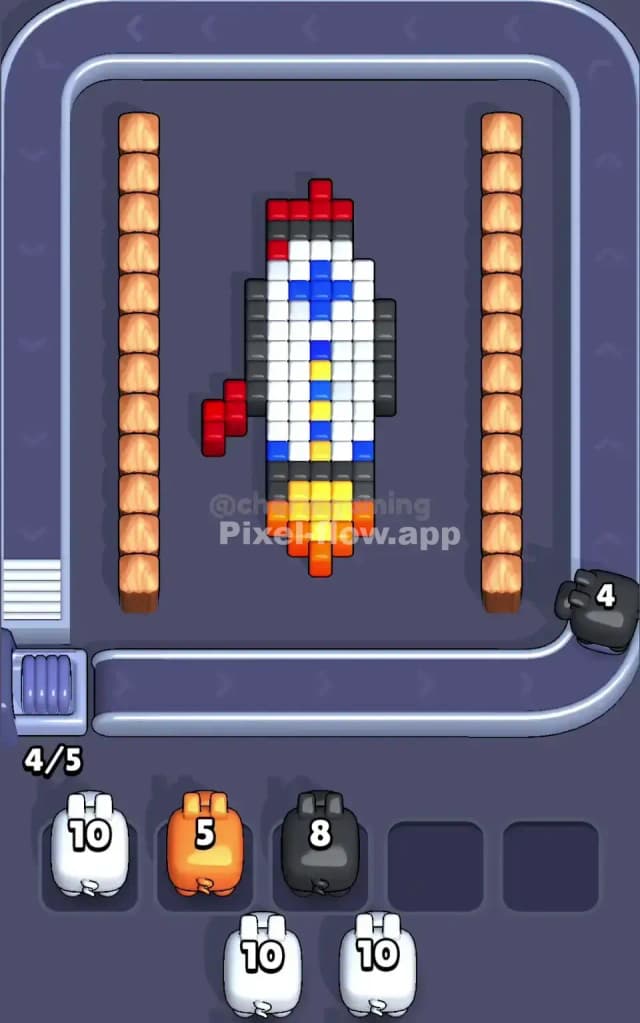
This level features a retro-style pixel art rocket ship preparing for blast-off. The rocket sits dead center, framed by two tall, vertical pillars of tan-colored blocks that act as launch scaffolding. To beat Pixel Flow Level 120, you must strip away the outer scaffolding and the rocket's dark hull to reach the white, blue, and yellow tech inside.
Is this level hard? It is not very hard, but it is tricky. The danger lies in the two massive tan pillars on the sides. If you ignore them, they block shots from hitting the rocket's wings. If you focus on them too much without clearing the center, you might clog your waiting slots.
Pixel Flow Level 120 Overview
Imagine a space launch sequence. The main character here is a classic cartoon rocket. It has a heavy black outline that encases the entire fuselage. The nose cone and the two side fins are bright red. At the very bottom, there’s an engine exhaust plume made of orange and yellow pixels.
The rocket’s body is mostly white, but inside that white field is a blue cross pattern and a central yellow stripe.
Crucially, the rocket is flanked by two huge vertical walls of tan/light brown blocks. These aren't part of the ship; they are obstructions. They run almost the full height of the board. Because the conveyor belt wraps around the sides, pigs traveling down the left or right will hit these tan walls first before they can even think about targeting the rocket's red fins or black outline.
The board is symmetrical. What you do to the left pillar, you usually need to do to the right.
Step by step solution walkthrough for Pixel Flow Level 120
First Color Zone to Erase in Pixel Flow Level 120
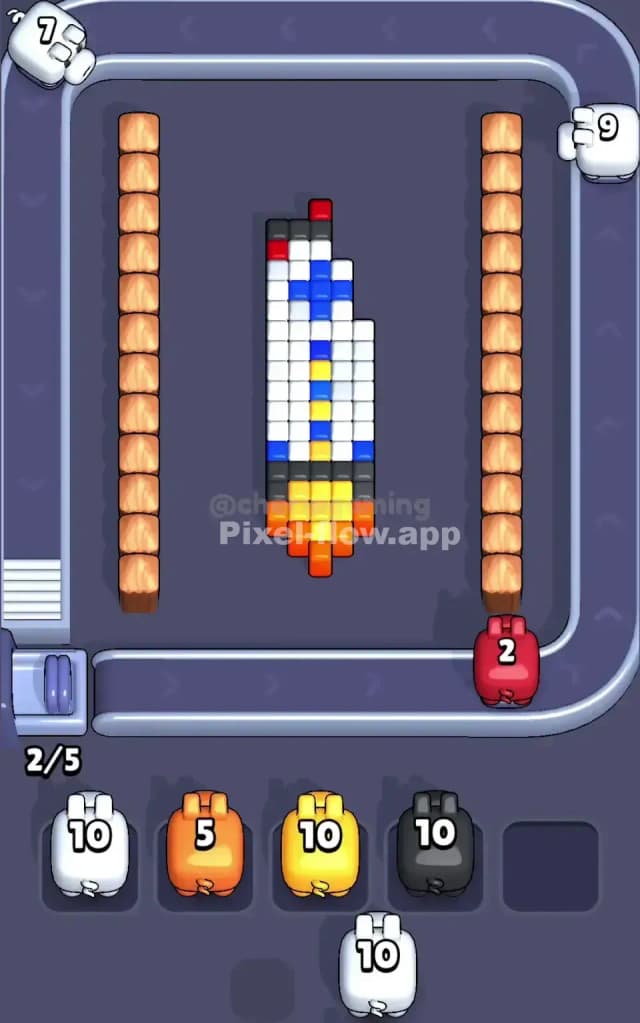
I start by targeting the tan scaffolding pillars on the far left and right.
Here is the logic: narrative and geometric. Narratively, you clear the launch tower before the rocket flies. Logically, these pillars are "shielding" the rest of the puzzle. If a red pig comes down the right side of the belt, it wants to shoot the red rocket fin. But it can't. The tan pillar is in the way.
If you see a tan/brown pig, play it immediately. It will clear a massive amount of space (about 10-12 blocks per pillar) and expose the black outline and red fins of the rocket. Do not waste time trying to snipe the center white blocks yet; you need the sides open to let your pigs attack the rocket from all angles.
How to pass Pixel Flow Level 120 without power ups or boosters
Once the tan pillars are gone, the picture looks surprisingly vulnerable. You have a naked rocket floating in space. Now you must switch tactics.
The next priority is the black outline. The black pixels form a thick shell around the entire ship. A black pig here is incredibly high-value because it can hit targets from almost anywhere on the belt—top, left, right, or bottom. Clearing the black outline is the key to unlocking the inner colors.
If you don't get black pigs, look for red. The red fins sticking out the sides are now exposed (thanks to removing the tan pillars). Clearing the red fins narrows the target profile, making it easier for white pigs to hit the central fuselage later without wasting ammo on accidental side-hits.
If your slots are filling up with white or yellow pigs, don't panic. Hold them. White is the "meat" of the level, but it is buried deep. You must peel the black and red skin off first. If you try to force white pigs too early, they will just drop into your waiting slots and clog the machine because they have no line of sight to the inner white blocks.
Last Details You Clean Up in Pixel Flow Level 120
The end game is usually the engine and the cockpit.
After the black hull is gone, you are left with a jagged shape of white, blue, and yellow. The orange engine flame at the bottom is often the last thing to survive because it sits low and central, hard for side-traveling pigs to hit until the very end.
Watch out for the blue cross inside the white body. Sometimes a blue pig will have ammo left over after hitting the exposed blue pixels, but the remaining blue pixels are hidden behind white ones. This is the final trap. Ensure you clear the white blocks surrounding the blue cross so your blue pig doesn't get stuck with 1 ammo left and nowhere to shoot.
The final move is usually a satisfying cleanup of the yellow engine core or that stubborn orange exhaust flame. Blast off.