Pixel Flow Level 135 Solution Walkthrough | Pixel Flow 135

How to solve Pixel Flow level 135? Get instant solution for Pixel Flow 135 with our step by step solution & video walkthrough.

Share Pixel Flow Level 135 Guide:
Pixel Flow Level 135 Gameplay
Pixel Flow Level 135 Solution 1
Pixel Flow Level 135 Solution 2
Pixel Flow Level 135 Solution 3

Pixel Flow Level 135 Overview

The Board Layout and Pixel Art Design

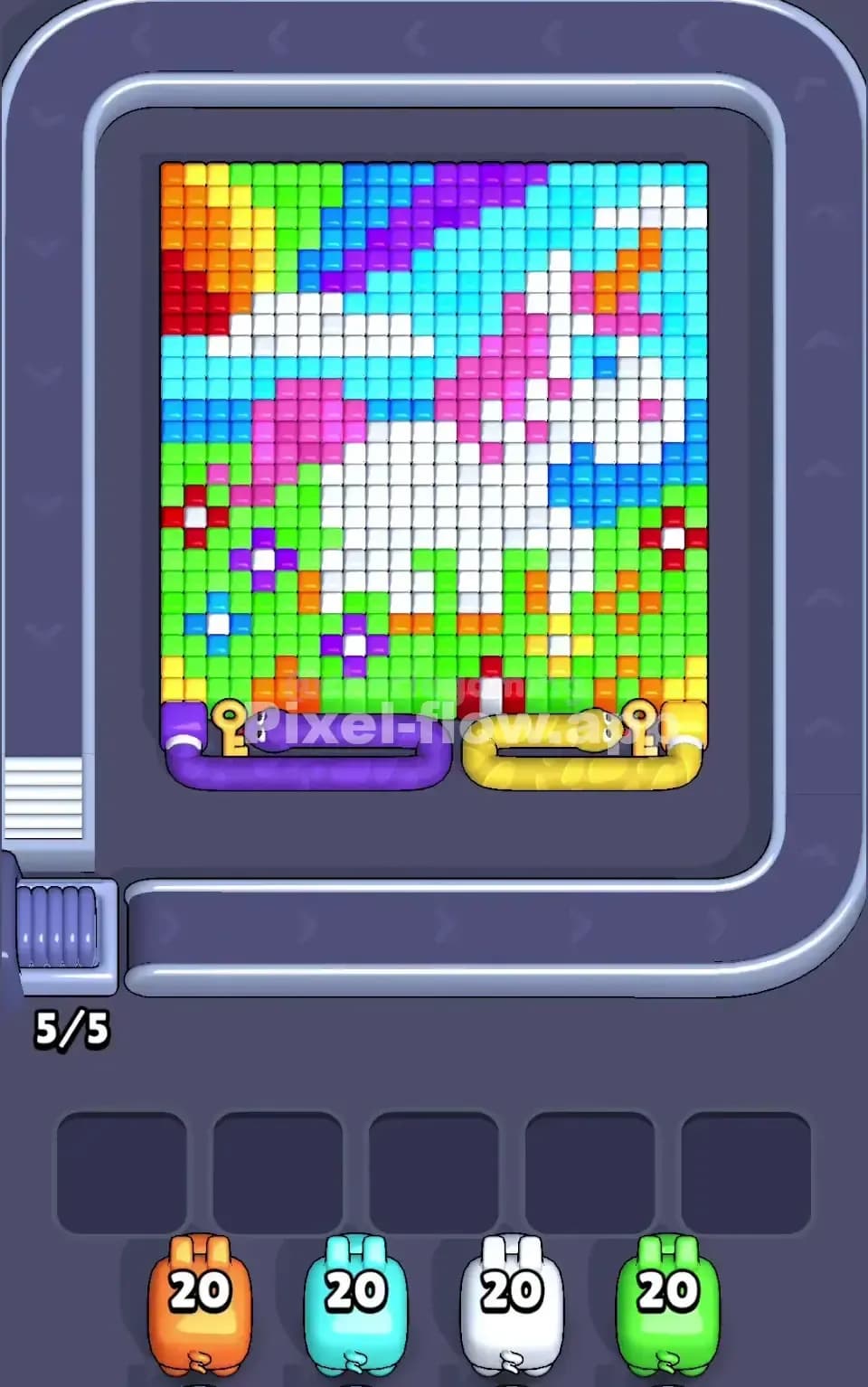
Pixel Flow Level 135 presents a charming cross-shaped composition featuring four distinct pixel art characters arranged symmetrically around a central orange pillar. On the left side, you'll encounter a cheerful yellow smiley face with a black outline, sitting above a green header and a dark gray base. The top-right quadrant displays a cyan-blue character with similar framing, while the bottom-left showcases an orange character with green accents, and the bottom-right reveals a striking purple character also adorned with green details. The entire board is anchored by a tall vertical column of orange cubes running through the middle, creating a natural dividing line between left and right sections. The outer perimeter is filled with dark gray voxels that form the background and structural support for all the colored layers.

Win Condition and Deterministic Gameplay

Your goal in Pixel Flow Level 135 is straightforward on the surface: clear every single cube from the board until nothing remains. What makes this achievable is the fully deterministic nature of the pig conveyor belt and their fixed ammo counts. You'll see three pigs at the bottom, each carrying 20 ammunition units (labeled "20/20"). These pigs will always arrive in the same order, and their ammo is always predictable—meaning there's no luck involved, only strategy and sequencing. Understanding that you have exactly 60 total ammo shots to work with is crucial; you must spend every bullet on matching-colored cubes to expose the deeper layers and eventually reach victory.


Why Pixel Flow Level 135 Feels So Tricky

The Central Orange Bottleneck

The most intimidating obstacle in Pixel Flow Level 135 is that towering orange pillar running vertically through the board's center. With so many orange cubes stacked in a single column, you're relying entirely on an orange pig to clear them all—and that pig arrives late in the rotation. If you rush too quickly through the outer colors (yellow, cyan, green, and purple), you risk filling all five waiting slots with "stuck" pigs that have ammo but no valid targets, because the orange cubes remain blocking critical paths. This creates a deadlock where new pigs can't enter the conveyor, and you're left unable to progress. I found myself repeatedly jamming the buffer by being too eager to clear surface-level cubes without thinking ahead to the orange requirement.

Hidden Color Pockets and Ammo Mismatches

Another sneaky challenge in Pixel Flow Level 135 lies in the way colors are distributed across layers. The green cubes aren't just visible at the top of each character—they also appear as trim around the shoulders and edges, sometimes hidden behind the yellow or cyan or orange foreground. Similarly, dark gray voxels form thick outlines that you might mistake for permanent structure when they're actually part of the clearable board. If you expend an entire pig's ammo on the wrong section, you'll watch the remaining cubes of that color stay stubbornly on the board while your pig drops into the waiting line with nothing left to contribute. I nearly fell into this trap several times before realizing that the game's layering is more complex than a simple front-to-back reveal.

The Mental Endurance Test

Honestly, Pixel Flow Level 135 punishes impatient thinking. The level requires you to simultaneously track three separate pig queues, mentally simulate where each shot lands, count remaining ammo, and plan which color to expose next—all while watching the clock tick or worrying about slot congestion. The first few attempts felt overwhelming because I wasn't thinking in terms of "what happens if I let this pig sit partially spent and call the next one?" Instead, I was reacting to whatever color was most visible, which inevitably led to jamming. The breakthrough moment came when I stopped playing reactively and started mapping out the entire sequence on paper, working backward from the orange pillar to see which colors had to go first. Once that clicked, Pixel Flow Level 135 transformed from maddening to satisfying.


Step-by-Step Strategy to Clear Pixel Flow Level 135

Opening: Establishing Control and Preserving Slots

Your opening moves in Pixel Flow Level 135 are absolutely critical because they set the tempo for everything that follows. I recommend starting with the yellow smiley face on the upper left. Yellow is abundant and visible, and the first pig in your queue is almost certainly yellow or a color that won't clash with this strategy. Spend approximately 10–12 of your first pig's 20 ammo on yellow cubes, targeting the face itself and working outward to expose the green border behind it. Don't empty the first pig completely on yellow alone; you want to halt that pig with 8–10 ammo remaining, which forces it to drop into a waiting slot without jamming the system. This conservative approach keeps your buffer relaxed and gives you room to maneuver.

Next, direct your attention to the cyan character in the upper right. Push the second pig through, spending roughly 12 ammo to clear cyan and begin revealing the green trim on that side. Again, deliberately hold back the final shots; you're preserving at least three empty waiting slots throughout this phase. The key principle is that Pixel Flow Level 135 rewards patience over greed. Every time you leave a partially-spent pig parked in the buffer, you're buying yourself options and preventing the catastrophic deadlock that comes from filling all five slots with stuck pigs.

Mid-Game: Exposing Layers and Sequencing Precision

By mid-game in Pixel Flow Level 135, your waiting slots should contain one or two half-spent pigs, and you're cycling the conveyor actively. Now it's time to tackle the colors that will unlock the central orange pillar. The green cubes form a critical network across the top of both upper characters and likely connect downward toward that central column. Allocate approximately 15–18 ammo from your second or third pig to comprehensively clear all visible green. This is where counting and planning ahead really matter: scan the board carefully to spot every green cube, because leaving even three or four green cubes behind will trap a pig with wasted ammo.

Once green is largely cleared, move to the orange pillar itself. If your third pig is orange or if a subsequent pig enters the line, deploy it strategically against that central column. The orange pillar is a marathon, not a sprint; you might need to spend most or all of a pig's 20 ammo just on that one color. Don't panic if a pig ends its turn still facing orange cubes—that's expected and fine. The pillar will eventually crumble once you've committed sufficient ammo, but rushing this step or trying to knock it out prematurely (before clearing surrounding cubes) will strand you with no other targets.

End-Game: Precision Finishing and Buffer Cleanup

The final stretch of Pixel Flow Level 135 demands laser-focused execution. By this stage, you should have cleared yellow, cyan, green, and most or all of orange. You're likely staring at the purple character in the bottom-right and the orange character in the bottom-left, both still bearing significant cube counts. Verify your exact remaining ammo—you should have around 15–25 shots left if you've played efficiently. Systematically wipe out purple using one dedicated pig, spending every shot on purple until it's gone. Then repeat for orange.

The final danger zone arrives when just a handful of cubes remain across multiple colors. If you have, say, 3 purple, 2 orange, and 4 gray cubes left but your current pig only matches purple, that pig will exhaust itself on purple and drop into a waiting slot. If all five slots are full, you're stuck. To avoid this, keep tabs on your queue and ensure at least one waiting slot remains empty until the very last pig finishes its final shot. The winning move in Pixel Flow Level 135 is often simply waiting—holding your patience, letting a partially-spent pig rest in the buffer, and trusting that the next pig in line will handle a different color and push you toward the victory screen.


The Logic Behind This Pixel Flow Level 135 Plan

Exploiting Determinism and Ammo Efficiency

Pixel Flow Level 135 is designed so that the exact pig sequence and ammo values are fixed. This means every clear run of the level follows the same conveyor order and the same total ammunition (60 shots from three 20-ammo pigs). The strategy outlined above works because it treats the level as a logic puzzle rather than an action game. By planning which color each pig should tackle, you're ensuring that no ammo is wasted on colors that have already been fully cleared, and you're structuring your moves so that later pigs always have valid targets available. The orange pillar, in particular, is your anchor point—because it's massive and centrally placed, you can build your entire strategy around when to hit it, which allows you to use earlier pigs on the outer colors (yellow, cyan, green) and save a dedicated pig for the final push on orange. This isn't about hope or luck; it's about using determinism as your advantage.

The Waiting Slot Buffer and Preventing Deadlock

Understanding the five-slot waiting buffer is the secret to not hitting a hard game-over in Pixel Flow Level 135. Every time a pig exhausts its ammo or runs out of matching cubes, it parks in one of five slots. If all five fill up with pigs that still have ammo but no valid targets—perhaps because you cleared all cubes of their color or because you didn't expose their color yet—the game locks and you fail. The strategy prevents this by (a) never over-clearing a single color, (b) always planning two or three pigs ahead, and (c) deliberately leaving pigs partially spent so they occupy a slot without clogging the system. By monitoring your buffer as carefully as you watch the board, you stay in control of Pixel Flow Level 135 and avoid the frustration of a last-second jam.

Staying Calm and Counting Ahead

Mastering Pixel Flow Level 135 ultimately comes down to patience and mental discipline. Before each pig enters, take a breath and ask yourself: "Which color does this pig shoot? How many matching cubes are visible? Will I have targets for the next pig if I clear everything now?" Write down rough ammo allocations if you're struggling; the five-second investment in planning saves minutes of frustration. Watch the queue indicator on the left side to see which pig is coming next, and use that information to guide your current pig's behavior. If a yellow pig is about to enter and you still have yellow on the board, maybe hold your current orange pig in the buffer rather than forcing it to grab an unrelated color. This deliberate, thoughtful approach transforms Pixel Flow Level 135 from a chaotic scramble into a satisfying puzzle that rewards foresight and composure. The level isn't harder than others—it's just stricter about rewarding smart sequencing, and that clarity is what makes it so rewarding to finally conquer.