Pixel Flow Level 216 Solution | Pixel Flow 216 Walkthrough
How to beat Pixel Flow Level 216: Video solution & walkthrough. The fastest way to pass Pixel Flow 216.
Is this the wrong level layout?🤔
Pixel Flow randomizes levels for different players. Don't worry, just upload a screenshot of your board, and our AI will find the correct video instantly.



Pixel Flow Level 216 Walkthrough
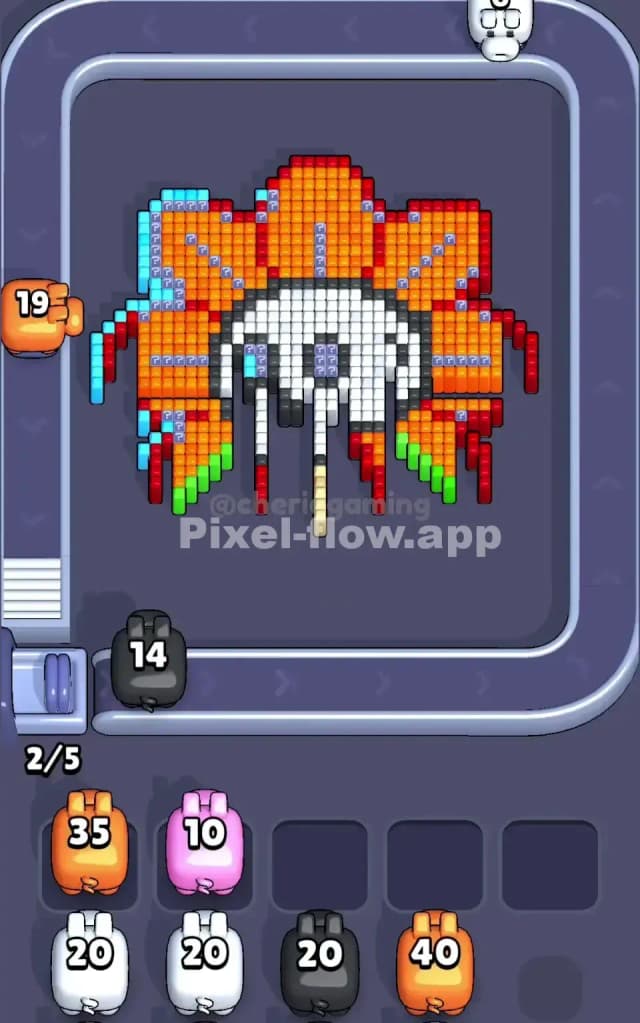
This level is a "Day of the Dead" style icon: a bright skull sitting right in the center of a blooming flower. You are dealing with a massive amount of Orange forming the petals, a Cyan (light blue) outline protecting the edges, and a dense White center for the skull itself.
The gimmick here is the sheer volume of "Hidden Blocks" (blocks marked with a ?). Almost every orange pixel is hiding another color underneath. You have to strip the surface to see what you are actually fighting. Is this a very hard level? No. It’s intimidating because of the size, but the color separation is clean. You won't get stuck unless you ignore the outer rim.
Pixel Flow Level 216 Overview
The artwork is a classic sugar skull design. It feels festive but rigid. The center is a blocky, white skull with black eye sockets and a triangular nose. Surrounding this bone-white core is a massive explosion of orange petals.
The structure is radial. Eight petals fan out from the center. Notice the Cyan border? It’s thin, usually just one pixel wide, wrapping around the tips of the orange petals.
This board is symmetrical, but the danger lies in the verticality. As you chip away the orange petals, you aren't just clearing space; you are revealing vertical columns of color (seen in the damage states) that act as the structural support for the skull. The top and bottom petals are the thickest. They are your easiest targets. The side petals are trickier because the rotation of the belt might make the angles weird.
Step by step solution walkthrough for Pixel Flow Level 216
First Color Zone to Erase in Pixel Flow Level 216
I start by aggressively targeting the Orange blocks on the top and bottom petals.
Here is the logic: The game gives you high-capacity Orange pigs early on (you can see a generic queue often has 40-ammo orange pigs). The orange zone is the largest contiguous area on the board. If you try to get cute and snipe the Cyan edges first, you will likely clog your five waiting slots with fat Orange pigs that have nowhere to go.
Dump the Orange ammo into the fat part of the petals immediately. Ignore the skull. Ignore the blue rim if you can. You need to "de-bulk" the flower so you can see what is hiding underneath those question marks.
How to pass Pixel Flow Level 216 without power ups or boosters
Around the halfway point, the board gets ugly. You’ve likely stripped off most of the orange petals, and the picture looks like a ruined glitch. This is the danger zone.
When the orange layer peels back, you will expose vertical strips of White and Black, and sometimes random Cyan fillers that were hiding inside the petals.
To survive without power ups, you must switch your brain from "color matching" to "layer peeling." Do not try to drill a hole straight to the black eyes of the skull. It won't work. The game physics often block shots to the center if the outer "ribs" of the flower remain.
If you have a Cyan pig, scour the outer rim. Hunt down those single leftover blue pixels on the far edges. If you leave a single blue pixel floating on the edge, it might block a shot to a crucial inner white block later. Clear the perimeter completely before you obsess over the skull's face.
Last Details You Clean Up in Pixel Flow Level 216
The end game is almost always the Skull's face. specifically the Black pixels forming the eyes and nose, and the White pixels of the jaw.
Once the flower is gone, the skull is small. This is risky. Small targets mean you might miss and waste ammo, or worse, have a pig with 10 ammo and only 2 targets visible.
Save your White pigs for the very end. The jaw of the skull is usually the last thing to go because it sits low and central, often protected by the last remnants of the bottom orange petal. Ensure the bottom layers are fully scraped clean so your shots have a straight line to the chin.