Pixel Flow Level 215 Solution | Pixel Flow 215 Walkthrough
How to beat Pixel Flow Level 215: Video solution & walkthrough. The fastest way to pass Pixel Flow 215.
Is this the wrong level layout?🤔
Pixel Flow randomizes levels for different players. Don't worry, just upload a screenshot of your board, and our AI will find the correct video instantly.

Pixel Flow Level 215 Walkthrough
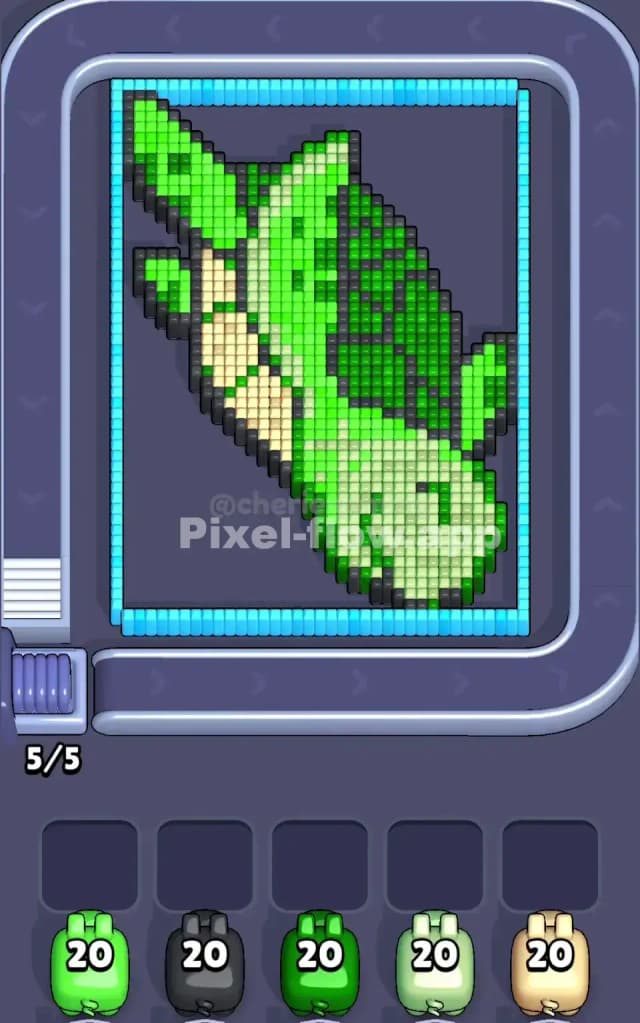
This level features a giant sea turtle swimming diagonally across the board. The main colors here are variations of green—dark green for the shell pattern, bright lime for the body, and pale cream for the underbelly—all wrapped in a thick, light blue border. To beat Pixel Flow 215, you need to peel off that blue border first to access the turtle itself, then carefully dismantle the layered greens without clogging your slots.
Is it difficult? Yes. The color palette is extremely monochromatic. Differentiating between "lime green," "forest green," and "pale green" at high speed makes this a very hard level.
Pixel Flow Level 215 Overview
Imagine a sea turtle gliding through shallow water. The most distinct feature of Pixel Flow Level 215 is the bright light blue frame that boxes the turtle in completely. It’s not just a background; it’s a cage. Nothing inside the turtle can be touched until you break this blue perimeter.
The turtle itself is asymmetric. The head points toward the top-left, and the shell dominates the center and right side. The colors are tricky because they blend together visually:
- Light Blue: The outer "water" frame.
- Dark Grey/Black: The outline of the shell and flippers.
- Forest Green: The heavy shading on the shell.
- Lime Green: The main skin tone on the head and flippers.
- Cream/Beige: The soft underbelly scutes on the left side.
Your biggest danger is the "Green Trap." You will see three different shades of green pigs on the belt. If you grab the wrong shade before its corresponding layer is exposed, that pig will sit in your slot, useless, blocking your flow.
Step by step solution walkthrough for Pixel Flow Level 215
First Color Zone to Erase in Pixel Flow Level 215
The absolute first priority is the Light Blue Border.
Narratively, you have to drain the water to get to the turtle. Logically, this blue border physically blocks almost every other pixel. Look at the top and bottom edges especially. The blue rows are thick and cover the tips of the flippers and the head.
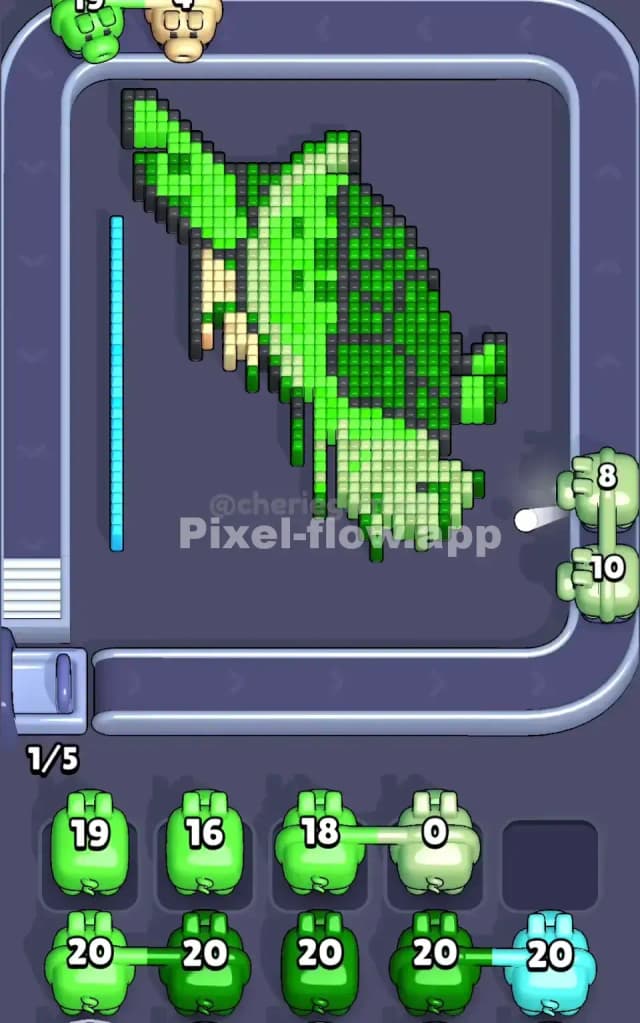
Wait for the Light Blue pigs. Do not touch the green ones yet. If a Green pig comes down the belt, let it pass. If you pick it up now, it will have zero targets and just clog a slot. Focus entirely on clearing that blue rectangle until the turtle’s outline is raw and exposed.
How to pass Pixel Flow Level 215 without power ups or boosters
Once the blue frame is gone, you enter the mid-game grind. The turtle is exposed, but it's covered in a hard Dark Grey/Black outline.
- Target the Outline: Your next best move is usually the Dark Grey/Black pigs. These pixels form the "edge" of the turtle art. Clearing them opens up the inner colors. If you ignore the black outline, the green pigs will often just bounce off or find no valid path to the inner pixels.
- The Green Gradient Problem: Now you have three greens: Forest (dark), Lime (bright), and Pale (head/belly).
- Look closely at the Lime Green (brightest) sections on the head and front flippers. These are often the "highest" layer physically. Prioritize the Lime Green pigs first.
- Avoid the Forest Green pigs until you have cleared significant chunks of the Lime Green. The dark green spots on the shell are often buried under or behind the brighter green pixels.
- The Cream Belly: The beige/cream section on the left is a safe zone. It’s usually distinct and separated from the messy green shell. If you see a Cream pig, grab it immediately. It’s a guaranteed clear that won't conflict with the confusing greens.
If you refuse to use power ups, patience is your only weapon. You might have a slot full of a specific green pig that currently has no targets. Do not panic. Wait for the belt to bring a Black or Cream pig to clear a path. Only discard the useless pig if you are absolutely choked with 4/5 slots full.
Last Details You Clean Up in Pixel Flow Level 215
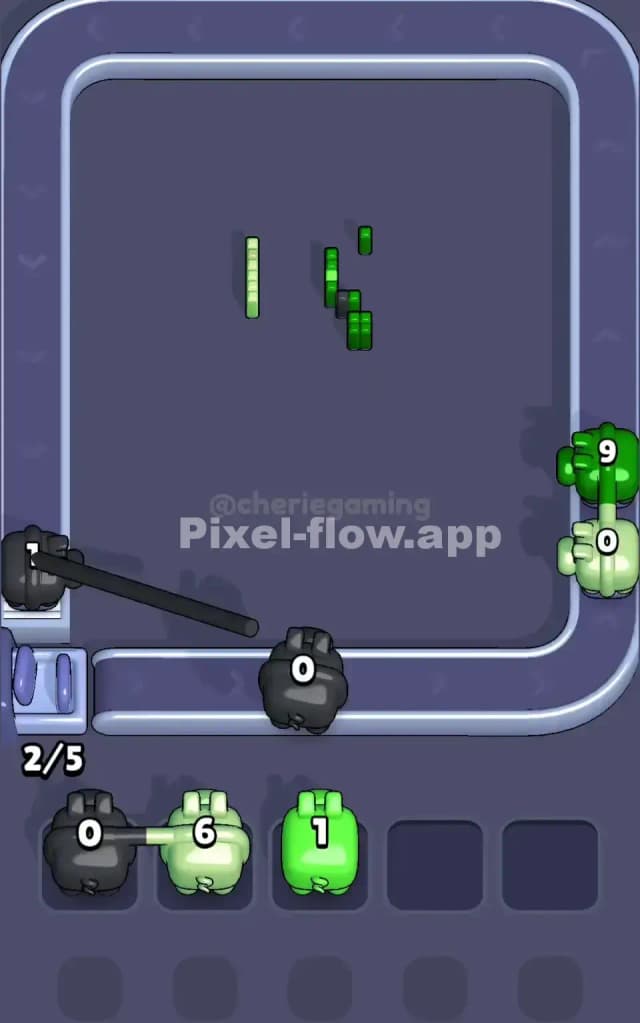
As the level ends, you'll be left with the "deepest" layers of the turtle. Usually, this means the Forest Green patches in the center of the shell and perhaps a few stubborn Black pixels that were hiding underneath the lighter colors.
The visual noise clears up here. You will see isolated clumps of dark green. Now is the time to spam those Dark Green pigs. Be careful of stray pixels near the edges of the screen—sometimes a single black pixel from the tail remains hidden in the corner. double-check the corners before you waste a pig on a color that isn't there. Once the heavy shell is gone, the level is yours.