Pixel Flow Level 218 Solution Walkthrough | Pixel Flow 218

How to solve Pixel Flow level 218? Get instant solution for Pixel Flow 218 with our step by step solution & video walkthrough.

Share Pixel Flow Level 218 Guide:
Pixel Flow Level 218 Gameplay
Pixel Flow Level 218 Solution 1
Pixel Flow Level 218 Solution 2
Pixel Flow Level 218 Solution 3

Pixel Flow Level 218 Overview

The Board Layout and Colors

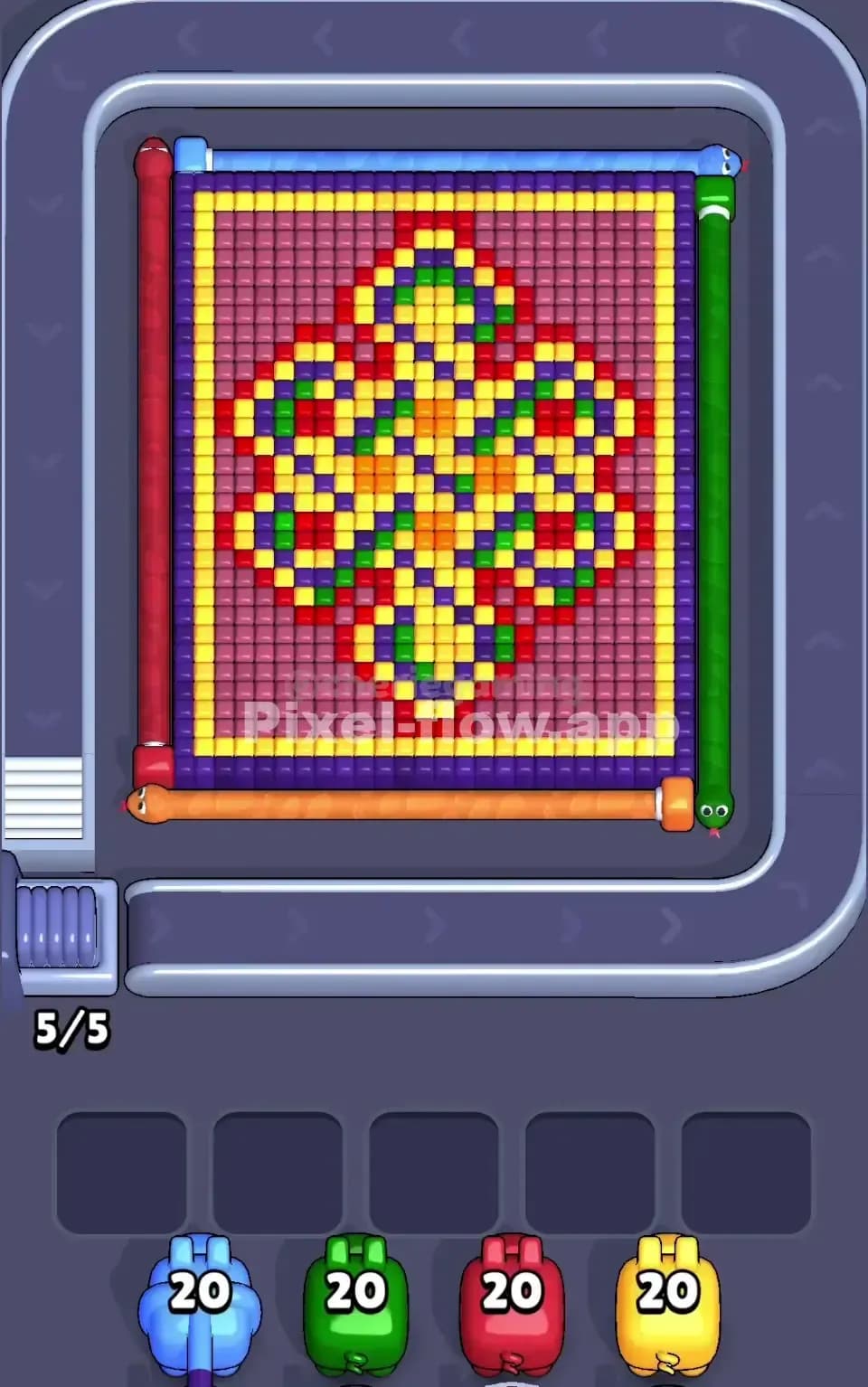
Pixel Flow Level 218 presents you with a charming pixel-art face—think of it as a stylized cat or fox with expressive features. The board is dominated by a rich purple background that forms the deepest layer, with cyan, pink, white, black, and red cubes layering over the top to create the facial details. You'll notice the face's eyes are outlined in black and white, the snout and cheeks are rendered in pink and white, and the ears pop out in cyan and lighter tones. At the bottom of the board, there's a band of red and pink that creates visual depth and serves as a strategic puzzle zone.

Your immediate challenge in Pixel Flow Level 218 is clear: you've got five pigs waiting in the queue, and they're carrying specific ammo loads that you can see at the bottom of the screen. The red pig packs 20 shots, two purple pigs each have 20 ammo, and a white pig rounds out the roster with another 20 shots. Every single cube you see must be destroyed by matching-color pig ammo, and the order in which you deploy these pigs determines whether you'll solve the level smoothly or hit a dead end.

Understanding the Win Condition

Your goal in Pixel Flow Level 218 is to destroy every single voxel cube on the board, revealing the empty purple void beneath. There's no moving pieces around—the pigs automatically shoot their color when they land on the conveyor, and the game's deterministic nature means the same pig order always produces the same outcome. You can't undo moves or reorder the queue, so every decision matters. The waiting slots below the board can hold up to five stuck pigs, and if all five slots fill while pigs still have unspent ammo and nowhere to shoot, you've locked yourself into an unwinnable state. This is why planning ahead isn't optional—it's essential for clearing Pixel Flow Level 218 successfully.

Why Pixel Flow Level 218 Feels So Tricky

The Waiting Slot Bottleneck

The biggest trap in Pixel Flow Level 218 is the red pig at the front of the queue. With 20 shots of red ammo, it's going to deposit a lot of cubes into those waiting slots if there aren't enough red targets visible early on. Looking at the board, you can see a concentrated band of red and pink cubes at the very bottom, but the rest of the visible board is dominated by purple, cyan, pink, white, and black. If you deploy the red pig too early, it'll destroy its chunk of red cubes, but then it'll get stuck in a waiting slot with ammo still unspent. Once the red pig is wedged in there, you've lost one of your five precious buffer slots, and the margin for error shrinks dramatically. This is the critical tension in Pixel Flow Level 218—you need the right sequence to keep slots open and ammo flowing.

Scattered Color Patches and Hidden Layers

The facial features in Pixel Flow Level 218 create an awkward color distribution. The eyes contain clusters of white and black that are separated by cyan and pink zones, making it impossible to clear them all at once. The purple background is extensive, but purple pigs will only appear if they're actually queued, and you'll have to be precise about when you deploy them. There's also the challenge of the cyan patches scattered across the face—some are prominent in the ears and eyes, but others are tucked into transition zones where they're mixed with pink and white. This scattered distribution means you can't just fire pigs blindly and hope for the best; you need to think through which colors will open up new regions as you go.

The Frustration Point (and When It Clicked)

Honestly? Pixel Flow Level 218 stumped me for longer than I'd like to admit. I kept deploying the red pig early because it was first in line, assuming the game would naturally open up red targets. Instead, I'd watch it blow through the bottom band of red, jam itself into a waiting slot, and then I'd be stuck with three pigs still in queue and nowhere for them to go. The breakthrough came when I realized I needed to flip my thinking: instead of reacting to which pig was first, I had to ask, "What color region on the board needs to be cleared first to expose deeper layers and keep slots moving?" That mindset shift—treating Pixel Flow Level 218 like a puzzle of layered colors rather than a race to use pigs in order—made everything click into place.

Step-by-Step Strategy to Clear Pixel Flow Level 218

The Opening: Start with Cyan to Build Momentum

Your first move in Pixel Flow Level 218 should feel counterintuitive—don't send the red pig yet. Instead, pause and study the conveyor queue. I recommend letting the first pig (red) pass into the waiting slots as a deliberate sacrifice if necessary, or better yet, identify where cyan cubes are clustered. The cyan in the ears and upper face creates a natural opening. If cyan is available when a cyan pig surfaces in your queue, deploy it immediately. This strategy achieves two things: it clears a visible color region, and it exposes deeper layers beneath the topmost cyan layer. By maintaining this mindset in Pixel Flow Level 218, you're essentially peeling back the onion, one color at a time, while keeping at least two or three waiting slots empty for safety. The key is discipline—don't panic if the red pig lands in a waiting slot early. A single stuck pig with 20 ammo is manageable if you keep slots open.

Mid-Game: Sequence Pigs to Expose Layers and Park Safely

As you progress through Pixel Flow Level 218, you'll reach a phase where the board starts to look fragmented. The eyes will have some black and white showing, the cheeks will be partially clear, and the red band at the bottom will shrink as you've chipped away at it. This is where precise sequencing becomes critical. Watch your queue carefully: if the second purple pig is coming up and you see purple patches scattered across the middle of the face (beneath the cyan and pink you've cleared), fire that purple pig and let it do its work. As each pig lands and shoots, observe which new colors get exposed. The white layer, for instance, might be hiding beneath pink and black—once you clear those, white becomes a priority. Pixel Flow Level 218 rewards you for thinking two or three pigs ahead. If you're about to place a pig and you can already see that it'll run out of valid targets, consider letting it park in a waiting slot intentionally rather than fighting it. A parked pig with a few remaining shots that lands exactly when a new layer of its color appears is far better than a pig that jams up with 15 unspent shots.

End-Game: Empty the Board Cleanly and Avoid Last-Minute Jams

The final stretch of Pixel Flow Level 218 is where carefulness pays off. By the time you've cleared most colors, your waiting slots should be relatively clear, and you're dealing with the last few pigs in queue and the remaining scattered cubes. Black is often one of the final colors in games like this because it's used for fine details like eyes and mouths—it's relatively sparse. If black cubes remain near the end, a black pig will slice through them quickly and won't clog your slots. Similarly, the white pig should have an easy time in the endgame because white is often mixed with other colors early on and becomes abundant in the final layer. Your last two or three pigs should be able to demolish whatever's left without incident. The critical moment is when you're down to one or two waiting slots remaining and there are still three or four pigs in the queue. At this point in Pixel Flow Level 218, count the remaining cubes of each color visible on the board and mentally align them with your upcoming pigs. If the math doesn't work—like you've got a purple pig coming but no purple cubes showing—you know you're at risk of jamming, and you need to reconsider your prior moves or accept that you might need to restart.

The Logic Behind This Pixel Flow Level 218 Plan

Exploiting Determinism and Ammo Counts

The elegance of Pixel Flow Level 218 lies in its complete determinism. Every pig always has the same ammo count, they always arrive in the same order, and the board is always identical. This means there's a "correct" sequence—a way to line up your pigs so that each one's ammo gets spent on visible cubes and no pig gets stuck. By thinking about the problem as a matching puzzle (pig color to cube color to waiting slots), you're no longer fighting randomness; you're solving a deterministic equation. The red pig's 20 shots might seem daunting, but if you've cleared the pink and cyan layers above the red band, you can unleash the red pig and watch it vanish that entire bottom region. The purple pigs' ammo counts matter less once the purple background is your primary target. Pixel Flow Level 218 wants you to understand that ammo is only a problem if there are no cubes to shoot; if you keep layers exposed, ammo becomes a resource that gets consumed exactly as needed.

Staying Calm and Planning Ahead

The hardest part of Pixel Flow Level 218 isn't the mechanics—it's the mental discipline to pause before each move and count. Before you deposit a pig, ask yourself: "Are there enough visible cubes of this color for the pig's ammo count?" and "How many waiting slots are currently full?" If you've got four slots occupied and a pig that's going to run out of targets, you're one pig away from disaster. However, if you've got three slots clear and a pig with 20 ammo that'll drain to maybe 5 remaining, that pig can park safely while you clear new layers with the next pig in queue. This approach to Pixel Flow Level 218 transforms what feels like chaos into a manageable sequence of decisions. You're no longer hoping the game works out; you're engineering the solution. That sense of control, once you feel it, makes even the trickiest levels feel solvable. Every pig becomes a tool with a specific job, and every waiting slot becomes a temporary holding area that you manage deliberately rather than dreading.