Pixel Flow Level 219 Solution | Pixel Flow 219 Walkthrough
How to beat Pixel Flow Level 219: Video solution & walkthrough. The fastest way to pass Pixel Flow 219.
Is this the wrong level layout?🤔
Pixel Flow randomizes levels for different players. Don't worry, just upload a screenshot of your board, and our AI will find the correct video instantly.

Pixel Flow Level 219 Walkthrough
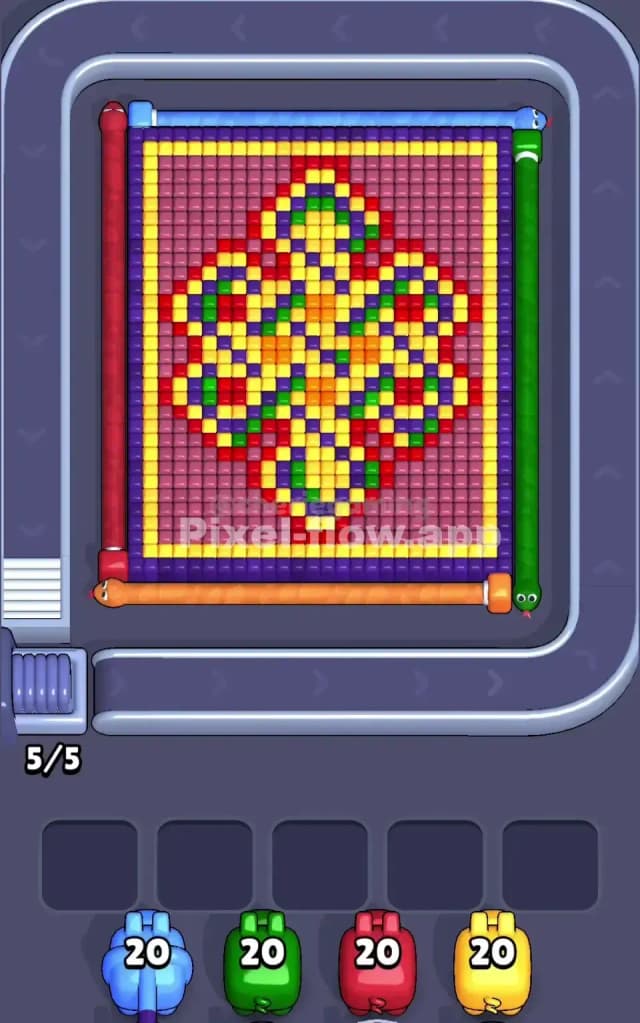
Pixel Flow Level 219 is a fortress disguised as a pixel art rug. You aren't just clearing layers here; you are breaking into a vault. The artwork features a complex, multi-colored Celtic knot pattern buried deep in the center, but you won't see that for a long time. The image is protected by thick outer walls—long, solid bars of Red, Blue, Green, and Orange that run along the four edges of the board.
The rules are strict: you cannot touch the inner picture until you destroy these outer guards. Because the layers are so dense and the starting queue is misleading, I judge this to be a very hard level. You will fail if you clog your slots with colors that cannot hit the outer rim.
Pixel Flow Level 219 Overview
This level creates a claustrophobic feeling. It’s a "Woven Rug" design, totally symmetrical, which usually implies safety. It’s a lie. The artwork is structured like an onion.
- The Guardians: The outermost edge isn't pixels; it's four solid pipes. Blue on top, Green on the right, Red on the left, and Orange on the bottom.
- The Rims: Once the pipes are gone, you face a thick Dark Purple square border, followed by a thinner Yellow square border.
- The Filler: Inside the borders lies a massive, boring field of Pink/Mauve pixels. This is the "fog" hiding the actual level.
- The Core: Finally, the center is a chaotic knot of Red, Yellow, Green, and Purple sparkles.
The visual trap here is the Yellow Pig. In your starting lineup, you will often see a Yellow pig. However, look at the board. There is NO accessible Yellow. The bottom bar is Orange. The inner Yellow rim is shielded by the Purple rim. That Yellow pig is a dead weight until the mid-game.
Step by step solution walkthrough for Pixel Flow Level 219
First Color Zone to Erase in Pixel Flow Level 219
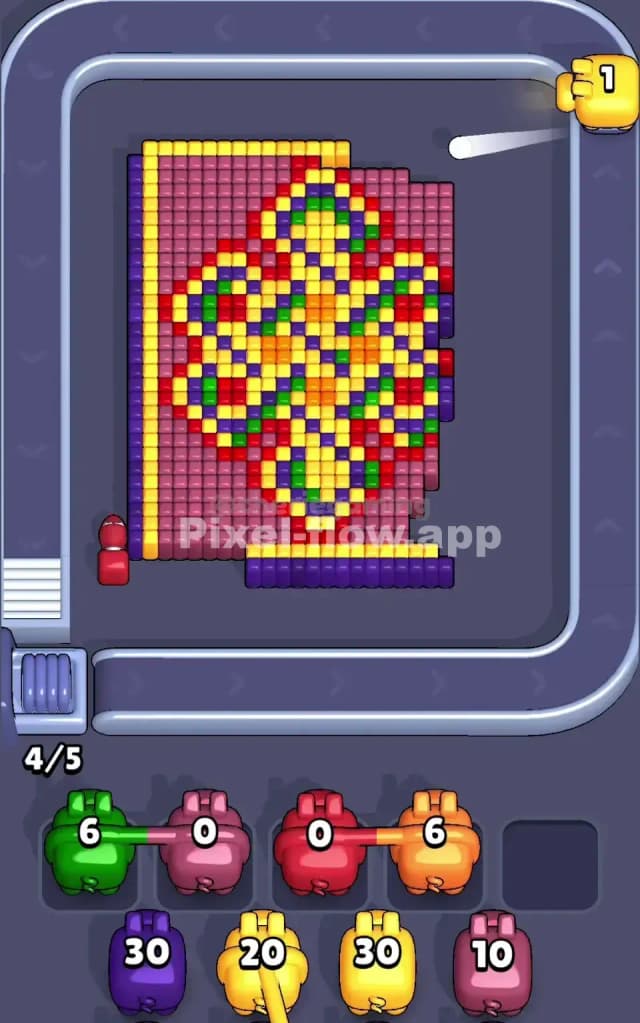
Your priority is breaking the "Cardinal Walls." You must use the Red, Green, and Blue pigs immediately to smash the Left, Right, and Top bars respectively.
This is where the level tries to kill you. You will likely have a Yellow pig in your queue of four. Do not try to force it. There is no target for it. Place it in a waiting slot immediately. You need to cycle through your queue to find an Orange pig (to break the bottom wall) or Purple pigs (to start chipping the outer pixel rim). If you don't clear at least two of the outer walls in the first 30 seconds, the angle of your shots will be too restricted to hit the corners of the Purple rim, and you will effectively soft-lock the game. Focus entirely on the edges. Ignore the center.
How to pass Pixel Flow Level 219 without power ups or boosters
Once the four walls and the Dark Purple rim are destroyed, the game shifts. You are now staring at a giant block of Pink (mauve) pixels that acts as a lid over the center art.
This is the endurance phase. You will get a lot of Pink pigs. Use them aggressively. The Pink layer is "safe" to clear because it touches almost everything. The danger here is getting distracted by the colorful center knot peeking through. Do not try to snipe the specific Red or Green pixels in the center yet. They are often disconnected or blocking each other.
Stick to the "Peeling" strategy:
- Clear the Yellow square rim completely.
- Clear the Pink filler entirely.
- Only then should you worry about the complex knot.
If you have a pig color that matches the center knot (like Green or Red) but the Pink filler is still blocking the path, wait. Let the Pink pigs work first. If you shoot a Green pig into the Pink mass, you waste ammo hitting nothing or getting stuck on a single pixel.
Last Details You Clean Up in Pixel Flow Level 219
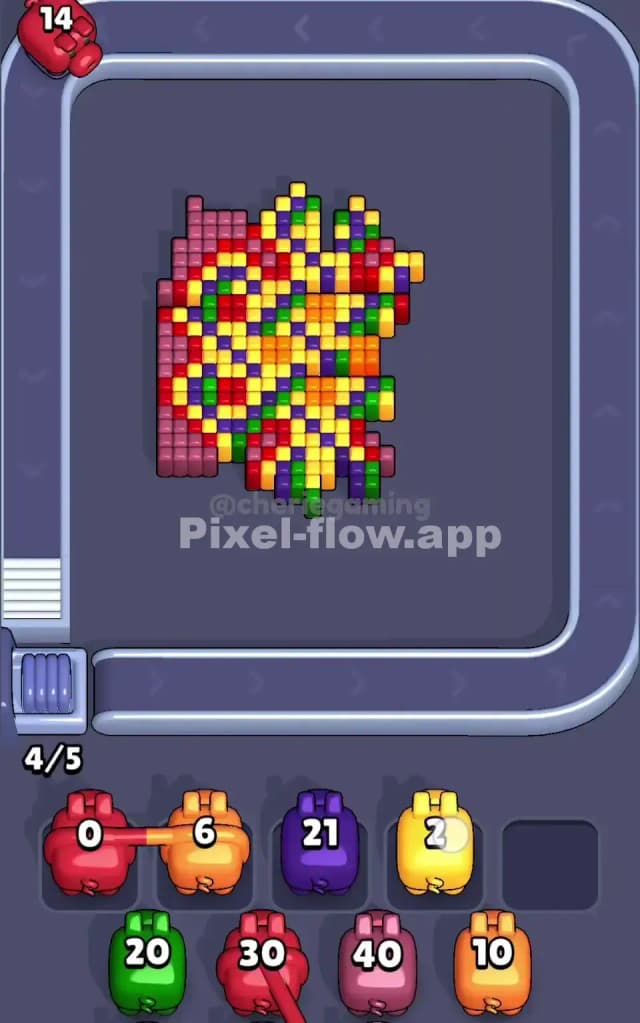
The end-game of Pixel Flow Level 219 is messy. You have removed the rug's borders and filler, leaving a floating, skeletal knot of colors.
The remaining structure is porous. A Red pixel might be hiding behind a Green one. The conveyor belt movement becomes your enemy here. Watch the rotation. You might have a Blue pig ready, but the only Blue pixels are on the far left side, shielded by a stray Yellow block.
Wait for the conveyor to bring your pig to the exact row or column needed. Do not spam shots. Fire one cube at a time to ensure you don't waste ammo on a block that was already destroyed by the previous shot. The last few moves are usually clearing the "intersections" of the knot—where Purple and Yellow blocks alternate in a checkerboard pattern. Keep your waiting slots empty for these specific colors.