Pixel Flow Level 220 Solution | Pixel Flow 220 Walkthrough
How to beat Pixel Flow Level 220: Video solution & walkthrough. The fastest way to pass Pixel Flow 220.
Is this the wrong level layout?🤔
Pixel Flow randomizes levels for different players. Don't worry, just upload a screenshot of your board, and our AI will find the correct video instantly.



Pixel Flow Level 220 Walkthrough
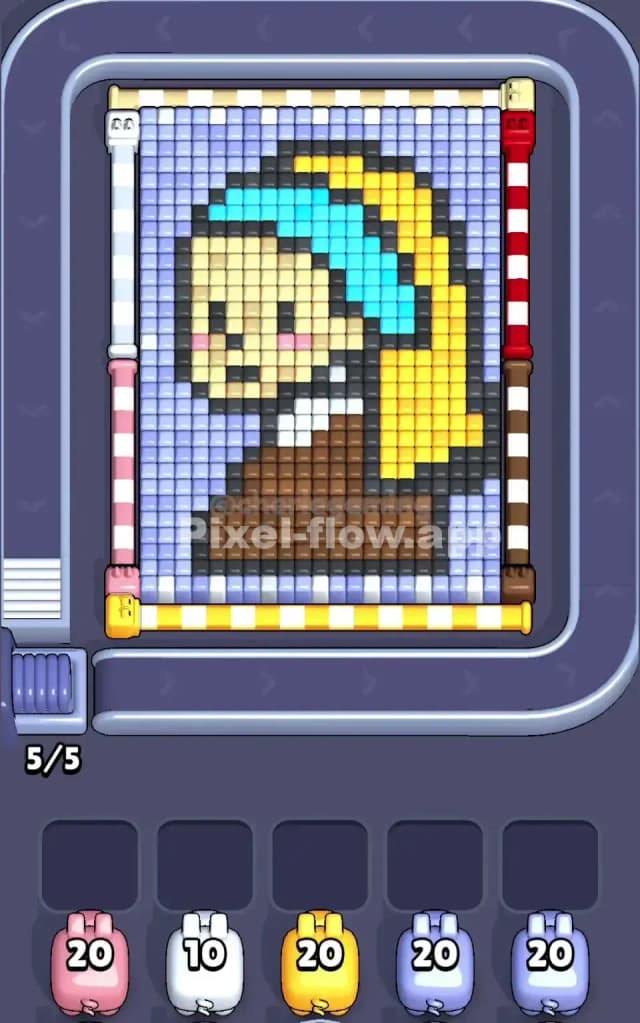
This level features a pixel art recreation of the famous "Girl with a Pearl Earring" painting. The board is dominated by a massive border of Light Purple (Lavender) pixels that act as the background canvas. Inside, you have the figure herself: a Beige face, a Brown jacket, and her iconic turban made of Cyan and Yellow.
The rule for success here is volume management. You need to match pigs with high ammo counts (like 20 or 40) to color blocks that are actually large enough to absorb that ammo. If you deploy a pig with 20 ammo to hit a tiny 2-pixel detail, that pig will sit in your waiting slots forever, blocking your progress. Because of the density of the background and the deceptive ammo counts, I judge this to be a very hard level.
Pixel Flow Level 220 Overview
Imagine the painting is stuck inside a block of lavender ice. That is essentially what you are looking at in Pixel Flow Level 220. The subject is looking over her left shoulder. The left and bottom edges of the board are thick walls of Lavender. The right side is heavy on the Yellow tail of her turban.
The asymmetry here is dangerous. The "meat" of the picture—the face and body—is clumped in the center, protected by black outlines. However, the game gives you high-ammo pigs for colors that appear as tiny details, like the Pink on her cheeks or the White on her collar. This mismatch between "visible paint" and "pig ammo" is the primary way players lose here. You see a Pink pig, you see pink cheeks, you tap. Big mistake. Now you have a pig with 18 ammo clogging a slot.
Step by step solution walkthrough for Pixel Flow Level 220
First Color Zone to Erase in Pixel Flow Level 220
You must prioritize the Light Purple (Lavender) background immediately. Looking at your starting queue, you likely have a Pink pig and a White pig blocking the way, with Light Purple pigs further back.
Do not be afraid to move the Pink and White pigs into the waiting slots just to get them out of the way. Do not expect them to finish their job yet. Your goal is to reach the Light Purple pigs. Once you activate them, they will shred the massive lavender border on the left and bottom. This is critical because the lavender pixels physically block the line of sight to the inner layers of the turban and jacket. Until the background is gone, your other pigs are uselessly firing at shielded blocks.
How to pass Pixel Flow Level 220 without power ups or boosters
Mid-game, the board usually looks like a floating head. The background is gone, leaving the jagged outline of the girl. Now you face the "Ammo Trap."
- The Yellow Turban: You will see Yellow pigs with 20 ammo. Use them immediately. The yellow section of the turban is thick and deep. It will easily consume all the ammo, clearing the pig from the board quickly.
- The Cyan Risk: The bright blue (Cyan) top of the turban is also a safe bet. It’s a solid chunk.
- The Pink/White Trap: This is where you die. In Pixel Flow Level 220, the pink cheeks and white collar look small. However, if you refused to use boosters, you need to be sure there are enough pixels to kill the pig. Usually, the white collar extends deeper than it looks. The pink cheeks do not.
- Strategy: If you have a Pink pig with high ammo clogging a slot, focus on clearing the Beige face pixels around the cheeks. Sometimes, clearing the surrounding face reveals hidden pink pixels underneath or adjacent, allowing that stuck pig to finally empty its clip and leave.
Last Details You Clean Up in Pixel Flow Level 220
The final hurdles are usually the Black outlines and the Brown jacket. The black pixels form a cage around the colors. Often, a Black pig will clear the outline, but because the outline wraps around the whole figure, it takes a long time for the shots to travel.
Watch the corners. The bottom right often hides a stray Brown pixel or a piece of the Black border that is hard to hit from the main conveyor belt angles. Ensure you keep one slot open in the endgame so you can cycle through useless colors to find the specific Brown or Black pig needed to snipe that last voxel. If you cleared the massive Lavender blocks early as recommended, you should have the space to maneuver these final shots.