Pixel Flow Level 227 Solution Walkthrough | Pixel Flow 227

How to solve Pixel Flow level 227? Get instant solution for Pixel Flow 227 with our step by step solution & video walkthrough.

Share Pixel Flow Level 227 Guide:
Pixel Flow Level 227 Gameplay
Pixel Flow Level 227 Solution 1
Pixel Flow Level 227 Solution 2
Pixel Flow Level 227 Solution 3

Pixel Flow Level 227 Overview

The Starting Board and Visual Layout

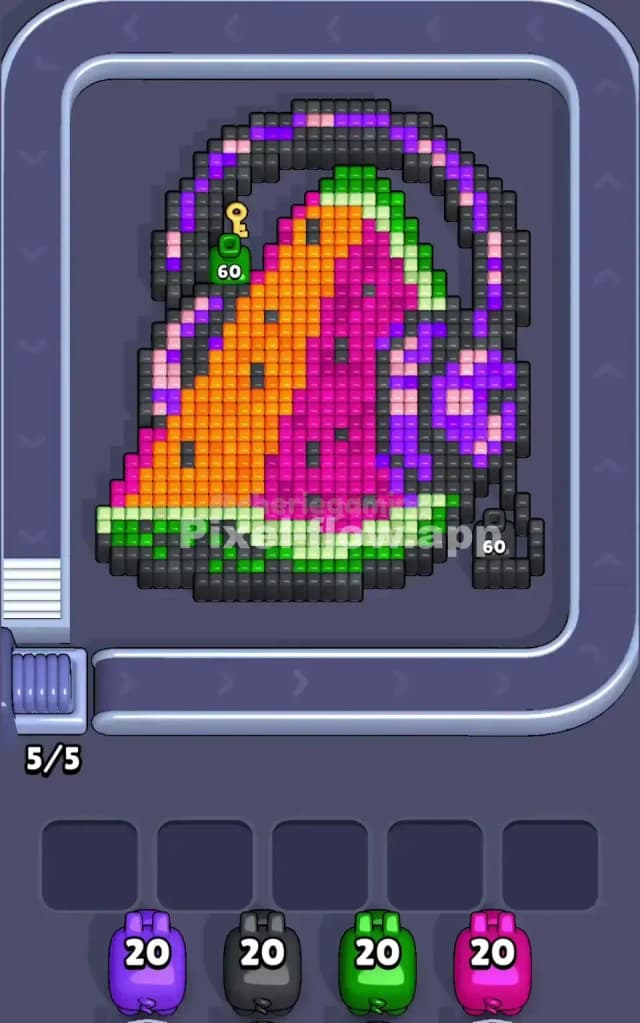
Pixel Flow Level 227 presents a vibrant, layered voxel portrait that demands patience and careful sequencing. The board features a striking character rendered in warm oranges, hot magentas, cool purples, crisp greens, and accent blacks and whites. At first glance, you'll notice that orange and magenta dominate the center of the composition, creating a dense, interlocking mass that forms the visual heart of the puzzle. The purple and green cubes frame the edges and fill strategic pockets, while black voxels act as a shadowy border that holds everything in place. This multi-layered structure means you're not just clearing colors randomly—you're excavating a pixel art image from the outside in, exposing new colors as you work deeper.

Understanding the Win Condition and Deterministic Nature

To clear Pixel Flow Level 227, you must eliminate every single voxel cube on the board. Your four pigs arrive in a fixed sequence with predetermined ammo counts: purple (20), black (20), green (20), and magenta (20). Every matching cube you destroy spends exactly one unit of ammo, and when a pig runs out of ammo or has no valid targets remaining, it drops into one of your five waiting slots. The beauty—and the trap—of Pixel Flow Level 227 lies in its determinism. The puzzle isn't random; it's a logic game where pig order and ammo alignment are fully predictable. Once you understand which pigs feed which colors and when to deploy them, you're halfway to victory.

Why Pixel Flow Level 227 Feels So Tricky

The Magenta-Orange Bottleneck

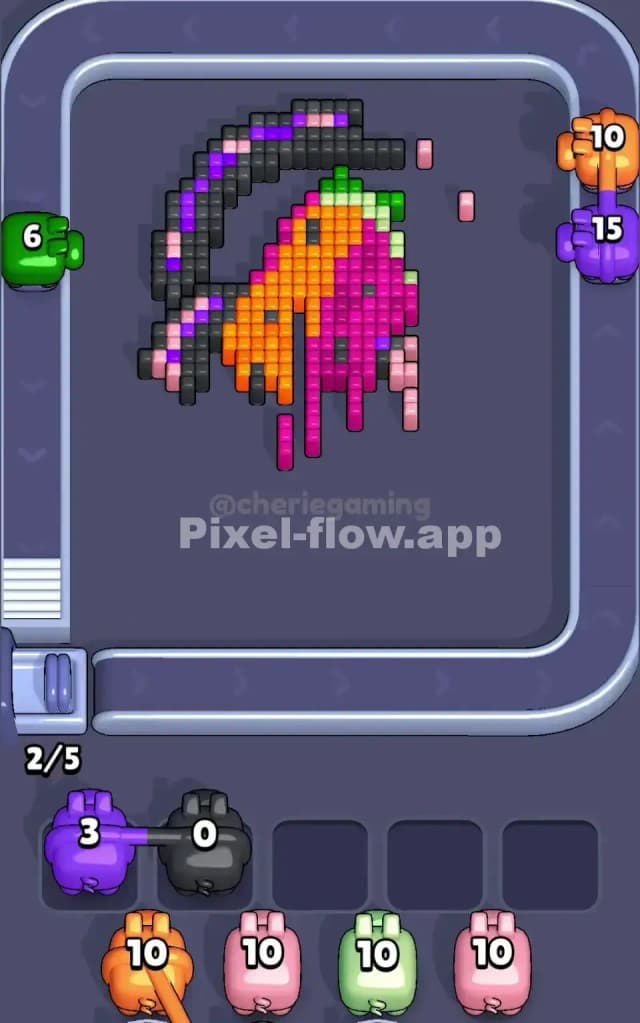
The biggest threat in Pixel Flow Level 227 is the massive magenta-orange cluster that dominates the board's center. Magenta arrives last in your pig queue, which means you can't simply blast away at it first. Instead, you need to clear enough surrounding cubes to expose deeper layers and prevent your earlier pigs from becoming trapped. If you're not careful, you'll fill up all five waiting slots with pigs that still have ammo but no valid targets left—and when that happens, you've failed. The magenta pig's 20 ammo count is generous, but it's useless if there are no magenta cubes exposed when it finally rolls onto the conveyor belt. This creates a psychological pressure: you know magenta is coming, but you can't force it to shoot until the board state permits it.

The Purple-Edge Problem and Scattered Targets

Purple arrives first with 20 ammo, and while there are definitely purple cubes on the board, they're scattered around the perimeter rather than clustered in one convenient zone. This means your purple pig will likely consume all its ammo quickly, but then it'll have no targets left and will park itself in a waiting slot. The danger is that if you don't plan ahead, you might find yourself with three of five waiting slots filled before you've even dealt with the interior colors. The black and green pigs also struggle with similar fragmentation: their targets are real, but they're distributed across the composition in a way that doesn't match up neatly with the sequence in which they arrive.

The Personal Frustration and the "Click" Moment

I'll be honest—my first dozen attempts at Pixel Flow Level 227 felt like I was flailing. I'd clear some purple edges, watch the black pig drop into a waiting slot almost immediately, and then panic as the green pig followed suit. It felt like the puzzle was conspiring against me, as if no matter what I did, I'd jam up the buffer. The turning point came when I stopped thinking about clearing specific colors and started thinking about exposing new colors. Once I realized that my job wasn't to exhaust each pig's ammo greedily, but to strategically sequence them so that each arrival found a board state rich with valid targets, the level suddenly made sense. Pixel Flow Level 227 isn't trying to trap you—it's asking you to think ahead.

Step-by-Step Strategy to Clear Pixel Flow Level 227

Opening: Establishing Control and Preserving Waiting Slots

Your opening move in Pixel Flow Level 227 should prioritize the purple edges without overcommitting. Let your purple pig shoot the purple cubes on the board's left, right, and upper perimeter—but don't chase every single purple target obsessively. The goal is to use roughly 12 to 14 of purple's 20 ammo to expose the architecture underneath while still leaving purple with a few targets remaining. This way, when purple drops into a waiting slot (as it inevitably will), it does so with ammo still in reserve, which gives you flexibility later. Keep at least three or four waiting slots completely empty at this stage. The pressure to fill those slots will mount as your queue advances, so starting conservatively means you're not gambling on luck to save you near the end.

Mid-Game: Layering Pigs and Exposing Deep Colors

Once black enters, direct it toward the black voxels that frame the board's outline and fill small gaps. Black's 20 ammo is substantial, and the black cubes are plentiful, so your black pig should have plenty to shoot. The key insight for Pixel Flow Level 227 at this stage is that destroying black cubes often exposes the magenta and orange core beneath. Black isn't just removing obstacles; it's architecting the board state for your later pigs. As black finishes, you might find yourself with two pigs waiting (purple and black). That's acceptable. Now green arrives, and this is where Pixel Flow Level 227 requires careful navigation. Green has 20 ammo and should focus on the green voxels scattered across the upper edges and right side. However, by the time green enters, you'll likely see that earlier pigs have destabilized the structure. Green's job is to finish those green targets without overcommitting, leaving room for magenta to dominate the end-game. If you can engineer green to drop into a waiting slot with 5 or more ammo remaining, you've preserved options.

End-Game: The Magenta Finale and Avoiding Last-Second Jams

This is where Pixel Flow Level 227 becomes a test of foresight. Magenta arrives last and carries 20 ammo. By this point, you should have cleared most non-magenta colors, leaving a board dominated by that hot pink-purple core. Magenta should have an abundance of targets and should be able to spend its entire ammo reserve without difficulty. However, watch your waiting slots carefully. If you enter the magenta phase with all five slots full and three or more pigs still carrying ammo, you're in trouble. Magenta can only squeeze in if at least one slot opens up. The final sequence requires you to exhaust whichever waiting-slot pigs have remaining ammo before magenta's shots run dry. A common failure pattern in Pixel Flow Level 227 is reaching the end with green or black still in a waiting slot, both holding ammo and blocking magenta's entry when there's still work to be done. Plan to have just one pig waiting by the time magenta rolls up, so magenta can act as the cleanup crew without obstruction.

The Logic Behind This Pixel Flow Level 227 Plan

Exploiting Ammo Counts, Pig Order, and Waiting Slots

The strategy for Pixel Flow Level 227 works because it respects three unchanging factors: the pigs arrive in a fixed order, each pig has a fixed ammo cap, and you have exactly five waiting slots. Rather than viewing your pigs as tools to greedily exhaust, think of them as careful servants of a master plan. Every pig should be released with the understanding that it will eventually sit in a waiting slot, and that slot is finite and precious. By front-loading your earlier pigs with conservative ammo spending, you ensure that by the time magenta—the color that dominates Pixel Flow Level 227—arrives, the board is primed for rapid-fire destruction. This isn't luck; it's deterministic planning. You're not hoping magenta finds targets; you're architecting the board so targets are unavoidable.

Staying Calm, Counting Ammo, and Planning Ahead

Mastering Pixel Flow Level 227 comes down to cultivating a patient, forward-thinking mindset. Before you send any pig onto the conveyor belt, count the visible cubes of its color. Ask yourself: "How many of those cubes will still be exposed three pigs from now?" Watch your waiting slots like a hawk—they're your most precious resource. When you're two or three pigs ahead in your head, simulating where each will shoot and where it will park, you're no longer reacting to the board; you're choreographing it. Pixel Flow Level 227 rewards this kind of deliberate play. The moment you stop rushing and start planning, the solution emerges from the noise.