Pixel Flow Level 236 Solution Walkthrough | Pixel Flow 236
How to solve Pixel Flow level 236? Get instant solution for Pixel Flow 236 with our step by step solution & video walkthrough.


Pixel Flow Level 236 Overview
The Board Layout and Subject Matter
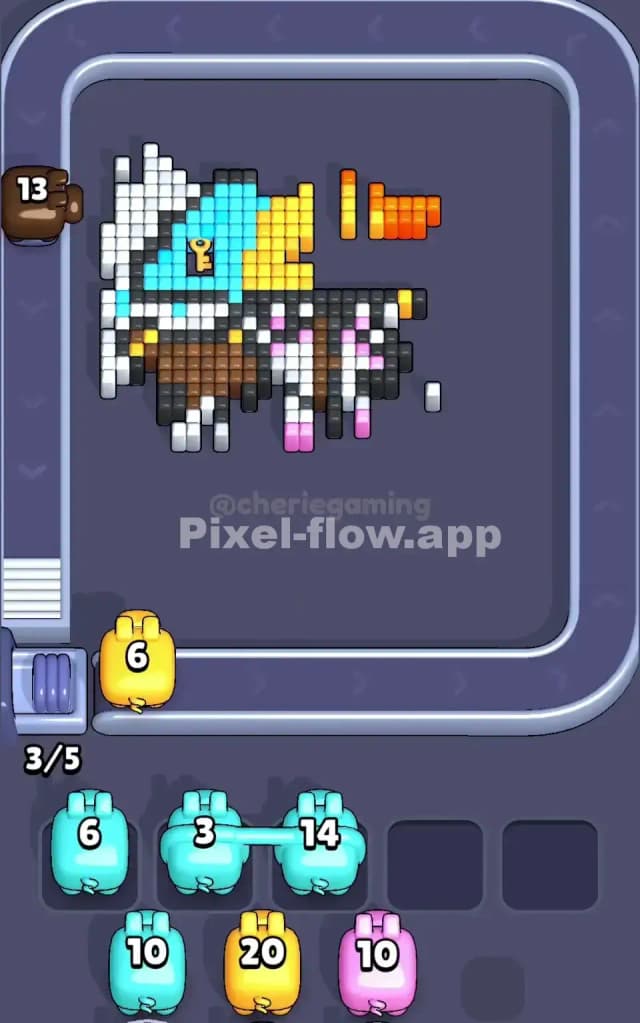
Pixel Flow Level 236 features a charming pixel-art scene of a house by the beach. The main subject is a cozy dwelling with a bright orange and yellow roof that dominates the upper portion of the board, complete with a cyan-colored sky above it. Below the house sits a brown structure (the main building walls), surrounded by decorative elements like pink flowers, white trim accents, and a cyan ocean at the bottom of the composition. The board is densely layered with multiple colors stacked on top of each other, which means you're not just clearing one surface—you're peeling back layers to expose deeper cube colors as you progress.
The visible color palette includes cyan (sky and water), yellow and orange (roof), brown (house walls), pink (flowers), white (trim and details), and black (outlines and shadows). Each of these colors appears in both the foreground and background, creating a complex puzzle where your pig order and ammo management directly determine whether you can expose all the hidden layers beneath.
Win Condition and Deterministic Nature
Your goal in Pixel Flow Level 236 is straightforward: clear every single voxel cube on the board. You have five pigs queued at the bottom—each with a fixed ammo count and a predetermined color. The beauty of Pixel Flow 236 is that the pig sequence and their ammo values never change; every attempt follows the same order and ammunition allocation. This deterministic nature means there's always a winning path if you sequence your moves correctly. You're not fighting randomness here—you're solving a puzzle with known variables, which makes strategic planning both possible and necessary.
Why Pixel Flow Level 236 Feels So Tricky
The Bottleneck: Managing Five Waiting Slots
The biggest threat in Pixel Flow Level 236 is filling up your five waiting slots without a viable clearing strategy. You can see right now that you have four pigs in queue: cyan (20 ammo), white (20 ammo), cyan (20 ammo), and black (20 ammo). If you call them carelessly, they'll land in the waiting slots and refuse to move until their matching color appears on the board. Once all five slots are full and you still have pigs with ammo that don't match any remaining cubes, you've jammed yourself into an unwinnable state. The panic sets in fast when you realize you've locked three pigs in the buffer with nowhere to aim, and suddenly that 20-ammo pig becomes a permanent anchor dragging you toward failure.
The Pink and White Puzzle in the Middle
One of the sneakiest problem spots in Pixel Flow Level 236 is the pink flower cluster scattered throughout the middle and lower-middle sections of the house. Pink cubes are few and far between compared to the cyan and brown that surround them, and they're sandwiched between multiple other colors. You might think you're making progress clearing yellow and orange from the roof, but then you'll discover that pink blocks are preventing access to deeper layers. If you don't plan ahead, you'll call a pig that has no pink targets and watch helplessly as it slides into a waiting slot, wasting precious moves and eating up your buffer space.
The White Trim Trap
White cubes appear scattered as decorative trim across the house outline and windows. They're not as numerous as cyan or brown, but they're just common enough to be annoying. The white pig arrives third in your queue with 20 ammo, and if you haven't exposed enough white cubes by that point, you'll be forced to park it in a waiting slot. This creates a domino effect where your later pigs get backed up, and suddenly you're juggling four stuck pigs with nowhere to go. I remember the first time I hit this trap—I'd cleared the roof too greedily without exposing the window details, and I watched the white pig land in slot three with a sinking feeling in my stomach.
When It Clicked
For me, Pixel Flow Level 236 "clicked" when I realized I needed to think backwards from the end state. Instead of asking "What can I clear right now?" I started asking "What colors do I absolutely need to clear to unlock the pink and white sequences?" That mental shift transformed the level from frustrating to manageable. Suddenly the sequencing made sense: you can't afford to jam your waiting slots, so you need to expose target colors methodically before calling each new pig.
Step-by-Step Strategy to Clear Pixel Flow Level 236
Opening: Set Up Your Color Exposures
Start by calling the first cyan pig. You've got 20 ammo, and cyan is everywhere on this board—it forms the sky, the ocean, and scattered accent tiles throughout the composition. Your job right now isn't to obliterate every cyan cube; it's to be surgical. Target cyan cubes that block access to other colors, especially those surrounding the pink flower cluster in the middle. Spend roughly 10–12 of your cyan ammo on cubes that "unlock" deeper layers. Leave at least 2 waiting slots free at this stage; you're testing the waters and gathering intelligence about what lies beneath.
After the first cyan pig finishes or gets parked (if you've run out of visible targets), you're ready for the white pig. White appears as trim and window details. Don't spray it randomly—focus on white cubes that sit adjacent to pink or yellow sections. You want to expose the interior structure of the house so that subsequent pigs have clear sightlines to their targets. The white pig's 20 ammo should be used to remove trim edges and reveal what's hiding behind them. Again, keep at least one waiting slot open when this pig finishes.
Mid-Game: Expose Layers and Manage the Buffer
Now you've got your second cyan pig incoming, and by this point, you should have a clearer picture of where the pink cubes are clustered. The second cyan pig is your chance to be more aggressive with cyan cubes that sit on top of pink or brown sections. With 20 ammo in your second cyan pig, you can afford to clear a substantial chunk of the sky and upper water areas while simultaneously peeling back layers to expose pink. Aim for cyan cubes that sit directly above pink flowers; this removes obstacles and creates clear targets for later pigs.
Here's where patience becomes critical: if your second cyan pig runs out of targets before burning all 20 ammo, park it in a waiting slot and let the black pig have its turn. The black pig (20 ammo) represents your dark outlines and shadows—the structural framework that defines the house. Black cubes often sit as borders and accents around other colors. Use this pig to clear black cubes that are blocking access to pink, yellow, or brown sections. The black pig is your "cleaner"—it removes visual noise and scaffolding, making room for the remaining pigs to work efficiently.
By the mid-game phase, you should have exposed most of your pink targets. If you've done this correctly, your waiting slots should have one or two pigs parked, but no more. You're maintaining breathing room for future calls.
End-Game: The Final Color Sequence and Clean Finish
As you near the end of Pixel Flow Level 236, you should have the house structure largely exposed. Your remaining pigs need to focus on orange, yellow, brown, and any remaining pink and white cubes. Call pigs strategically to maximize ammo efficiency. If you've got an orange pig remaining, make sure you've exposed all orange cubes before calling it—there's nothing worse than a fully-loaded pig with nowhere to aim.
Your final moves should feel almost peaceful. By this stage, you've cleared the sky, the roofline details, the main structure, and the flower accents. What remains should be easily visible: scattered brown cubes from the walls, maybe some final water cubes at the bottom, and a few stray colors that you've been saving for last. Empty your waiting buffer by calling pigs whose colors are on the board. If you've managed your ammo correctly, you'll watch the last few cubes vanish, and the level will clear cleanly with no jammed pigs left behind.
The Logic Behind This Pixel Flow Level 236 Plan
Why Order and Ammo Matter More Than You Think
Pixel Flow Level 236 succeeds or fails based on one fundamental principle: your pigs are predetermined, and their ammo is fixed. You can't change the sequence or request a different color. What you can do is time when each pig enters the board, which determines what targets are available to them. By calling pigs in a deliberate order rather than reflexively, you're essentially solving a constraint satisfaction problem. The cyan pig's 20 ammo works perfectly if you've exposed cyan targets, but it becomes wasted if you call it too early or too late. The same applies to every other pig in your queue. This deterministic framework means that Pixel Flow Level 236 has a correct solution waiting to be found; you're not gambling—you're engineering.
Staying Calm, Counting Ammo, and Planning Ahead
The psychological game in Pixel Flow Level 236 is staying composed when you feel the pressure of limited waiting slots. Every time a pig lands in the buffer without a target, your anxiety spikes a little. The antidote is simple: watch your queue constantly and count ammo before calling the next pig. Before you press a pig to enter, ask yourself: "Are there visible cubes of this color on the board right now?" If the answer is yes, proceed. If it's no, wait. Expose new colors first, then call the pig. This rhythm—anticipate, expose, call—prevents the catastrophic buffer jam that kills most Pixel Flow Level 236 attempts.
Additionally, plan two or three pigs ahead. Glance at your queue and think about what the next three colors will need. If you see that cyan and white are coming back-to-back, make sure you've exposed enough cyan and white cubes to keep both of them active. This forward-thinking approach transforms chaos into choreography. You're no longer reacting to the board; you're orchestrating the pigs like a conductor leading a symphony. When you hit that final clearing move in Pixel Flow Level 236, you'll feel the satisfaction of a puzzle solved, not a level won by luck. That's the mark of true mastery.