
Pixel Flow Level 248 Solution | Pixel Flow 248 Walkthrough
How to beat Pixel Flow Level 248: Video solution & walkthrough. The fastest way to pass Pixel Flow 248.
Is this the wrong level layout?🤔
Pixel Flow randomizes levels for different players. Don't worry, just upload a screenshot of your board, and our AI will find the correct video instantly.


Pixel Flow Level 248 Overview
The Board and Its Visual Challenge
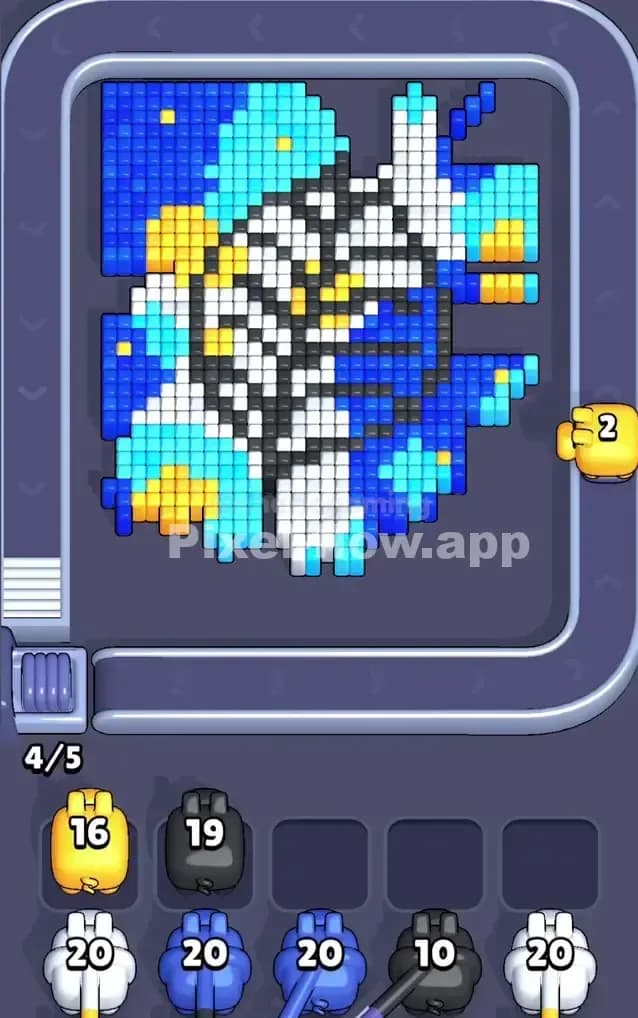
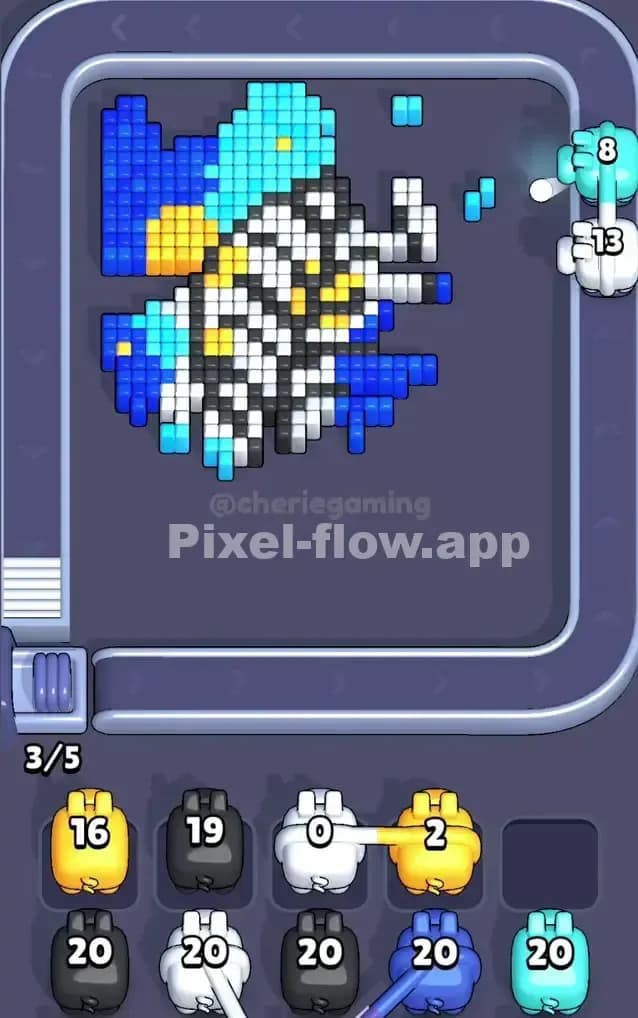
Pixel Flow Level 248 presents a striking pixel art image of a stylized face or mask, rendered across multiple color layers. The dominant colors are deep blue (forming the background and large sections), cyan (creating mid-tone details and highlights), white (defining facial features and structure), yellow (accent spots and smaller detail areas), and black (outlines and fine contours). What makes Pixel Flow Level 248 particularly tricky is that the white and black layers sit prominently in the center, creating a visual "dense zone" that demands careful sequencing to unravel. The board feels layered, with the blues and cyans forming thick outer shells while the central white and black sections create a bottleneck—you can't simply blast through one color and expect smooth progress.
Win Condition and Determinism
To beat Pixel Flow Level 248, you must clear every single voxel cube from the board. The five color-coded pigs at the bottom—black (20 ammo), blue (20 ammo), white (20 ammo), yellow (20 ammo), and cyan (20 ammo)—will shoot in the order they arrive at the conveyor. Each pig automatically targets cubes matching its color and spends one ammo per cube destroyed. What's reassuring about Pixel Flow Level 248 is that the pig order and ammo counts are completely deterministic; once you know the sequence, you can plan exactly which colors to expose and when. There's no randomness—only strategy and patience.
Why Pixel Flow Level 248 Feels So Tricky
The Central Bottleneck
The biggest threat in Pixel Flow Level 248 is the white and black section dominating the middle of the board. Both colors are sandwiched between outer layers (blues and cyans), meaning you can't shoot them until you've exposed them by clearing surrounding cubes first. Here's the real danger: if you don't strategically clear those outer layers in the right order, you'll end up with three or four stuck pigs in your waiting slots, all demanding targets that aren't yet visible. Once all five slots fill with pigs that have nowhere to shoot, the level fails immediately. That's why Pixel Flow Level 248 punishes hasty play—you need to think two moves ahead and ensure at least one color remains partially exposed so incoming pigs don't jam up.
Awkward Color Patches and Hidden Layers
Cyan is spread across the board in several isolated pockets, making it hard to know exactly when the cyan pig will run out of ammo. Similarly, yellow appears in small accent clusters, not as one contiguous region. This fragmentation means that even if you clear most cyan early, a few scattered cubes might linger in hard-to-reach spots, forcing your cyan pig into a waiting slot earlier than expected. Additionally, the black outlines weave through the white section unpredictably. In Pixel Flow Level 248, the black and white pigs are your real problem children—their ammo counts (20 each) sound substantial, but the visual complexity means you might expose all available white cubes before the white pig arrives, leaving it stranded with ammo but no targets.
The Moment It Clicked for Me
Honestly, Pixel Flow Level 248 frustrated me on my first five attempts. I kept bulldozing through blues and cyans, thinking I'd expose white and black automatically. Instead, I'd finish all the blues, only to watch the white pig arrive with a full magazine and absolutely nothing to shoot at. The level "clicked" when I realized I needed to hold back early, deliberately leaving a few blue or cyan cubes so that pigs arriving later would have something to do. It's a mental shift—instead of "clear as much as possible," it's "clear in the right sequence." That perspective change made Pixel Flow Level 248 suddenly manageable.
Step-by-Step Strategy to Clear Pixel Flow Level 248
Opening: Expose the Center Without Jamming
Start by targeting the outer blue cubes, but do it selectively. Let your first blue pig (20 ammo) eliminate blues in the upper and lower corners, working inward but deliberately avoiding a complete blue wipeout. Your goal is to expose cyan and yellow pockets without yet touching the white and black core. Why? Because if you clear all blues on your first pass, the cyan pig arrives next and has too many targets, burns through its ammo, and the white pig shows up to an already-exposed board with dwindling cubes. Instead, use your opening to expose maybe 60–70% of the blues, keep 2–3 waiting slots free, and prepare the board so that cyan has a natural stopping point. Think of Pixel Flow Level 248 like peeling an onion—remove layers gradually, not all at once.
Mid-Game: Sequencing Pigs and Exposing Inner Layers
Once blues are partially cleared, unleash cyan to hit the newly visible cyan patches. The cyan pig should consume most of its 20 ammo on exposed cubes, but again, don't aim for 100% completion on your first pass. Watch the waiting slots; if you've got three pigs queued and only one slot left, you must leave enough targets for the next incoming pig or it'll jam. After cyan, your black pig should arrive next—it's the perfect pig to target the outline layer and start separating the white section from the surrounding material. Black has 20 ammo and the black cubes form a natural skeleton throughout Pixel Flow Level 248, so the black pig usually has plenty of targets without ever getting stuck. Use this pig to carve out the white section's borders, but leave the interior white cubes intact until the white pig is actually on the board. Yellow is your wildcard; it's scattered enough that you can use yellow strategically to break up remaining cyan or blue islands without worrying too much about sequence. By the mid-game phase, you should have cleared roughly 60% of Pixel Flow Level 248, with a clear sense of which colors are still waiting and how much ammo each remaining pig needs.
End-Game: Finishing Clean Without a Last-Second Jam
In the final stretch, you're managing the last pigs (usually white and any remaining blue/cyan) to cleanly empty the board. Here's the critical move: by the time the white pig arrives, the white cubes should be mostly exposed and ready for execution. The white pig's 20 ammo should map almost perfectly to the remaining white cubes on the board. If you've sequenced correctly, white finishes its job, the yellow pig cleans up any remaining strays, and the final pig (often blue or cyan) mops up any hidden pieces. The absolute worst scenario in Pixel Flow Level 248 is reaching the last two pigs with both waiting slots full and five mismatched cubes left over. To avoid this, as you approach the end, count ammo and cubes obsessively. If the white pig has 8 ammo left but only 7 visible white cubes, you know you're safe—one ammo will go unused, but the pig won't jam. If the reverse is true (9 white cubes, 8 ammo), you've made a sequencing error earlier and might need to restart.
The Logic Behind This Pixel Flow Level 248 Plan
Exploiting Determinism and Slot Management
The strategy above works because Pixel Flow Level 248 is entirely deterministic. You're not fighting randomness; you're solving a puzzle with a known sequence. By controlling when you expose each color, you dictate when each pig arrives and ensure it has targets waiting. The five waiting slots are your pressure valve; as long as you keep at least one empty and manage ammo carefully, you'll never jam. This is the key insight: most players fail Pixel Flow Level 248 because they treat it like a fast-paced action game, rushing to clear colors. In reality, it's a planning puzzle where slower, more deliberate moves yield success. Count the visible cubes of each color before each pig arrives, then predict whether that pig's ammo will match the board state. If it won't, adjust your strategy on the previous pig.
Staying Calm and Playing Two Pigs Ahead
The final ingredient is mental discipline. Watch the incoming queue of pigs constantly and always think two moves ahead. "If the blue pig clears these cubes, the white pig will arrive with this board state—will it jam?" This forward-thinking prevents panic moves and last-second disasters. Pixel Flow Level 248 rewards patience and planning over speed. Trust the deterministic sequence, manage your waiting slots, and match ammo to cubes with precision. Follow this philosophy, and Pixel Flow Level 248 will fall into place.