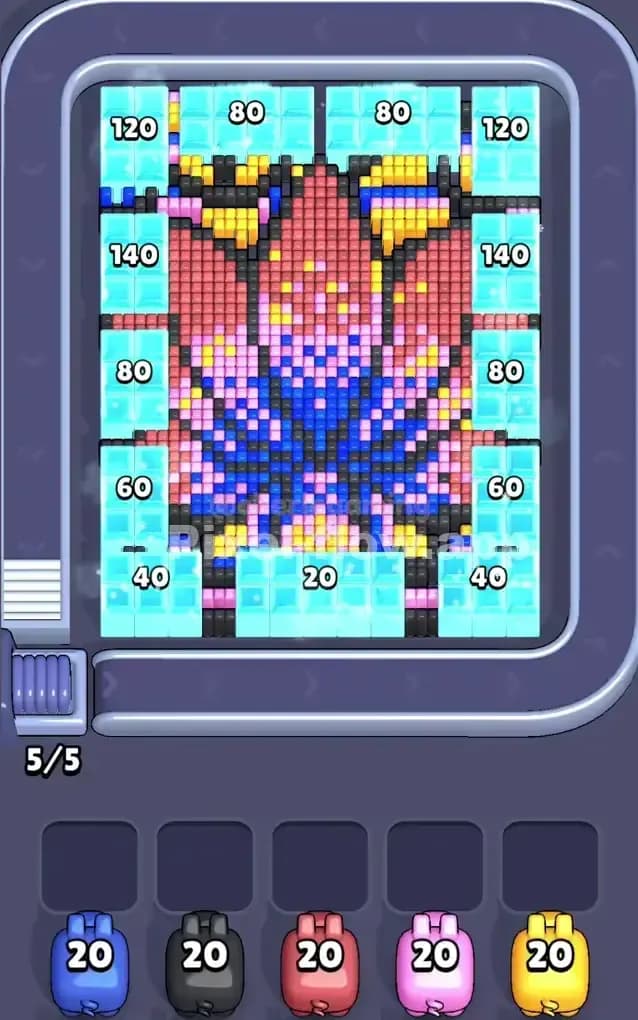
Pixel Flow Level 275 Solution | Pixel Flow 275 Walkthrough
How to beat Pixel Flow Level 275: Video solution & walkthrough. The fastest way to pass Pixel Flow 275.
Is this the wrong level layout?🤔
Pixel Flow randomizes levels for different players. Don't worry, just upload a screenshot of your board, and our AI will find the correct video instantly.


Pixel Flow Level 275 Walkthrough
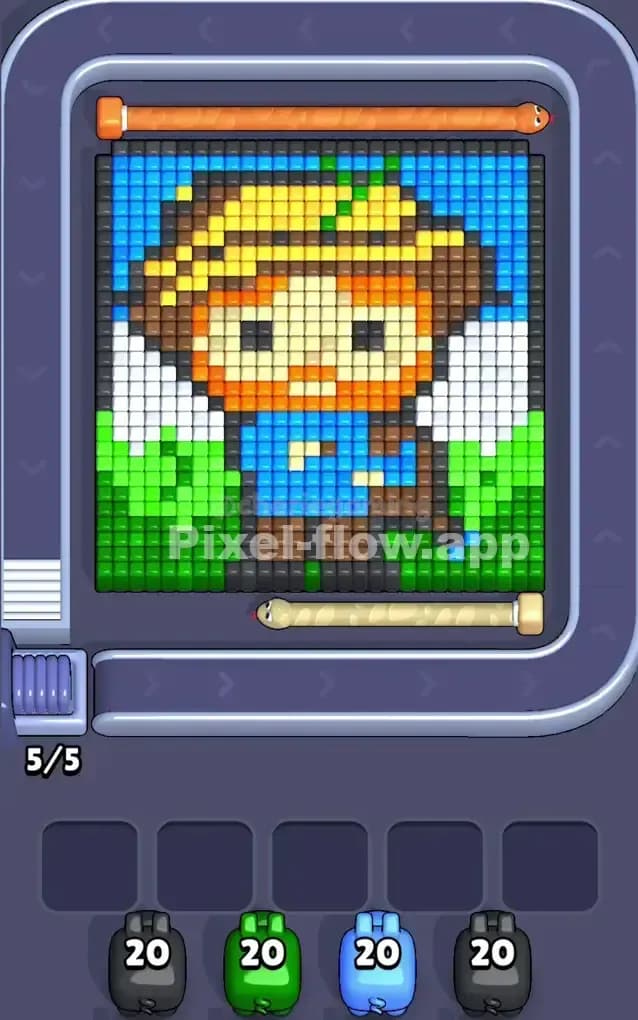
This level features a portrait of a bearded character—resembling a farmer or perhaps a famous painter—standing in a field. The image is dense. You have a massive block of green grass at the bottom, a solid blue sky up top, and white blocks flanking the character that look like clouds or wings. The character wears a yellow straw hat and a blue shirt.
You beat Pixel Flow Level 275 by peeling it like an onion. You must strip the background (sky and grass) first, then the character's outline, and finally the face itself. Because the layers are thick and the color palette is wide, the risk of clogging your slots is high. It is a very hard level.
Pixel Flow Level 275 Overview
Imagine a pixelated Vincent van Gogh standing in a sunny field. That’s your target. The center of the board is dominated by his face, framed by a bright Orange beard and a Yellow straw hat with a dark band. He wears a bright Blue shirt.
The background is simple but dangerous. The top third is almost entirely Cyan/Light Blue sky. The bottom third is solid Green grass. On the left and right edges, you have large patches of White.
The image is visually heavy on the bottom. The Green section is a solid "floor" of blocks. If you ignore this floor, you block your access to the character's feet and lower torso. The Black outline is also critical here; it wraps around the entire figure, separating the man from the background.
Step by step solution walkthrough for Pixel Flow Level 275
First Color Zone to Erase in Pixel Flow Level 275
I start by attacking the Green grass and the Black border immediately.
Looking at your starting queue, you likely have Black and Green pigs ready to go. This is a gift. The Green zone at the bottom is a massive, uninterrupted chunk. Sending a Green pig here is safe because it will fire rapidly, exhaust its ammo, and leave immediately. It won’t sit in your waiting slots.
Simultaneously, use the Black pigs to shave off the outer perimeter. The character has a thick black outline. Removing this outline early separates the "Man" from the "Background," making it easier to see which layers are actually on top. Do not touch the skin tone or the orange beard yet; those are buried deep.
How to pass Pixel Flow Level 275 without power ups or boosters
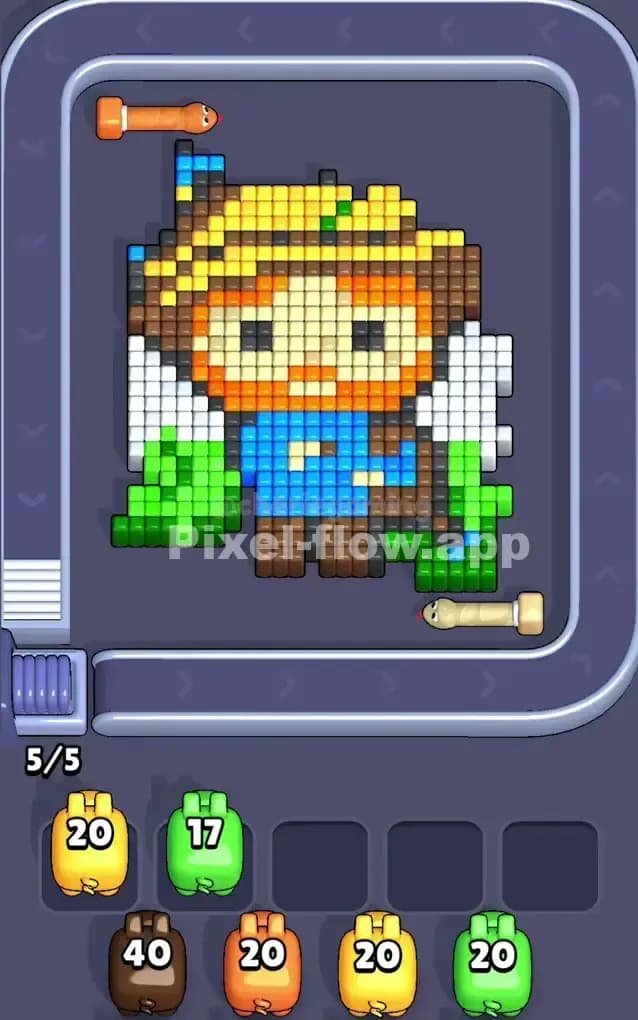
Once the grass and sky are gone, you hit the "naked" phase. The character is floating in empty space. This is where most players lose Level 275.
You will see the Orange beard and the Blue shirt are now the outermost layers. The Yellow hat is also exposed.
- Prioritize the Shirt: The Blue shirt is usually a flat, forward-facing layer. Clear it to expose the body underneath.
- The Beard Trap: The Orange beard covers the skin. Do not summon a Cream/Skin colored pig until the Orange is mostly gone. If you pull a Skin pig now, it will have zero targets and will choke one of your 5 slots.
- The Hat: The Yellow hat has layers. Clear the bright Yellow first. This often reveals the darker brown band or hair underneath.
If the conveyor belt offers you a White pig, look at the sides. If the "clouds" are still there, take it. If the clouds are gone, let the White pig pass. You cannot afford to store a pig that only has 3 targets left deep inside the image.
Last Details You Clean Up in Pixel Flow Level 275
The end of Pixel Flow Level 275 is all about the face. Once the hat and beard are stripped away, you are left with the Cream/Skin face and the Black eyes.
Be careful here. Sometimes a single stray pixel of the hat or beard remains hidden behind a "front" block. Ensure the face is totally flat before you commit your final pigs. The very last moves are usually the two black dots for the eyes and perhaps a dark pixel for the mouth or shoes. Watch the belt. Don't grab that final Black pig until you actually see the whites of his eyes (or rather, the empty space where his eyes should be).