Pixel Flow Level 280 Solution Walkthrough | Pixel Flow 280
How to solve Pixel Flow level 280? Get instant solution for Pixel Flow 280 with our step by step solution & video walkthrough.


Pixel Flow Level 280 Overview
The Board and Its Layers
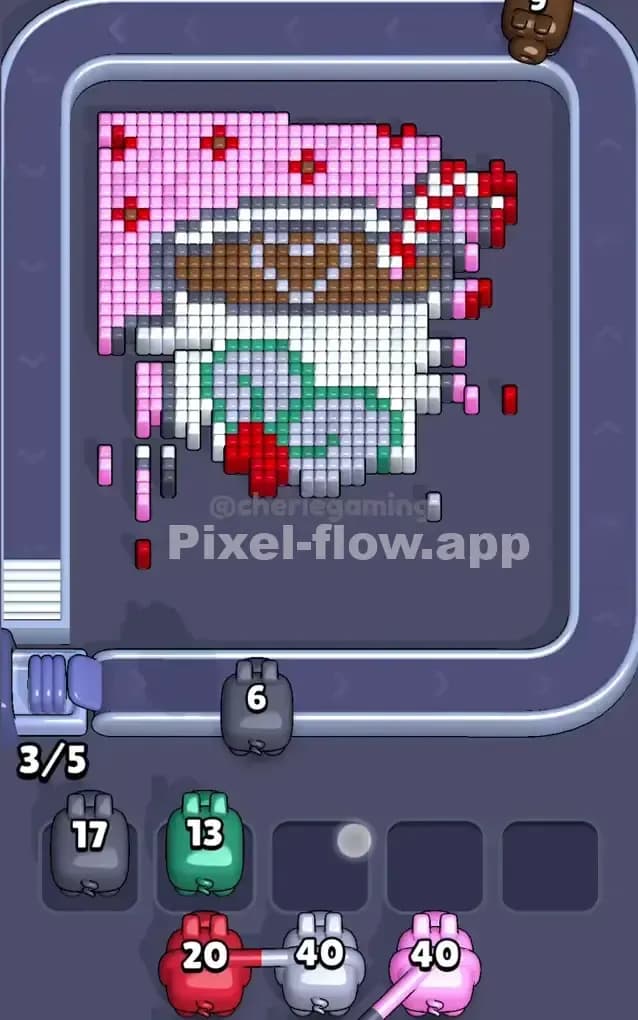
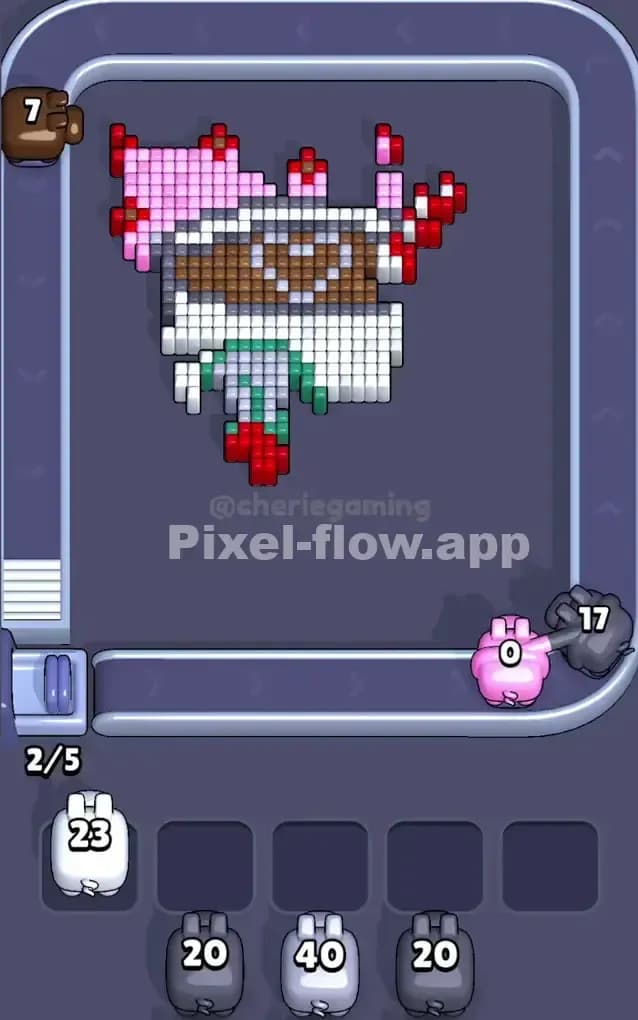
Pixel Flow Level 280 presents a charming mug illustration set against a pink background, and that's where the visual simplicity ends. The mug itself is constructed from multiple color layers: you'll see a brown handle outline, white body panels, green decorative leaf details, red accents (likely flowers or ornaments on the mug), and a dominant pink backdrop that fills much of the playfield. The challenge isn't just clearing cubes—it's understanding that this mug is built in depth, with foreground colors obscuring the layers beneath them. You're not just destroying a picture; you're excavating it, layer by layer, which means early decisions about which color to prioritize will directly impact what becomes accessible later.
Win Condition and Determinism
To beat Pixel Flow Level 280, you must clear every single voxel cube from the board. This sounds straightforward until you realize that your pig queue is completely deterministic—each pig arrives with a fixed ammo count and always targets the same color. The win condition forces you to think backwards from the end state: which pigs must fire last to avoid jamming the waiting slots, and which colors should be eliminated early to expose hidden layers? There's no randomness here, only planning.
Why Pixel Flow Level 280 Feels So Tricky
The Pink Bottleneck
The dominant pink background is Pixel Flow Level 280's biggest trap. Pink cubes are everywhere, and while that might sound manageable, the real problem emerges when you've cleared most other colors but still have pink scattered across the board. If your incoming pigs don't have enough combined ammo to finish pink, or if pink gets blocked under other colors, you'll find yourself with three or four pigs sitting in the waiting slots with nowhere to aim. I've felt the panic of watching the buffer fill up while a single pink cube hides behind the mug's white body—it's a lesson in patience and forward-thinking that Pixel Flow Level 280 teaches very firmly.
Awkward Color Pockets
The mug's structure creates isolated pockets where colors live in clusters rather than rows. That red ornament in the center? It might only be reachable after you've stripped away green and white. The brown handle outline sits in a very specific region, and if the brown pig arrives before you've exposed enough of the handle, it'll drop into a waiting slot prematurely. Similarly, the green leaf pattern is sandwiched between white and red, so you can't simply fire every green cube whenever a green pig shows up—you have to sequence things carefully to expose green without losing access to other colors.
The Ammo-to-Target Mismatch
This is the subtle frustration that makes Pixel Flow Level 280 genuinely difficult. You might have a pig with 20 ammo, but only 15 visible targets of its color remain—the other 5 cubes are buried. If you fire that pig without exposing the hidden cubes first, you've wasted ammo potential and left yourself in an impossible state. The game doesn't forgive miscounts or miscalculations, and Pixel Flow Level 280 demands that you mentally track not just what's visible now, but what will become visible as you peel back layers.
When It Clicks
Honestly, Pixel Flow Level 280 frustrated me until I stopped trying to rush and started counting every single cube of every color before committing to a pig. Once I realized that the waiting slots aren't just a buffer—they're a resource that I need to manage like ammo itself—the level transformed from chaotic to solvable. The moment I cleared pink last (instead of first) was when everything clicked into place.
Step-by-Step Strategy to Clear Pixel Flow Level 280
Opening: Establish a Safe Buffer
Start by letting the first pink pig fire, but only partially. Yes, pink is everywhere, but don't empty the queue on it immediately. Instead, fire your opening pink pig to clear some of the background cubes, then stop at two or fewer firing actions to keep your waiting slots open. This seems counterintuitive, but Pixel Flow Level 280 rewards restraint. By keeping 3–4 waiting slots free at the start, you buy yourself flexibility when awkward colors arrive.
Next, fire the white pig. White forms the mug's body and is a relatively contiguous mass, so it's a clean target that won't hide other colors. Clearing white early exposes the interior details of the mug—the green and red—and it frees up space on the board without creating new problems. White should drop into a waiting slot after its ammo is spent, and that's fine; you've got room.
Mid-Game: Layer by Layer, Plan Three Pigs Ahead
Once white is gone, the mug's structure becomes clearer. Now you'll target brown (the handle) and gray (the mug's outline/rim). These aren't dominant colors, so firing them cleanly is possible. Brown has an ammo count of 20, and gray likely has 20 as well. Here's the critical insight: count the visible cubes of each color before you fire the pig. If you see fewer cubes than ammo, the extras are hidden, and you need to note that. Don't panic—it just means that color will reappear as you clear other layers.
This is where Pixel Flow Level 280 demands planning ahead. Before you fire a gray pig, glance at the queue and ask: what comes after gray? If it's another gray pig, great—the first one will expose cubes for the second. If it's pink, then you'd better make sure clearing gray doesn't trap pink in the waiting slots. Move the mouse over pig icons in the queue (or mentally track them) to stay two moves ahead.
At the mid-game point, you should have fired pink, white, brown, and gray pigs in some order, and the board should be visibly simpler. The mug's interior—that green leaf pattern and red ornament—should now be fully exposed or nearly so. Park any half-spent pigs in waiting slots without guilt; they're not failures, they're placeholders.
End-Game: Green, Red, and the Pink Finish
As you enter the final stretch of Pixel Flow Level 280, only green and red remain on the mug itself, plus scattered pink in the background. Fire green pigs to clear the leaf details. Green's ammo is fixed, and once you've exposed it, it shouldn't hide anymore. Next, fire red pigs to eliminate that ornament and any red accents. Red's ammo count should align almost perfectly with visible red cubes if you've sequenced everything correctly.
Here's the final move: save pink for last. I know this feels wrong when pink covers the entire background, but pink is the easiest color to count and the least likely to jam your waiting slots once everything else is gone. Fire pink pigs in sequence until the board is empty. With 4 out of 5 waiting slots occupied by "spent" pigs from earlier rounds, you might have only one empty slot, but that's enough to slot the final pink pig and clear the level.
The last few actions should feel clean: pink pig fires, pink cubes vanish, waiting slot fills, board is clear, level complete.
The Logic Behind This Pixel Flow Level 280 Plan
Exploiting Determinism and Order
Pixel Flow Level 280 isn't random; it's a puzzle where the solution is encoded in the pig sequence and ammo values. By recognizing which pigs come in which order and how much ammo each carries, you can reverse-engineer the level. If you know a pink pig with 40 ammo is coming fourth, and you see only 35 pink cubes on the board, you immediately know 5 pink cubes are hidden under other layers. This knowledge reshapes your strategy: clear the overlaying colors first, not pink, so those hidden cubes become targets.
The waiting slots are part of the puzzle's constraint system. They're not just a frustration—they're a hint. The fact that you have exactly five slots tells you something about the pig sequence. If you fill all five slots early, you've miscalculated, and Pixel Flow Level 280 will punish you with a stuck state. By consciously managing which pigs go into which slots and when, you're solving the puzzle mechanically.
Staying Calm and Counting
The most practical advice for Pixel Flow Level 280 is simple: count before you fire. Take five seconds to mentally tally every visible cube of the color you're about to target. If the count is lower than the pig's ammo, note it and move on with confidence—the hidden cubes will appear. If the count matches the ammo exactly, fire with certainty. This removes panic and replaces it with information.
Watch the incoming queue. Pixel Flow Level 280 is won by knowing what's coming before it arrives. If you see pink, pink, white, then brown in the queue, you've got a roadmap. Fire the first pink carefully, leave room in the buffer, and prepare for the second pink to either expose new targets or fill an existing waiting slot. This two-to-three-pig lookahead mindset transforms Pixel Flow Level 280 from a guessing game into a solvable logic puzzle.
Stay patient, trust the numbers, and Pixel Flow Level 280 will yield to your strategy.