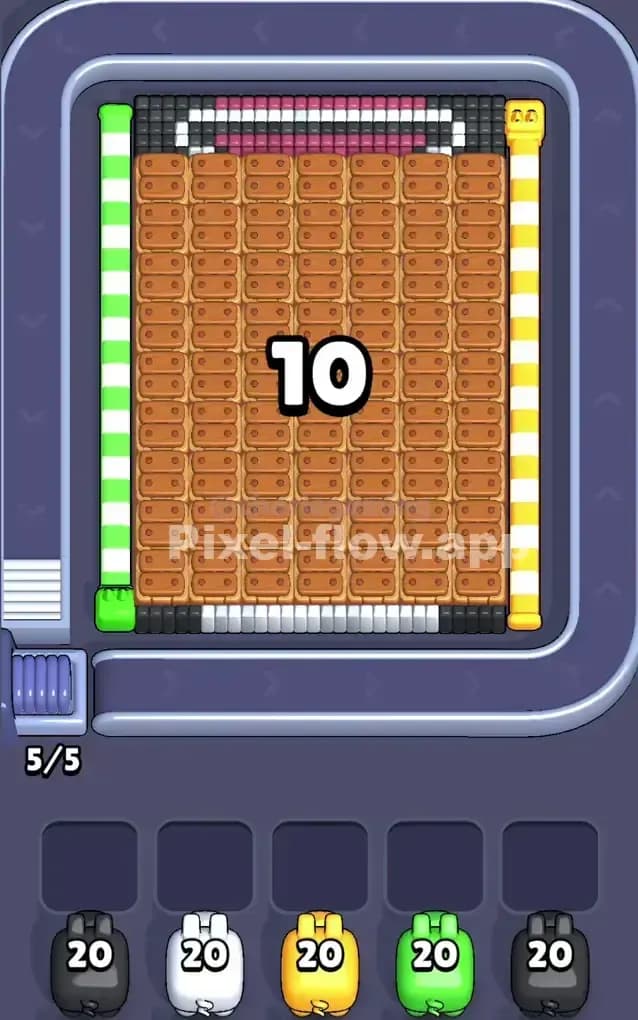
Pixel Flow Level 279 Solution | Pixel Flow 279 Walkthrough
How to beat Pixel Flow Level 279: Video solution & walkthrough. The fastest way to pass Pixel Flow 279.
Is this the wrong level layout?🤔
Pixel Flow randomizes levels for different players. Don't worry, just upload a screenshot of your board, and our AI will find the correct video instantly.
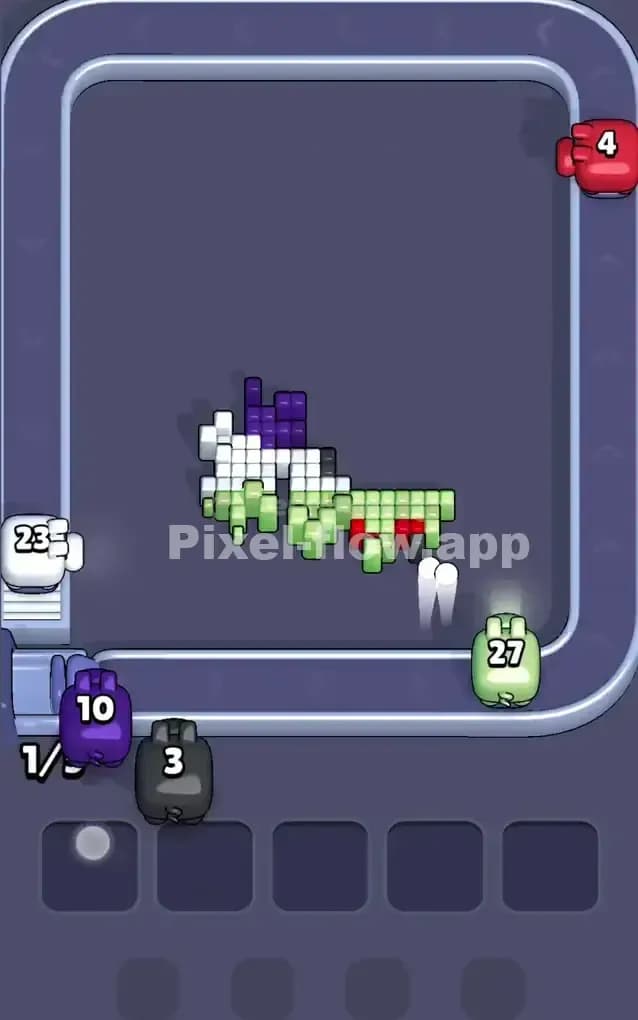
Pixel Flow Level 279 Overview
The Board: A Fiery Bird Over Layered Terrain
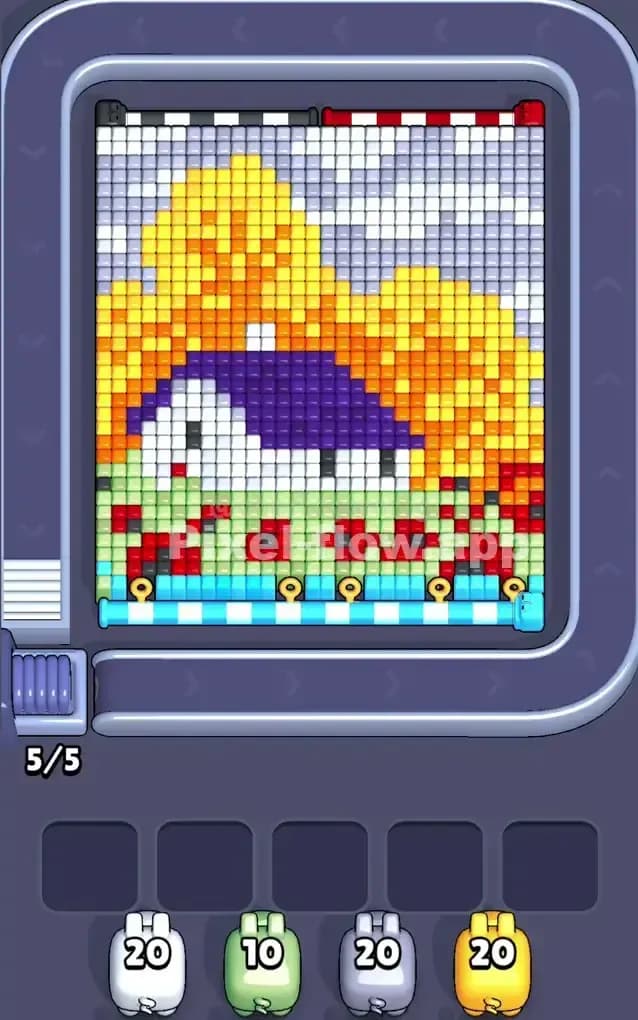
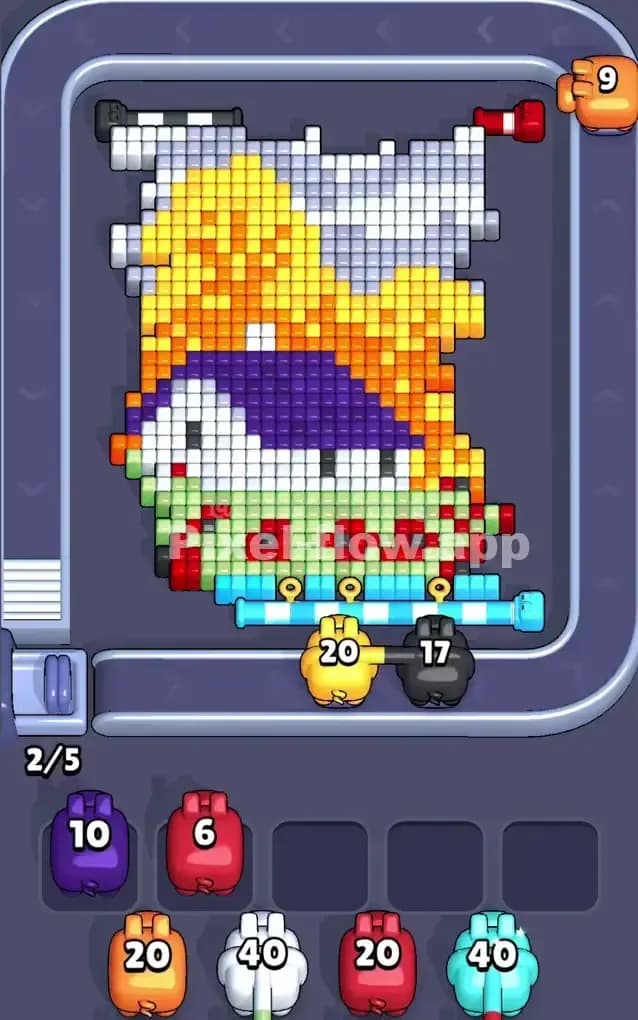
Pixel Flow Level 279 presents you with a stunning pixel-art bird in flight, rendered almost entirely in shades of yellow, orange, and red against a light blue and white sky background. The bird's wing and body dominate the upper two-thirds of the board, creating a warm, vibrant centerpiece. Beneath the bird sits a purple band (the bird's underside or shadow), followed by a green grassy strip, and finally a red pattern at the very bottom that hints at deeper layers waiting to be exposed. The board is compact but dense, with multiple color zones that require precise sequencing to clear completely.
Win Condition and Deterministic Sequencing
To conquer Pixel Flow Level 279, you must eliminate every single voxel cube on the board by carefully ordering the pigs that arrive on the conveyor belt. The five pigs waiting at the bottom each carry a fixed ammo count: two pigs with 20 shots, one with 10, and one with 20. Because pig order and ammo values never change, victory in Pixel Flow Level 279 comes down to understanding which pig to launch when, so that their shots land on matching colors and expose the next layer. There's no luck involved—only strategy and planning ahead.
Why Pixel Flow Level 279 Feels So Tricky
The Orange-and-Yellow Bottleneck
The biggest threat in Pixel Flow Level 279 is the sheer volume of orange and yellow cubes that make up the bird's wings and body. These two colors occupy so much visual real estate that you'll need multiple pig launches to clear them entirely. The danger is this: if you spend too much ammo on yellow or orange early without exposing the purple and green layers beneath, you risk running out of matching targets. When a pig has ammo left but no valid cubes to shoot, it slides into one of your five waiting slots. Fill all five slots with "stuck" pigs, and you've locked yourself into a failure state—even if you have ammo left, you can't use it because there's nowhere for new pigs to enter.
Subtle Problem Spots That Slow You Down
The purple band beneath the bird is narrow but crucial; it's not visible until you clear enough orange and yellow to expose it. If you miscalculate how many orange shots you need, you might leave isolated orange cubes stranded behind the purple, forcing you to wait for another orange pig—but by then your buffer could be dangerously full. Additionally, the red zone at the bottom is heavily fragmented and mixed with other colors, which means you can't simply spam all your red ammo in one go. You'll need to alternate between reds and other colors to keep exposing new sections. The green layer, while less visually dominant, is equally stubborn; it's sandwiched between red above and purple below, so you can't touch green effectively until the red above it thins out.
When the Level Clicked for Me
Honestly, my first three attempts at Pixel Flow Level 279 felt chaotic. I'd launch pigs in whatever order felt natural, watch my waiting slots fill up, and then realize I'd painted myself into a corner with a half-spent pig and nowhere to put the next one. But after I started counting ammo and predicting which colors would be exposed after each pig, everything shifted. The level went from feeling like controlled chaos to feeling like a puzzle I could solve. That breakthrough moment—when I managed to clear the last red cubes and watch the final green pig empty its entire magazine into a matching patch—made Pixel Flow Level 279 click.
Step-by-Step Strategy to Clear Pixel Flow Level 279
Opening: Establish Your Foundation and Preserve Buffer Space
Start Pixel Flow Level 279 by launching your first white pig (20 ammo). Yes, white cubes are scattered across the board, but they're primarily visible in the sky and border areas, and clearing them immediately opens up your sightlines and prevents early jams. This first move should eliminate roughly 8–12 white cubes, leaving you with at least 3 waiting slots free. Next, launch a yellow pig (20 ammo). The bird's body is thick with yellow, so you'll spend most or all of this pig's ammo here, exposing some of the orange beneath and revealing hints of the purple band. Keep your waiting slots at least half-empty at this stage; you want flexibility.
Mid-Game: Sequence Pigs to Expose Layers and Park Safely
Now comes the critical mid-game sequencing in Pixel Flow Level 279. Launch your orange pig (10 ammo) next. With 10 shots, you'll chip away at the orange wing sections and likely expose more of the purple underneath. Don't expect to clear all orange with just 10 ammo—that's not the goal. Your goal is to expose enough purple and green that your next pig has valid targets. After the orange pig, launch the other white pig (20 ammo) to finish any lingering white cubes and to serve as a buffer move. By the time this white pig drops into a waiting slot, you should have clear sightlines to the purple band and the top of the green layer.
Now here's where patience pays off in Pixel Flow Level 279: launch the remaining yellow pig (20 ammo) to finish any yellow you missed and to carve deeper into the purple. The purple band should start crumbling significantly after this move. As purple cubes disappear, the green layer becomes your new primary target. If your waiting slots are still manageable (no more than 3 full), you're on pace.
End-Game: Clear the Last Layers Cleanly
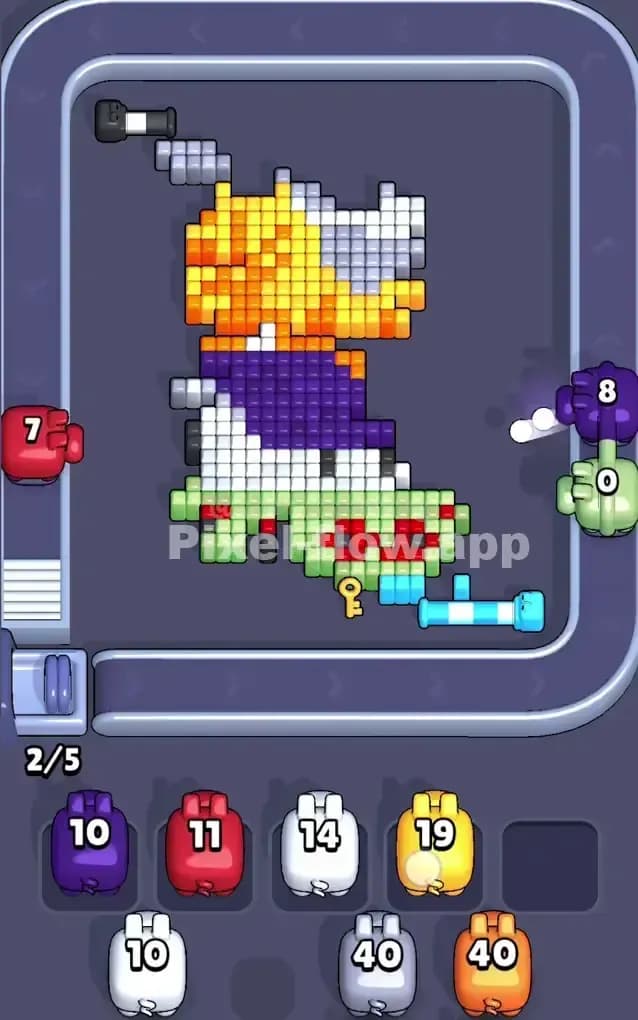
In the final stretch of Pixel Flow Level 279, you'll face red and green cubes. If you haven't already, launch a pig specifically to target green and red in the lower zones. The key here is to avoid overshooting: don't use all your ammo on green and then find yourself with a pig that can only shoot red but no red cubes remain exposed. Watch your waiting slots constantly. If you notice you're down to one or two free slots, pause and think before launching the next pig. Count the remaining ammo across all pigs in the queue and estimate how many cubes are still on the board. If the numbers don't line up—if you have way more ammo than cubes—you're setting up a failure.
The final move in a successful Pixel Flow Level 279 run usually involves a pig with a small ammo count (like your orange pig) polishing off the last few scattered cubes. If you've planned correctly, all five waiting slots will fill exactly as you clear the last cube, leaving no stuck pig behind.
The Logic Behind This Pixel Flow Level 279 Plan
Exploit Predictability, Don't Fight It
Pixel Flow Level 279 rewards you for thinking like a programmer, not a reflex gamer. Every pig has a fixed ammo count; every waiting slot has a fixed capacity. The board has a finite number of cubes in each color. If you spend two minutes before your first move counting cubes and checking your pig queue, you can predict almost exactly which pigs will get stuck and when. The strategy above doesn't rely on luck or fast reflexes—it relies on matching ammo to expected cube counts and leaving buffer space so you never hit a deadlock.
Stay Calm and Think Two Pigs Ahead
When you're playing Pixel Flow Level 279, resist the urge to launch a pig the moment it reaches the front of the queue. Instead, glance at your waiting slots. If three are full, ask yourself: "What will the pig that's about to launch do? Will it have valid targets, or will it get stuck?" If it'll get stuck, is there a pig behind it that can finish off the cubes that pig started? Will that second pig also jam? By thinking just two moves ahead, you can sequence around potential deadlocks and keep your buffer clear. It's the difference between a successful Pixel Flow Level 279 run and a frustrating restart.