
Pixel Flow Level 282 Solution | Pixel Flow 282 Walkthrough
How to beat Pixel Flow Level 282: Video solution & walkthrough. The fastest way to pass Pixel Flow 282.
Is this the wrong level layout?🤔
Pixel Flow randomizes levels for different players. Don't worry, just upload a screenshot of your board, and our AI will find the correct video instantly.



Pixel Flow Level 282 Walkthrough
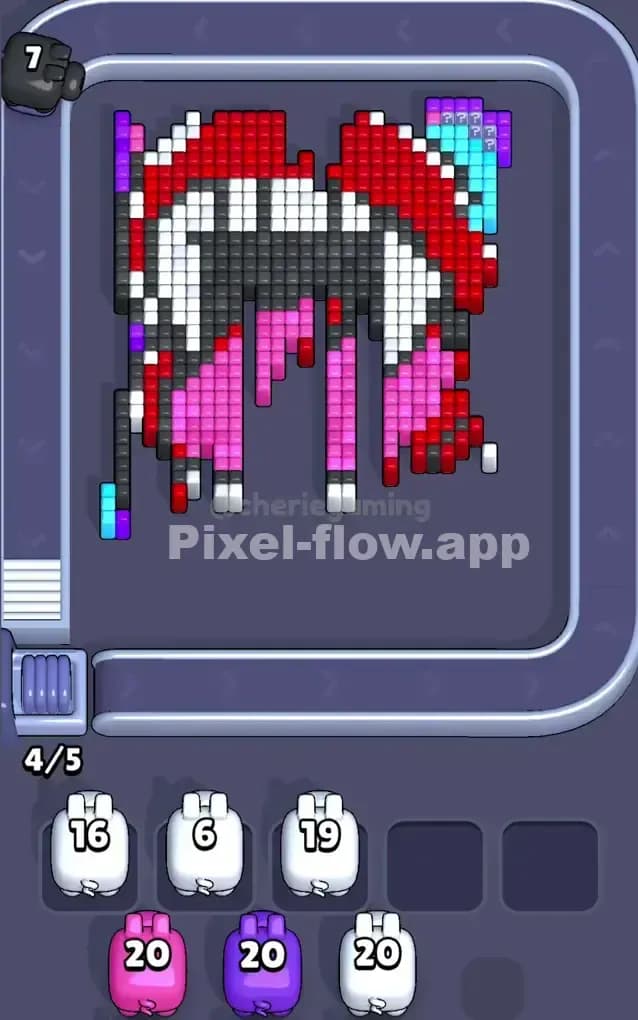
This level features a giant, pixelated vampire mouth wide open, complete with massive white fangs, bright red lips, and a pink tongue swirling in the center. The background corners are filled with gray blocks marked with question marks ('?'), and the entire bottom row is a solid strip of light blue (cyan).
The rule here is strictly layer management. You cannot touch the black void inside the mouth or the full shape of the tongue until you peel back the lips and the mystery blocks in the corners. Because the white fangs are vertical columns that are partially blocked by the red lips, this is a very hard level. You will constantly struggle with White pigs clogging your slots because their targets—the teeth—are mostly covered by Red blocks.
Pixel Flow Level 282 Overview
Think of this board as a Halloween sticker. You have a massive, gaping mouth dominating the center. The lips are a thick, bright red ring. Inside, two long white fangs drop down from the top lip, and smaller white teeth line the bottom.
In the very center, there's a pink tongue curling upward. The background inside the mouth is deep black. However, the most annoying part isn't the mouth itself; it's the frame. The bottom edge is a distinct strip of Cyan. The top left and right corners are initially covered in gray '?' mystery blocks. These mystery blocks are actually masking the Purple background layer.
The board is mostly symmetrical, but the tongue creates an imbalance. It leans slightly, meaning the Pink blocks aren't perfectly centered. This matters because the pigs for the tongue often come late, while the Red and White pigs arrive early and fight for space in your waiting slots.
Step by step solution walkthrough for Pixel Flow Level 282
First Color Zone to Erase in Pixel Flow Level 282
Your absolute first move is the Cyan (Light Blue) strip at the very bottom.
This is a no-brainer. The game practically hands this to you. In the starting queue, you’ll likely see a Cyan pig. That bottom row is the "floor" of the artwork. It doesn't overlap with anything dangerous, and clearing it gives you a clean baseline. If you skip this, that Cyan pig will sit in your slot for the entire game, wasting a valuable space.
Once the Cyan floor is gone, look immediately at the Purple pigs. Use them to attack the gray '?' blocks in the top corners. You don't know exactly what shape is under there until you hit it, but trust the color match. The Purple pigs will shatter those question marks, revealing the background and clearing the edges of the board. Do not let Purple pigs pile up; use them as soon as those mystery blocks are exposed.
How to pass Pixel Flow Level 282 without power ups or boosters
The mid-game is where Level 282 tries to kill you. At this point, the Cyan floor and Purple corners are gone. You are staring at a massive block of Red (the lips) and slivers of White (the teeth).
Here is the trap: The game will feed you White pigs. However, most of the white teeth are "behind" or "wedged between" the red lip pixels. You might only have 2 or 3 valid white targets exposed, but the pig has 20 ammo. If you drop that White pig into a slot, it stays there. Forever.
Prioritize the Red pigs above all else. The lips are the biggest surface area. Every Red block you destroy exposes more of the White fangs and the Pink tongue. If you have a choice between a White pig and a Red pig, play the Red one. Even if the White pig has valid targets, wait. You want the Red layer significantly reduced so that when you finally commit to a White pig, it can unload its full clip of 20 ammo in one go.
If you see your slots filling up with White pigs (like 16, 6, and 19 ammo remaining), stop. You are about to lose. You must aggressively clear the Red pixels bordering the teeth to free up shots for those stranded White pigs.
Last Details You Clean Up in Pixel Flow Level 282
Once the lips (Red) and fangs (White) are mostly decayed, you enter the final cleanup phase. The board will look like a skeleton of a mouth.
The primary color left will be Pink. The tongue is a weird shape; it swirls and has gaps. You likely have Pink pigs stuck in your queue behind other colors. Now is their time. The Pink layer usually sits partially behind the lower teeth, so ensure the bottom white row is gone before panicking about Pink.
Finally, the Black pixels. These represent the dark inside of the mouth. They are the deepest layer. You literally cannot clear them until the tongue and teeth are out of the way. Don't worry about Black pigs until the very end; they are the last thing to clean up before the victory screen. Keep one slot open for them, but don't prioritize them until the mouth is empty.