
Pixel Flow Level 283 Solution | Pixel Flow 283 Walkthrough
How to beat Pixel Flow Level 283: Video solution & walkthrough. The fastest way to pass Pixel Flow 283.
Is this the wrong level layout?🤔
Pixel Flow randomizes levels for different players. Don't worry, just upload a screenshot of your board, and our AI will find the correct video instantly.



Pixel Flow Level 283 Walkthrough
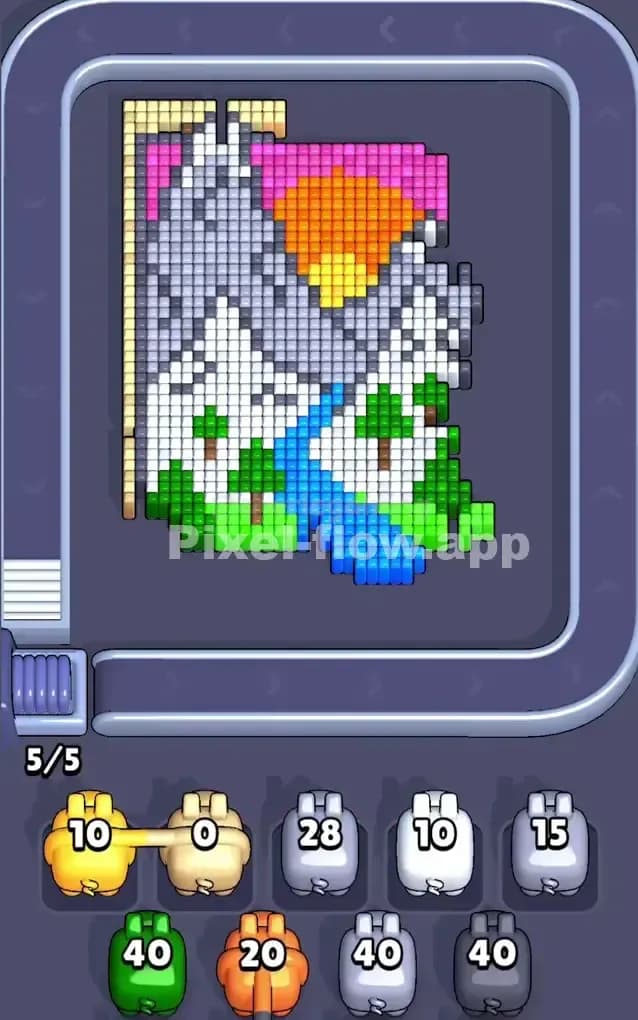
This level is a beautifully framed landscape piece, resembling a pixelated postcard of a mountain sunset. You are dealing with distinct layers here: a foreground frame, a massive mountain range in the middle, and a background sky. Because the layers are so thick and the color palette is wide (8+ colors), clogging your slots is a real risk. Be careful.
Based on the density of the central mountains and the way they block the background sun, this counts as a very hard level. You have very little room for error with your discard slots.
Pixel Flow Level 283 Overview
The artwork in Pixel Flow 283 is a scenic nature view. Imagine a hike in the Alps. Two massive grey peaks dominate the center, capped with white snow. Between them flows a winding blue river that widens as it reaches the bottom of the frame. Flanking the river are patches of green grass and pine trees.
But the real trouble lies in the background and the border. The entire scene is enclosed in a thick beige frame. Behind the mountains, you have a vibrant sunset—a pink sky with a two-tone sun (orange top, yellow bottom) tucking itself behind the peaks.
The asymmetry here is vertical. The top is "background heavy" (sky/sun), while the bottom is "foreground heavy" (river/grass). The massive grey and white mountains act as a wall in the center, physically blocking your shots from hitting the sky or the upper river until you chip them away.
Step by step solution walkthrough for Pixel Flow Level 283
First Color Zone to Erase in Pixel Flow Level 283
You have no choice here: you must attack the Beige Border first.
Narratively, this is the picture frame. Logically, it is a cage. This beige strip wraps around the entire image, shielding the edges of the pink sky, the grey mountains, and the green grass. Until this frame is broken, your pigs have very limited angles of attack.
You will likely see high-ammo Beige pigs (around 40 ammo) early in the queue. Do not waste them. If you get a color you can’t use (like Orange for the sun, which is buried deep), slot it. But as soon as Beige appears, clear that outer ring. Removing the border instantly exposes the "flesh" of the painting: the edges of the grey mountains and the pink sky become valid targets. If you don't clear the beige first, your grey pigs will waste ammo hitting nothing, or worse, end up clogging your waiting area because they can't reach the mountain pixels blocked by the frame.
How to pass Pixel Flow Level 283 without power ups or boosters
The mid-game of Pixel Flow 283 is dangerous. Once the beige frame is gone, you are staring at a chaotic mix of Grey, White, Green, and Blue. This is where most players lose.
The trap is the Grey and White Mountains. These are the "highest" elevation blocks in the voxel structure. They physically stick out. You might get an Orange or Yellow pig for the sun, but because the sun is behind the mountain, you cannot hit it yet. If you put that Orange pig in a waiting slot, it will sit there for a long time.
Your priority must be eroding the mountains.
- Prioritize Grey and White pigs. Even if you have a shot at the Green trees, if a Grey pig is available, use it. You need to flatten the mountains to open up lines of sight to the background sun and the upper river.
- Watch the River (Blue). The blue river runs down the middle. The bottom part is easy to hit, but the top part is squeezed between the peaks. Don't grab a Blue pig unless you are sure you can clear at least 10-15 blocks. If the top river is still blocked by white snow, skip the Blue pig for now.
- The Slot Management Rule: In this specific level, never fill your 4th slot unless you are about to clear a color completely. The variety of colors (Pink, Orange, Yellow, Green, Blue, Brown) means the game will feed you pigs you cannot use yet. Keep 2 slots open strictly for "trash" pigs that you need to stash while you dig for Grey/White pigs.
Last Details You Clean Up in Pixel Flow Level 283
Once the mountains are crumbled, the level becomes a cleaning job. You will likely be left with the Sunset (Orange/Yellow) and the Tree Trunks (Brown).
The sun is recessed. It was hiding behind the grey blocks. Now that they are gone, your Orange and Yellow pigs can finally unload. Watch out for the tree trunks. They are tiny brown voxels, usually only 1 or 2 blocks high. It is very easy to miss them and waste a waiting slot on a Brown pig that only shoots twice before becoming useless dead weight.
Make sure the Green canopy is fully gone before you deploy a Brown pig, otherwise, the pig will shoot the leaves, run out of targets (because the trunk is blocked), and sit in your slot with leftover ammo. That is a game-ender this late in the run. Clear the Green. Then finish the Brown trunks and the Sunset.