Pixel Flow Level 307 Solution | Pixel Flow 307 Walkthrough
How to beat Pixel Flow Level 307: Video solution & walkthrough. The fastest way to pass Pixel Flow 307.
Is this the wrong level layout?🤔
Pixel Flow randomizes levels for different players. Don't worry, just upload a screenshot of your board, and our AI will find the correct video instantly.



Pixel Flow Level 307 Walkthrough
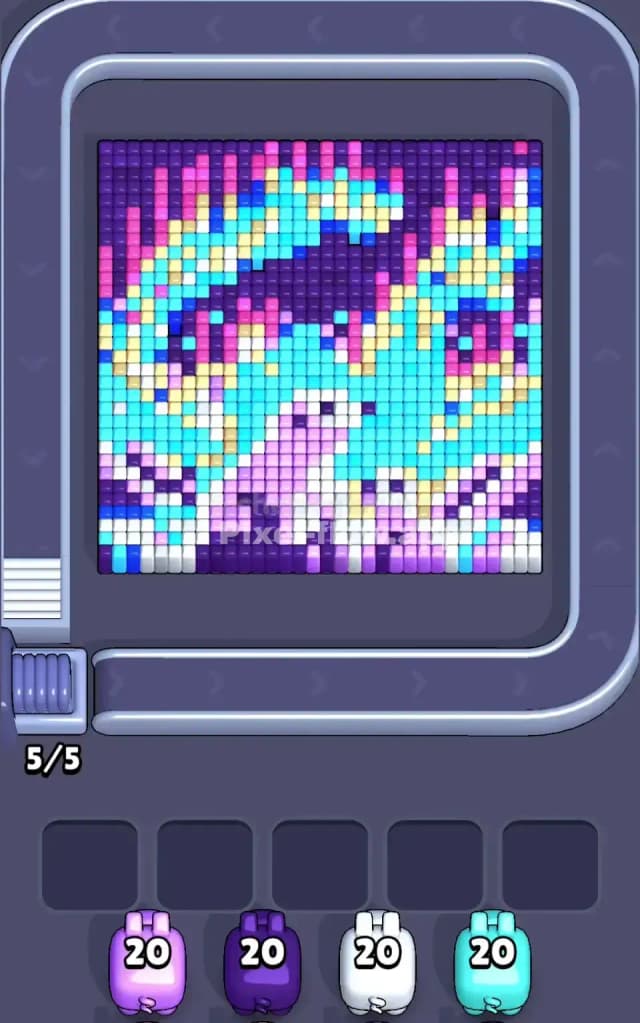
This level features a vibrant, swirling dragon head (or perhaps a phoenix) composed of intense neons: electric cyan, deep indigo, hot pink, and creamy white. The board is dense. There are very few "easy" single-color blocks to exploit early on. Instead, the colors are interwoven in complex spirals.
The rule for Pixel Flow 307 is strict: control the clutter. Your conveyor belt will offer you a mix of colors, but the board's surface is messy. If you grab a pig whose target color is buried three layers deep, it will jam your waiting slots. You must only pick pigs that have immediate, visible targets on the top layer. Is this a hard level? Yes, it is very hard due to the scattered color distribution.
Pixel Flow Level 307 Overview
The image depicts a mystical creature, likely a dragon, facing right. Its mane or feathers are a chaotic mix of cyan and pink spikes. The background isn't a solid block; instead, dark purple/indigo fills the negative space around the creature's neck and behind the head, while the creature itself is bright.
Key Asymmetries:
- The Neck (Bottom Center): This area is a heavy mix of pink, purple, and white. It's thick and layered.
- The Snout (Right Side): The face area is lighter, with more yellow and cyan, but it's surrounded by a "cage" of dark purple.
- The Swirl (Top Left): This is the most dangerous part. Strips of pink and cyan alternate rapidly here. If you clear one stripe, you reveal another color immediately beneath it, which can be disorienting.
Because the colors are so fragmented—a pink pixel here, a cyan one there—you can't just spam pigs. You have to watch the exact column the pig is aiming for.
Step by step solution walkthrough for Pixel Flow Level 307
First Color Zone to Erase in Pixel Flow Level 307
I start by targeting the Dark Purple/Indigo areas, specifically around the bottom edge and the top right corner.
- Narrative Reason: The dark purple acts as the "night sky" background for this dragon. It surrounds the bright head. By clearing it, you define the shape of the dragon, isolating the head from the neck.
- Logical Reason: The purple blocks on the bottom row are the most accessible. They are not covered by anything. Clearing the bottom row is crucial in Pixel Flow because it opens up lines of sight for the rest of the board. If you leave the bottom cluttered, your pigs will waste ammo shooting the "feet" of the drawing instead of the deep layers in the center. Get the purple out of the way to expose the cyan and pink roots.
How to pass Pixel Flow Level 307 without power ups or boosters
Around the mid-point, the dragon will look like a skeleton. You'll likely have cleared most of the outer dark purple and some of the white "highlights." The board often looks messy here, with jagged spikes of cyan and pink sticking up.
- Stop and Stare: Do not pull a pig from the belt unless you see at least 5-10 blocks of its color exposed. At this stage, the game tries to trick you with Cyan pigs. The dragon has a lot of cyan, but much of it is buried under pink or yellow crust. If you grab a cyan pig too early, it will shoot 3 blocks and then sit in your slot, useless.
- The Pink/White Trap: Focus on the Pink and White sections in the lower center (the neck). These usually block the bigger chunks of cyan behind them. Clear the neck first.
- Slot Management: Keep at least two slots open at all times. If you have three pigs waiting, prioritize clearing the one with the least ammo, even if it’s inefficient. You need the space more than you need the perfect shot.
Last Details You Clean Up in Pixel Flow Level 307
In the final phase, you are usually left with the core of the dragon's head.
- The Eye: There is often a cluster of dark pixels (purple or black) buried deep in the right side of the image—the dragon's eye. Watch out for this. You might think you are done with purple, but this small clump remains.
- The Cyan Mane: The very last blocks to go are usually the thickest part of the Cyan mane in the center-left. This stack is deep. Save your high-ammo cyan pigs for the very end. Do not waste a fresh 20-ammo cyan pig on stray pixels earlier; save it for this final, satisfying cleanup where it can drill straight down.