Pixel Flow Level 308 Solution | Pixel Flow 308 Walkthrough
How to beat Pixel Flow Level 308: Video solution & walkthrough. The fastest way to pass Pixel Flow 308.
Is this the wrong level layout?🤔
Pixel Flow randomizes levels for different players. Don't worry, just upload a screenshot of your board, and our AI will find the correct video instantly.
Pixel Flow Level 308 Walkthrough
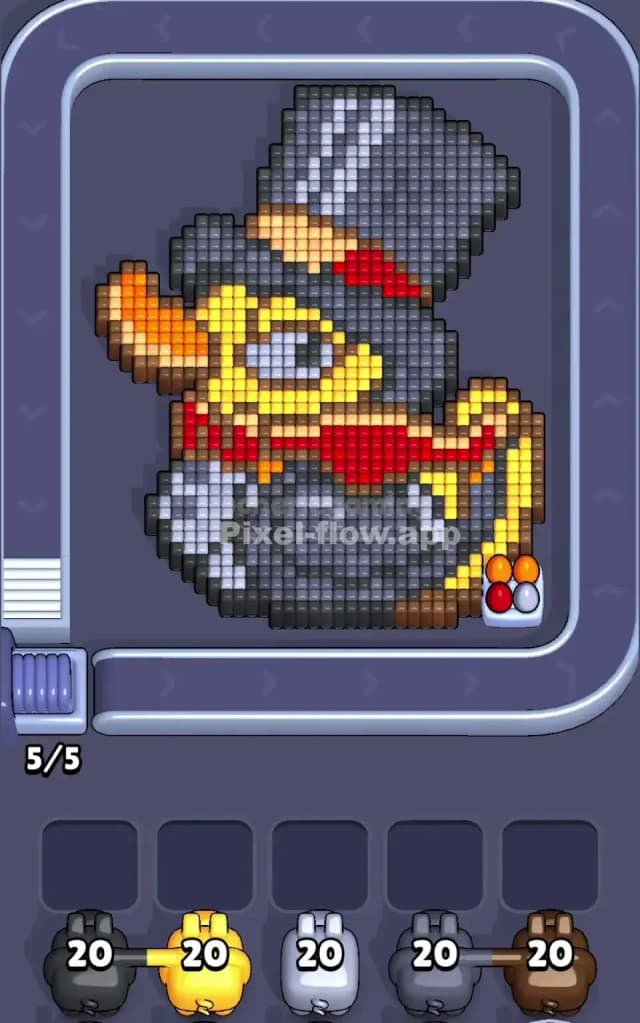
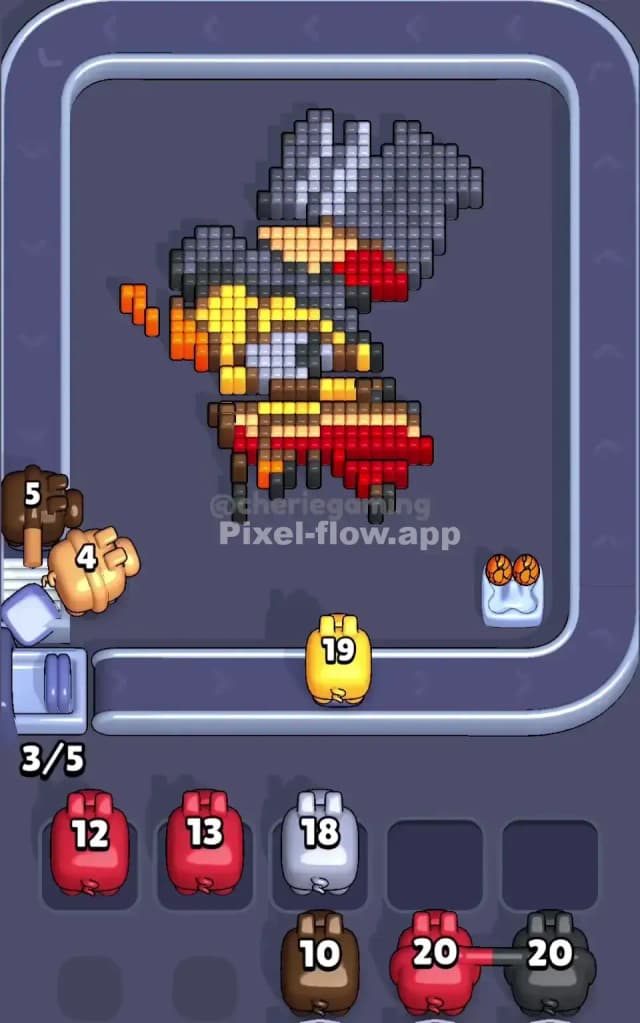
Level 308 is deceptively annoying. You are looking at a pixel art duck. Not just any duck—a dapper duck wearing a top hat and a monocle. This level relies heavily on distinct color layers, specifically the heavy use of dark grey/black for the hat and body, contrasting with the bright yellow face and red scarf.
To beat Pixel Flow Level 308, you need to manage the massive black/grey blocks first. These surround the intricate inner colors. If you ignore the hat, your other pigs will get clogged in the waiting area because they can't reach the yellow or red pixels underneath. Is it hard? Yes, it is a very hard level because the accessible "surface area" for colors other than black/grey is tiny at the start. One wrong move jams your slots.
Pixel Flow Level 308 Overview
The scene is a gentleman duck. He’s styled like a wealthy tycoon from the 1920s. He has a massive dark grey top hat with a light grey sheen, a monocle over his eye, and a bright red scarf wrapped around his neck. The background isn't relevant here because the figure takes up almost the entire central grid.
The asymmetry is vertical. The top half is almost entirely the top hat (black/dark grey). The bottom half is the body, which is also dark, but has the complex yellow/orange beak and face pushing out to the left. The right side is simpler, mostly the back of the duck's head and body.
This layout creates a bottleneck. The hat is a huge "shield." Until you chip away at that hat or the dark body, the Yellow, Orange, and Red pigs have almost nothing to shoot at. The danger zone is the left side where the beak sticks out. It looks accessible, but it's often blocked by a single layer of black pixels that you might miss.
Step by step solution walkthrough for Pixel Flow Level 308
First Color Zone to Erase in Pixel Flow Level 308
Start with Black/Dark Grey. This is non-negotiable. Look at the top hat. It is a solid slab of dark pixels. Look at the bottom curve of the duck. More dark pixels.
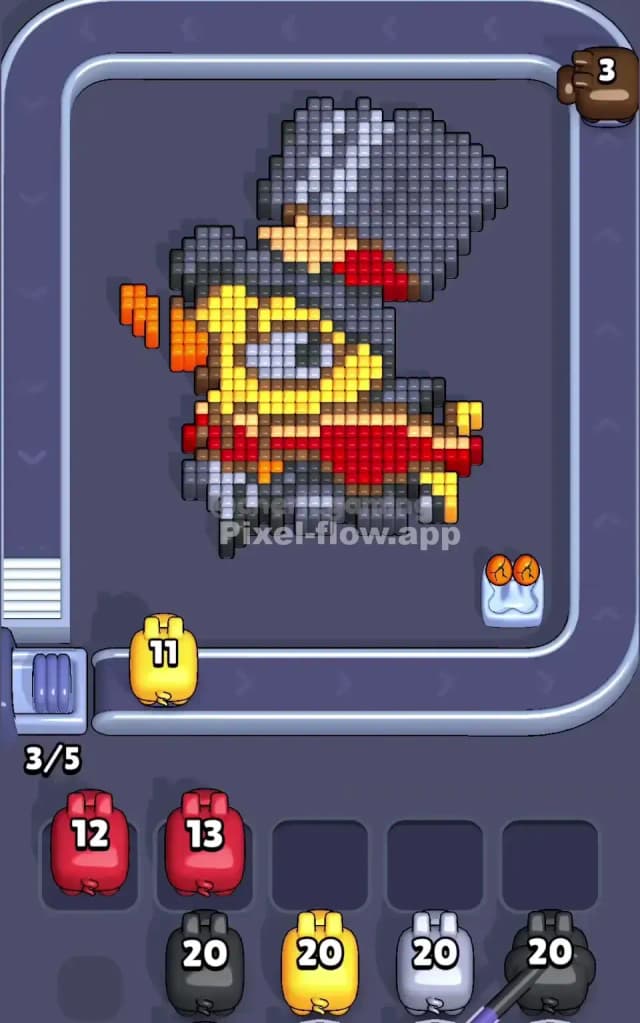
I start by targeting the massive top hat. Why? Because it clears vertical lanes. By removing the top hat's brim and the main stovepipe section, you expose the forehead and the monocle area. If you try to run the Yellow pigs first, they might hit the beak, but then they’ll just sit in your waiting slots because the rest of the yellow face is buried under the hat's shadow. Clear the dark grey. It opens up the board faster than any other move.
How to pass Pixel Flow Level 308 without power ups or boosters
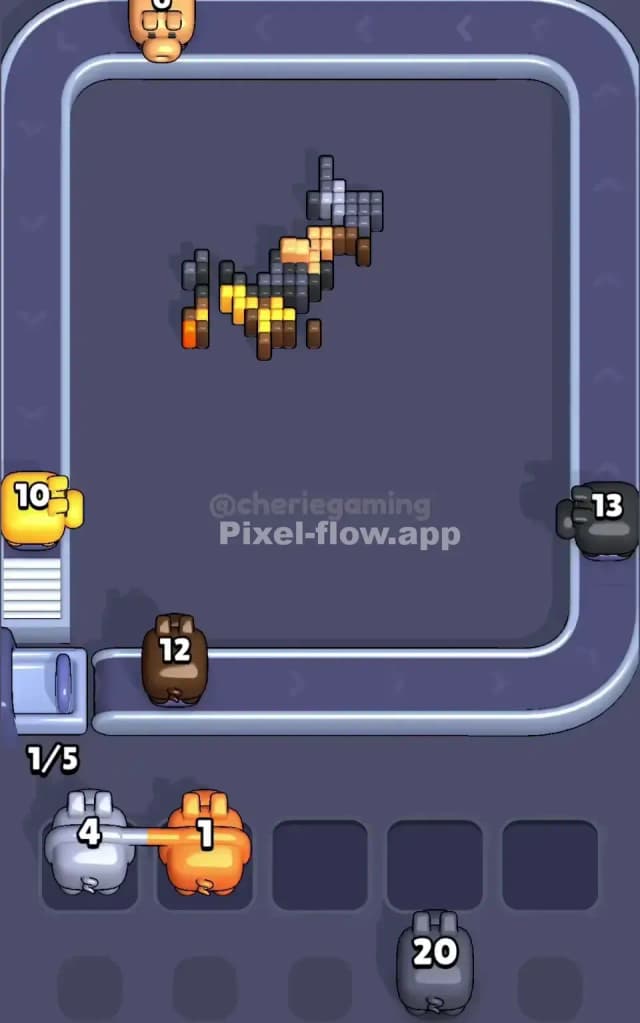
Once you’ve shaved off the hat and the outer layer of the back, the picture looks like a weird skeleton. You’ll see the bright yellow face and the red scarf floating in space.
At this mid-stage, the trap is the Red Scarf. The red pixels are often buried under the "chin" of the duck or tucked behind the white shirt collar.
Here is the priority shift:
- Finish the Greys: Even after the hat is gone, there are light grey pixels on the monocle and the shirt collar. Get rid of them. The White/Light Grey pig is usually high-capacity (20 ammo). Don't let him clog a slot waiting for three measly pixels. Clear them all.
- The Yellow/Orange Split: You will see a lot of Orange on the beak and Yellow on the face. These colors are often intermixed. Watch the conveyor belt. If an Orange pig comes up, ensure the beak is actually exposed. Often, a single black pixel remains on the tip of the beak. If you haven't cleared that black pixel, the Orange pig is useless.
- The Red Trap: Do not pull the Red pig until you have a clear shot at the entire scarf. The scarf wraps around the neck. The left side of the scarf is usually exposed early, but the right side is buried under the back feathers. If you pull Red too early, he shoots 5 shots and then sits in your slot, blocking you from finishing the Black layer.
Refusing power-ups means you must count shots. If a pig has 20 ammo, do not pull him if there are only 4 visible target blocks. He will never leave your waiting slot. He will sit there. He will end your run. Wait until the rotation brings a Black pig to clear the obstruction.
Last Details You Clean Up in Pixel Flow Level 308
The end game usually leaves you with the Monocle and the Collar.
The monocle is tricky. It has a mix of white (glass reflection) and grey (rim). The game often hides a single dark grey pixel right in the center of the eye. You think you are done with the dark colors, but that one pixel prevents the Yellow pig from clearing the face behind it.
Double-check the bottom right corner. The duck's tail feathers often have a lingering brown or dark grey pixel that blends into the shadow. Clean that corner. Once the heavy outline is gone, the bright inner colors (Yellow face, Red scarf) vanish in seconds. The structure collapses. You win.