Pixel Flow Level 320 Solution Walkthrough | Pixel Flow 320
How to solve Pixel Flow level 320? Get instant solution for Pixel Flow 320 with our step by step solution & video walkthrough.


Pixel Flow Level 320 Overview
The Board Layout and Pixel Art Subject
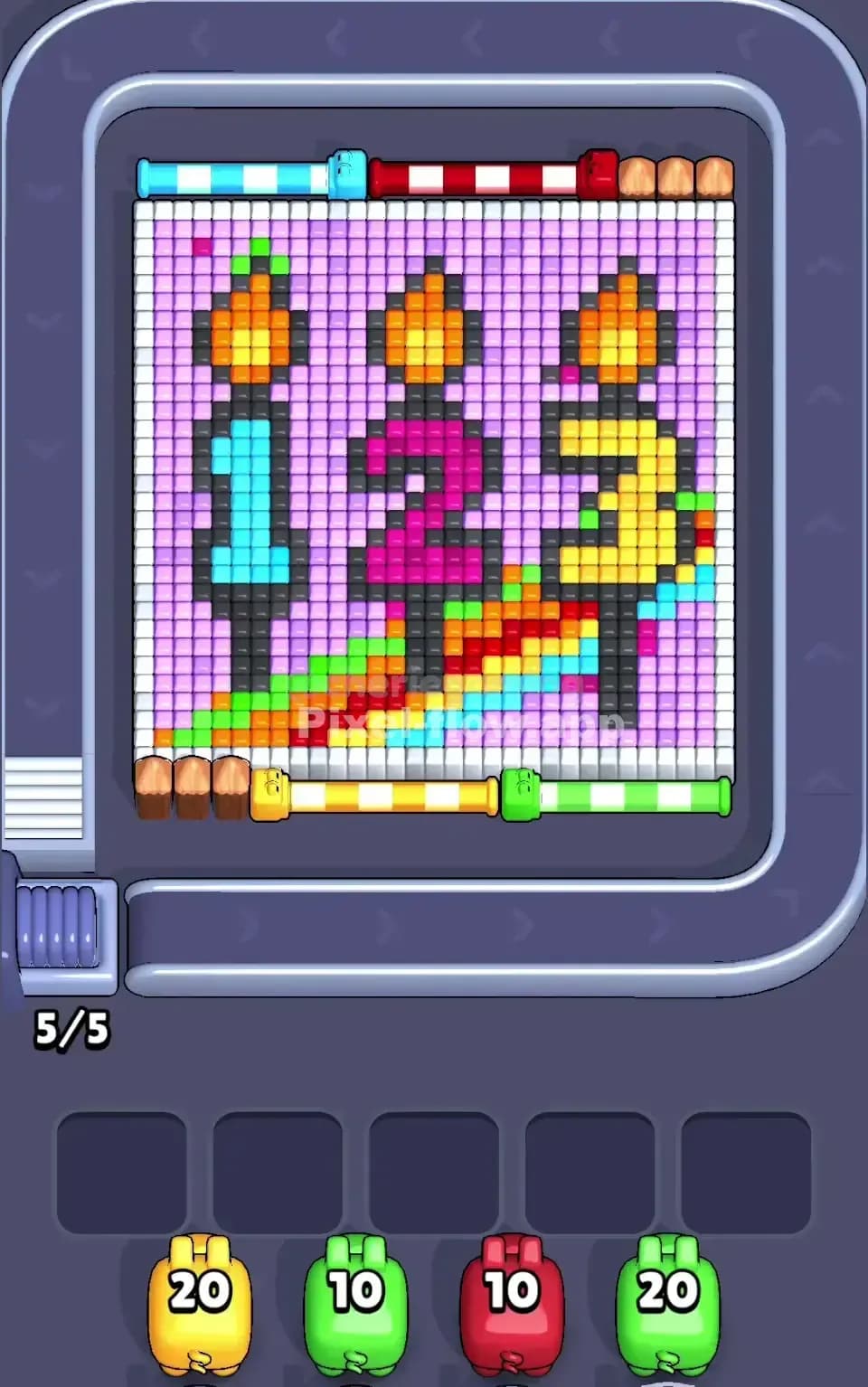
Pixel Flow Level 320 presents a vibrant, multi-layered voxel puzzle featuring three birthday candles—each with a distinctive flame—set against a lavender background. The candles are rendered in cyan, magenta, and yellow, with orange and red flames that sit atop darker wicks. A colorful rainbow arc sweeps across the lower portion of the board, incorporating greens, reds, oranges, and cyan hues. The board is densely packed, which means you're working with multiple color layers that'll need careful sequencing to expose and clear. The dominant colors you'll battle are pink (the background), yellow, cyan, magenta, orange, red, green, and black (the wicks). Don't let the "birthday" theme fool you—this level demands precision and forward thinking.
Win Condition and Deterministic Mechanics
Your goal in Pixel Flow Level 320 is to clear every single voxel cube from the board by strategically releasing color-coded pigs from the conveyor belt. Each pig shoots cubes of its own color; their ammo counts are fixed and deterministic, meaning every run plays out the same way if you make identical decisions. You've got four pigs waiting at the top: a yellow pig with 20 ammo, a green pig with 10 ammo, a red pig with 10 ammo, and another green pig with 20 ammo. The win condition is simple in concept but tricky in execution—eliminate all cubes without jamming your five waiting slots with "stuck" pigs that can't spend their remaining ammo. Understanding the order of your pig queue and planning which pigs to release when is the backbone of beating Pixel Flow Level 320.
Why Pixel Flow Level 320 Feels So Tricky
The Critical Bottleneck
The biggest threat in Pixel Flow Level 320 is the sheer density of pink background cubes mixed with the other colored layers. Pink is everywhere, forming the backdrop, and it's not directly shootable by any of your four pigs. That means the pink cubes will only clear when you've exposed the deeper layers beneath them or when they're part of an outer shell that gets removed naturally. Here's where the panic sets in: if you release pigs in the wrong order, you'll quickly find yourself with half-spent pigs sitting in your waiting slots, unable to target anything visible, while their ammo ticks away unused. This is the classic Pixel Flow Level 320 jam scenario. You might have a yellow pig with 8 ammo left, but all visible yellow cubes are gone, buried under pink. That pig drops into a waiting slot and stays there, blocking your progress.
Awkward Color Patches and Hidden Layers
The candle flames in Pixel Flow Level 320 create a secondary bottleneck. The orange flame sits in the upper-middle region, but there aren't many orange cubes visible at the start—most of them are tucked behind or within the darker wicks and surrounding layers. If you're not careful, you might expose orange cubes too late or burn through other colors prematurely, leaving orange stranded. Similarly, the magenta candle in the center has a compact, tightly arranged design; its magenta cubes are intertwined with black wicks and cyan backgrounds. The green of the rainbow arc at the bottom seems abundant, but some of it is layered under the red and orange sections, so releasing green pigs before exposing those upper layers is wasteful. The red pig in your queue has exactly 10 ammo, and if the red cubes in Pixel Flow Level 320 are scattered across multiple depths, miscounting can leave you with a stuck red pig and no recovery path.
The "Click" Moment
I'll be honest—Pixel Flow Level 320 frustrated me initially because I was releasing pigs reactively, chasing visible colors without considering what layers lay beneath. It wasn't until my third or fourth attempt that I realized the rainbow arc and the candle wicks formed a kind of "unlocking sequence." Once I started clearing the outer pink and yellow shells first, then strategically releasing green to expose the arc's depth, the rest of the puzzle suddenly made sense. The level "clicked" when I understood that some pigs are sacrificial—they're meant to clear surface clutter so that later pigs can access their true targets. That mental shift from "shoot all visible cubes of my color" to "unlock the board for future pigs" changed everything about my approach to Pixel Flow Level 320.
Step-by-Step Strategy to Clear Pixel Flow Level 320
Opening: Establish Your Buffer and Clear the Outer Shell
Start by releasing your first yellow pig (20 ammo) immediately. Yellow is relatively abundant on the board—you'll see it in the candle flames and scattered throughout the middle sections. Yellow will clear a good chunk of the outer pink layer, exposing deeper colors. Don't worry if your yellow pig doesn't spend all 20 ammo on the first shot; that's actually fine because yellow will likely have valid targets throughout Pixel Flow Level 320. After yellow, hold back and observe. You should still have at least three free waiting slots. Next, release the first green pig (10 ammo). Green is concentrated in the lower rainbow arc and some scattered spots. This pig will begin to expose the red and orange layers beneath the arc's surface. Keep at least two waiting slots free at all times during the opening—this buffer is your safety margin against premature jamming.
Mid-Game: Layer Exposure and Ammo Precision
Once yellow and the first green are working, release your red pig (10 ammo). The red cubes in Pixel Flow Level 320 are part of both the flame section and the rainbow arc, so this pig will have targets throughout the mid-game. Red's role is to continue peeling back layers and exposing the black wicks and cyan elements beneath. As red fires, monitor your waiting slots obsessively. If a pig drops into a slot before you've released the second green pig (20 ammo), that's usually fine—you've still got breathing room. Once red has spent its ammo or gotten stuck (don't panic if it does), release your second green pig. This pig has 20 ammo, significantly more than the first green, and it'll finish cleaning up the rainbow arc and any remaining green-colored sections. The second green is your workhorse for the mid-game stretch in Pixel Flow Level 320; it'll unlock critical patches that have been blocked since the start.
End-Game: The Final Cleanup and Buffer Management
As you enter the final stages of Pixel Flow Level 320, you should have one or two pigs already sitting in your waiting slots, likely running low on ammo or completely spent. Your goal now is to ensure that every remaining cube gets targeted by an available pig before the waiting slots completely fill. Count the visible cyan, magenta, orange, and any remaining yellow or pink cubes. If you've followed the mid-game sequence, most of these should be exposed by now. The black wicks might still be partially hidden, but they'll clear as collateral damage or when their adjacent colored cubes fall. Watch for any pig that still has ammo but no visible targets of its color—that's your signal to either release another pig to expose new layers or accept that pig into a waiting slot. The final moves should feel clean: knock out the last few colored sections in rapid succession, and you'll see the board clear completely. If you've managed your buffer correctly, you'll finish Pixel Flow Level 320 with pigs still firing or settling peacefully into slots without triggering a game-over jam.
The Logic Behind This Pixel Flow Level 320 Plan
Exploiting Determinism and Sequence Control
The strategy I've outlined for Pixel Flow Level 320 works because it respects the game's deterministic rules. Your four pigs are fixed in order, with exact ammo counts, and that predictability is your greatest ally. By releasing yellow first, you're leveraging its abundance to clear the low-hanging fruit and expose the board's deeper secrets. The first green pig is a probing tool; it's testing the rainbow arc and mid-layers without committing your heavy hitter (the second green with 20 ammo) until you're sure of what lies beneath. Red, sandwiched in the middle, cleans up the tricky overlap zones where flames, wicks, and arcs intersect. This sequencing isn't random—it's built on the principle that each pig should inherit a board state that maximizes its ammo efficiency. The second green pig, arriving late with the most ammo, mops up anything that earlier pigs couldn't target, ensuring minimal waste in Pixel Flow Level 320.
Staying Calm Under Pressure: Watching, Counting, Planning Ahead
Pixel Flow Level 320 will test your patience, so here's the mental framework I use: before releasing each pig, take a five-second pause. Scan the board for visible cubes of that pig's color. Count roughly how many there are—if it's fewer than half the pig's ammo, that pig will likely get stuck. That's not a disaster; it just means you need to plan the next pig release very carefully. Watch your waiting slots like a hawk. If three slots are suddenly full after a single pig release, something went wrong—you likely released a pig into a color desert. Re-evaluate and plan two pigs ahead, not one. Ask yourself: "If this pig gets stuck, do I have another pig coming that can expose new layers for it?" If the answer is no, reconsider the release order or accept that you're entering a risky phase of Pixel Flow Level 320. The level rewards forward thinking, not frantic clicking. Every decision should feel intentional. Once you internalize that rhythm—observe, count, plan, release—Pixel Flow Level 320 transforms from a frustrating puzzle into a satisfying sequence of logical steps.