Pixel Flow Level 323 Solution | Pixel Flow 323 Walkthrough
How to beat Pixel Flow Level 323: Video solution & walkthrough. The fastest way to pass Pixel Flow 323.
Is this the wrong level layout?🤔
Pixel Flow randomizes levels for different players. Don't worry, just upload a screenshot of your board, and our AI will find the correct video instantly.
Pixel Flow Level 323 Walkthrough
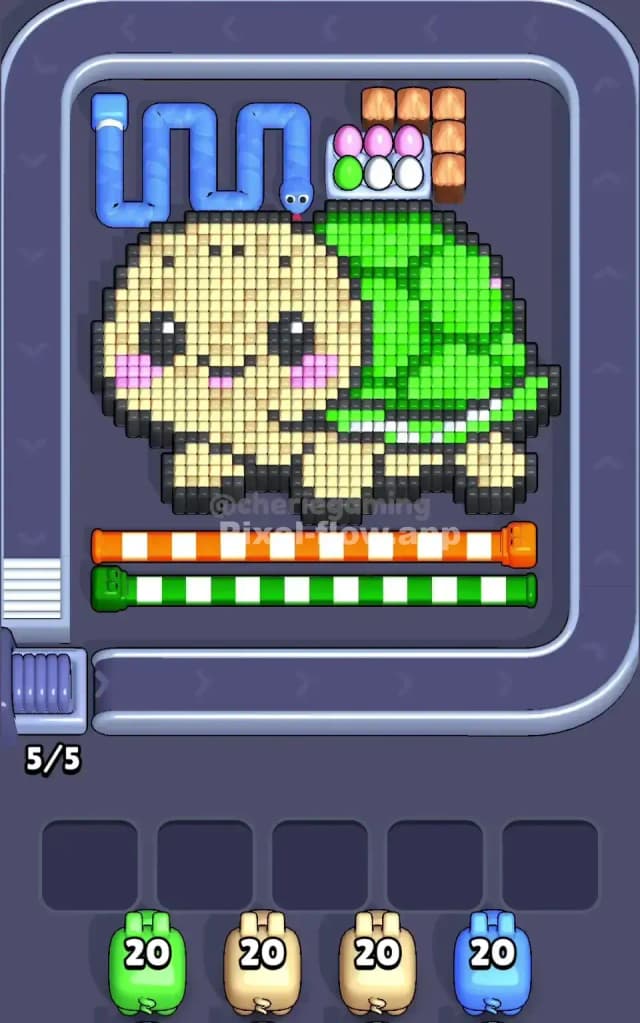
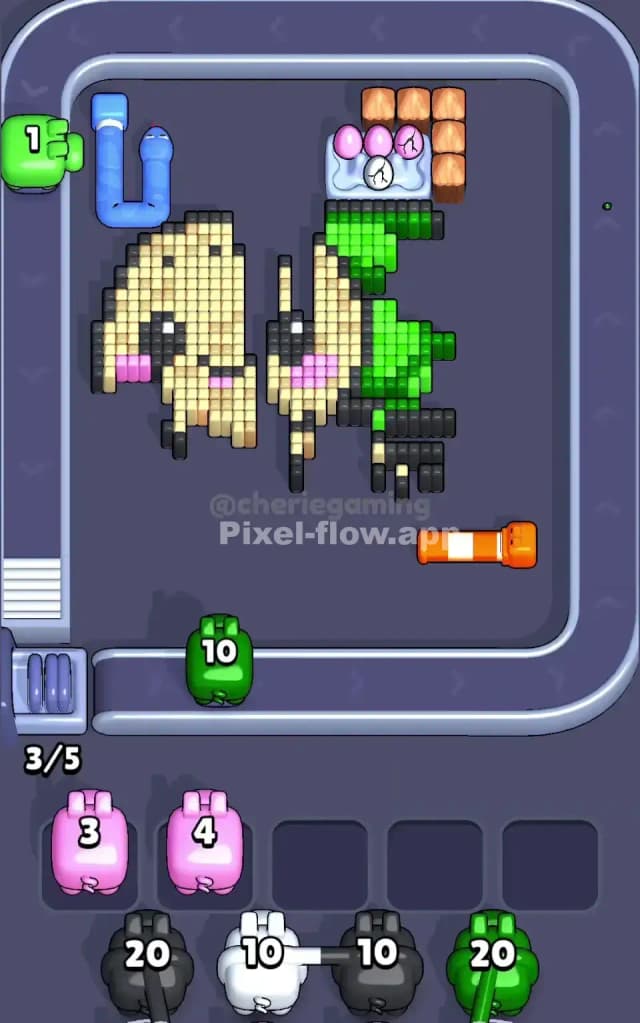
This level features a large, adorable voxel turtle, but don't let the cute face fool you. This is a tactical nightmare disguised as pixel art. You are dealing with a massive central figure surrounded by annoying perimeter clutter: a blue snake pipe in the top left, a carton of eggs on crates in the top right, and two horizontal barrier pipes (orange and green) guarding the bottom.
To beat Pixel Flow Level 323, you have to peel this onion from the bottom up. The horizontal pipes block your shots to the main turtle. If you don't clear them, your pigs will just bounce off or sit uselessly in your slots. Because of these layered defenses and the sheer volume of pixels in the turtle’s head, I judge this to be a very hard level.
Pixel Flow Level 323 Overview
The artwork here is a happy turtle with a massive beige head and a bright green shell. It feels deceptively cheerful. The composition is heavily weighted toward the bottom-center, where the turtle sits.
However, the real story of this level is the obstructions.
- The Bottom Gatekeepers: You have a Green striped pipe at the very bottom and an Orange striped pipe right above it. These are your primary antagonists. They physically shield the bottom rows of the turtle.
- The Top Corners: The top left has a winding Blue Snake structure. The top right has a crate holding "eggs" (Pink, Green, White pixels). These are easy to forget about while you focus on the turtle, but they will clog your waiting slots if you don't clear them when the specific colors appear on the belt.
- Asymmetry: The left side is dominated by the huge beige block of the turtle's face. The right side is mostly the green shell. This means your Beige pigs will do heavy lifting on the left, while Green pigs are needed on the right.
Step by step solution walkthrough for Pixel Flow Level 323
First Color Zone to Erase in Pixel Flow Level 323
Target the Green Bottom Barrier immediately.
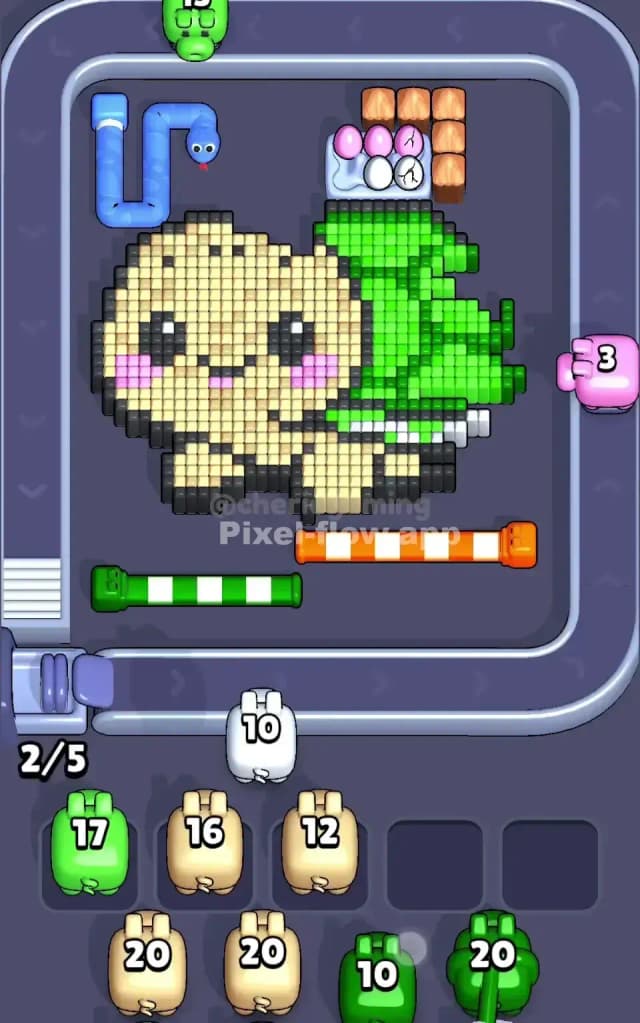
Look at your starting lineup. You likely have a Green pig with 20 ammo. Do not waste time looking at the shell. That Green barrier at the very bottom is the absolute first priority. It spans the entire width of the board and blocks access to almost everything behind it.
Until that green pipe is smashed, your other pigs might struggle to find valid targets lower down. By sending the Green pig out first, you kill two birds with one stone: you destroy the bottom barrier and you start chipping away at the turtle's green shell on the right side. This opens up the board for the Orange barrier (if you get an Orange pig) or allows you to start sniping the turtle's feet.
If you let that green pipe sit there, it will act as a shield, and your slots will fill up with useless pigs. Smash it.
How to pass Pixel Flow Level 323 without power ups or boosters
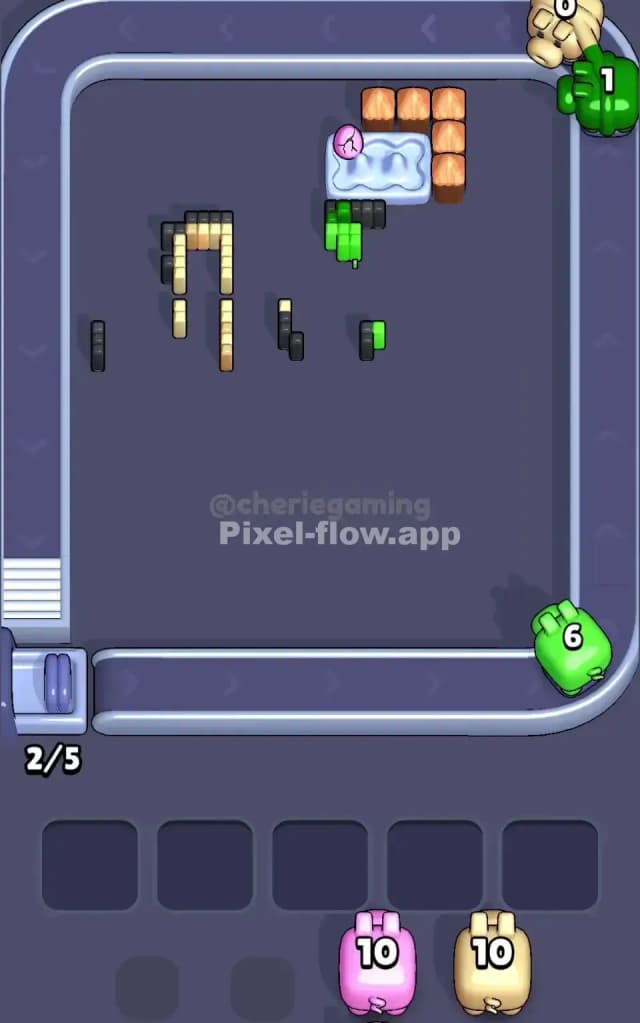
Once the bottom green pipe is gone, the level enters a dangerous middle phase. You will see the turtle getting sliced up, but the Beige color is going to be a problem.
The turtle's head is a massive block of beige pixels. You need to prioritize Beige pigs whenever they appear on the belt. Do not let them drop into your waiting slots if you can help it. If a Beige pig is on the belt and has a clear shot, take it immediately. The surface area is so large that a single pig often won't finish the job, so you need to keep that color cycling through.
Simultaneously, keep an eye on the Blue Snake in the top left. It’s isolated. When a Blue pig appears, use it to wipe that snake out. If you ignore the snake, you'll end up with a Blue pig stuck in your hold slot at the end of the game with no other blue blocks to shoot at, forcing a loss.
At this stage, your board should look like a half-eaten sandwich. The bottom barriers are gone, the shell is half-cracked, and you are just chewing through the massive HP of the beige head. Stick to the plan: clear the "rare" colors (Blue, Pink from the cheeks/eggs) as soon as they appear so they don't clog your slots, and dump massive ammo into the Beige and Green zones whenever possible.
Last Details You Clean Up in Pixel Flow Level 323
The end game usually revolves around the Top Right Corner and the Black Outlines.
The egg carton on the crates is tricky because it contains mixed pixels—White, Green, and Pink. You might find yourself with a tiny patch of white or pink left over there. Save a small ammo pig for these. Do not waste a full 20-ammo pig on 3 pixels if you can avoid it, but often you have no choice.
Finally, the black outline of the turtle is often the last thing to survive. It wraps around the whole figure. Make sure you keep a Black pig in reserve or on the belt to clean up these edges. If you clear the inside colors but leave the black outline, it becomes a "cage" that is annoying to hit if your aim isn't perfect. Clear the outline, pop the last egg, and you’re done.