Pixel Flow Level 348 Solution | Pixel Flow 348 Walkthrough
How to beat Pixel Flow Level 348: Video solution & walkthrough. The fastest way to pass Pixel Flow 348.
Is this the wrong level layout?🤔
Pixel Flow randomizes levels for different players. Don't worry, just upload a screenshot of your board, and our AI will find the correct video instantly.

Pixel Flow Level 348 Walkthrough
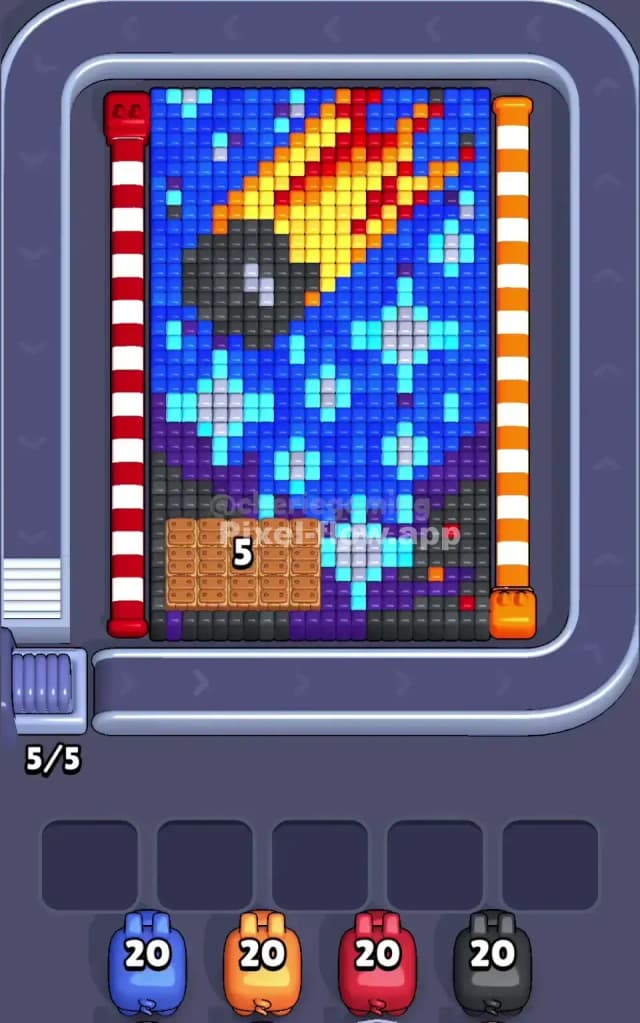
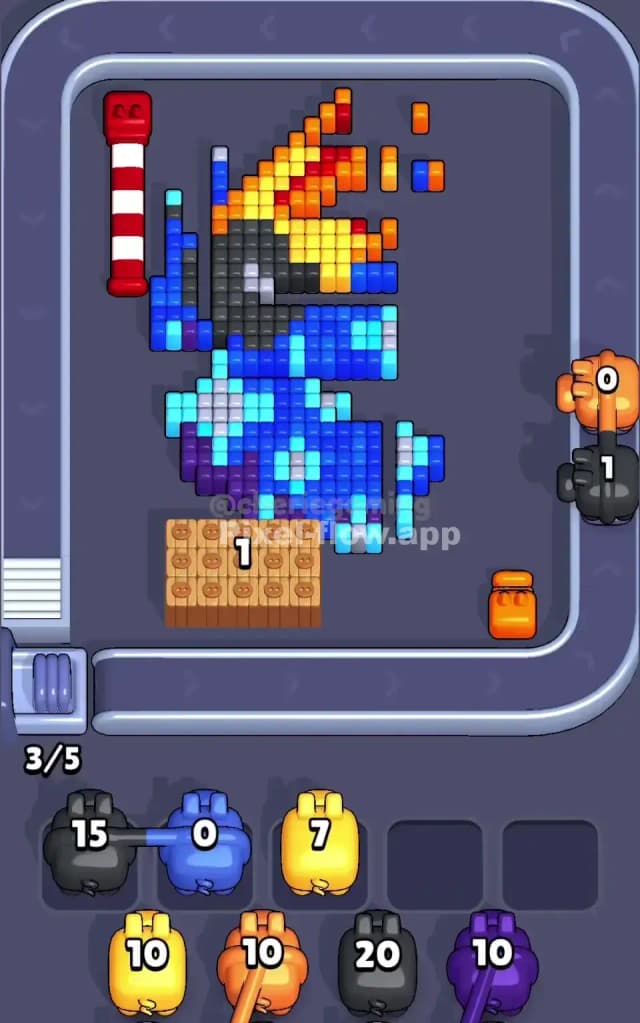
You are looking at a classic space scene here. The artwork features a massive, fiery comet streaking diagonally across a dark, starry night sky. The comet has a black and grey rocky core at the front, trailing a massive tail made of yellow, orange, and red pixels. The background is a heavy layer of dark blue, speckled with lighter blue "stars" in cross patterns. In the bottom left corner, you have a distinct annoyance: a wooden crate labeled with the number 5.
The rules for Pixel Flow Level 348 are strict. You have to peel back the layers of the sky to reach the comet, but that wooden crate acts as a shield for the bottom-left pixels. You need to clear colors adjacent to it or prioritize colors that aren't blocked by it to succeed. Because of the density of the blue background and the tricky gradient of the comet's tail, this is a very hard level.
Pixel Flow Level 348 Overview
This level tells a clear story of motion. The comet is crashing down from the top center towards the bottom right. The visuals are dominated by the contrast between the cool colors of the background (Deep Blue, Light Blue, Purple) and the hot colors of the projectile (Yellow, Orange, Red).
The board is highly asymmetric. The top right corner is filled with the fiery exhaust of the comet, while the bottom left is dark and heavy, anchored by that wooden crate. This crate is a major problem. It sits directly on top of the purple and dark grey sections at the bottom. Until you deal with the colors surrounding that crate, a significant chunk of the board is effectively a "no-fly zone."
The stars are another visual trick. They aren't just background noise; they are clusters of Light Blue pixels embedded in the Dark Blue. If you aren't careful, you might grab a Light Blue pig thinking you can clear the sky, only to find those stars are buried under a layer of Dark Blue you haven't cleared yet.
Step by step solution walkthrough for Pixel Flow Level 348
First Color Zone to Erase in Pixel Flow Level 348
Your first move must be the Dark Blue.
Here is the logic. The Dark Blue acts as the "wrapper" for the entire scene. It surrounds the comet, fills the gaps between the tail flames, and covers the bottom right corner completely. It is the topmost layer for about 60% of the board.
- Look at your pig queue. You will likely see Blue pigs early on.
- Do not try to snipe the Yellow or Orange of the comet tail yet. Those colors are often interleaved with the blue sky.
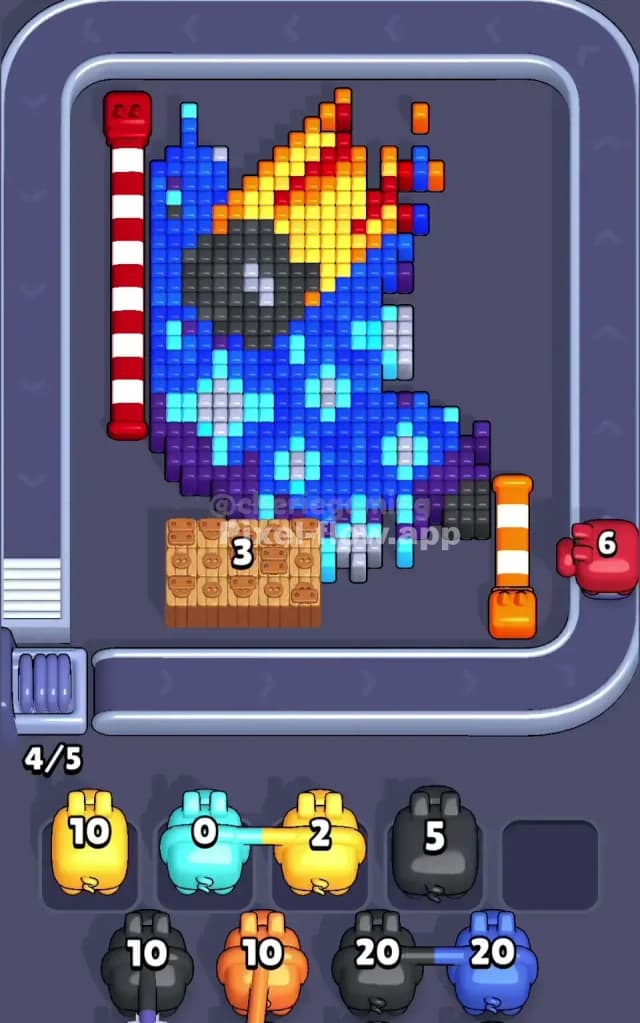
- By clearing the Dark Blue first, you accomplish two things. First, you expose the Light Blue stars which are often on a lower layer. Second, and most importantly, you start clearing the pixels around the Wooden Crate. The crate needs space to be resolved, or you simply need to clear the interference so your pigs can aim at the purple and black pixels hiding behind or near it.
If you ignore the Dark Blue and try to rush the comet, you will clog your waiting slots. The comet colors are too tightly packed to be a safe opening move.
How to pass Pixel Flow Level 348 without power ups or boosters
Once the main blue sky is stripped away, the level looks like a floating skeleton of a comet. This is the danger zone. You are left with the fiery gradient of the tail (Yellow, Orange, Red) and the solid head (Black/Grey).
The trap in Pixel Flow Level 348 is the gradient. The tail transitions from Yellow to Orange to Red. Often, these colors are stacked.
- Watch the Tail Order: Visually inspect the tail. Is the Red outlining the Orange? Or is the Yellow the outer shell? usually, in this art style, the brighter color (Yellow) is the core, and the darker colors (Red/Orange) frame it. However, sometimes the "flames" overlap.
- Prioritize the Edge: Look for the pixels that have nothing touching their outer side. If you see a Red pixel at the very tip of a flame with empty space next to it, that color is safe to clear. If you see a Yellow pixel surrounded by Orange, do not pick a Yellow pig. It will just sit in your slot, useless, until you clear the Orange.
- The Crate and Purple: By mid-game, that Wooden Crate should be your focus. The pixels underneath it or directly adjacent (often Purple or Dark Grey) are hard to reach. If you have a pig that matches the color pinned by the crate, play it immediately if the shot is clear. You cannot afford to let that bottom-left corner stagnate while you fiddle with the comet tail.
Last Details You Clean Up in Pixel Flow Level 348
As you enter the final phase of Pixel Flow Level 348, the board usually consists of the comet’s rocky core and scattered "star" debris.
- The Black Core: The head of the comet is a dense block of Black and Grey pixels. These are usually the deepest layer. They are safe to ignore until the very end because they rarely block other colors.
- Stray Light Blue: Keep an eye out for single Light Blue pixels that were part of the star patterns. Sometimes one lone star pixel hides behind a part of the comet tail you just cleared. If you have a Light Blue pig stuck in your slot from the beginning of the game, this is the moment you finally get to use it.
- Final Shot: The last move is almost always clearing that dense black rock or the final Red tip of the flame that was buried deepest in the layer stack.
Clear the sky, peel the flame carefully, and don't let the crate bully you. That is how you beat Pixel Flow 348.