Pixel Flow Level 351 Solution Walkthrough | Pixel Flow 351

How to solve Pixel Flow level 351? Get instant solution for Pixel Flow 351 with our step by step solution & video walkthrough.

Share Pixel Flow Level 351 Guide:
Pixel Flow Level 351 Gameplay
Pixel Flow Level 351 Solution 1
Pixel Flow Level 351 Solution 2
Pixel Flow Level 351 Solution 3

Pixel Flow Level 351 Overview

The Board and Its Structure

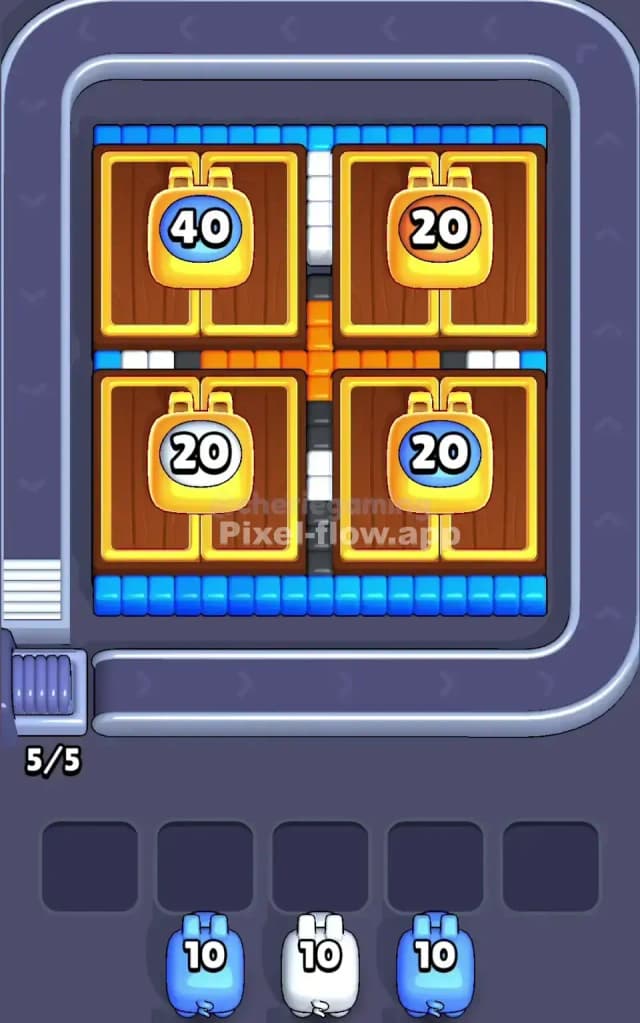
Pixel Flow Level 351 presents a deceptively charming wooden door with a golden padlock displaying the number 40. Surrounding this central door is a vibrant cyan border that serves as both decoration and a crucial part of the puzzle. The main visual challenge here is the layered construction: you're looking at a warm brown wooden door frame in the foreground, with the cyan border forming a secondary color zone behind it. The padlock itself is rendered in gold and yellow tones, creating a third distinct layer. What makes Pixel Flow 351 particularly tricky is that these visual elements aren't just eye candy—they represent the exact order and density of cubes you'll need to clear.

The starting board is roughly symmetrical, with the door occupying the central space and the cyan tiles filling the outer frame. You'll notice immediately that the cyan border dominates the visible cube count, which is important because it hints at which pigs will likely be working overtime. The brown tones of the door are fewer in number but strategically positioned, and the gold/yellow elements of the padlock form a tight cluster that can easily become a bottleneck if you're not careful.

Win Condition and Deterministic Gameplay

Your goal in Pixel Flow Level 351 is straightforward: eliminate every single voxel cube on the board by matching them with incoming pigs of the same color. The satisfying part is that every pig on your conveyor belt has a fixed ammo count—you can see it displayed on their sprite—and that ammo will never change. This means Pixel Flow Level 351 isn't about luck; it's about planning. If you know a cyan pig has 30 ammo and you can identify exactly 30 cyan cubes on the board, you've already solved half the puzzle. The other half is sequencing those pigs in the right order so that as you eliminate surface cubes, you progressively expose deeper layers without jamming your five waiting slots.


Why Pixel Flow Level 351 Feels So Tricky

The Cyan Border Bottleneck

Here's where Pixel Flow Level 351 kicks your confidence in the teeth: the cyan border is absolutely enormous compared to the other color zones. When you start the level, you're staring at what feels like 40–50 cyan cubes arranged in a frame around the central door. That's a lot of real estate to chew through, and if your cyan pig's ammo doesn't match perfectly, or if other pigs get stuck waiting for their turn, you'll quickly fill up your buffer with idle pigs that can't shoot anything. The cyan border is so visually dominant that it's tempting to blast through it immediately—but that's a trap. Rush the cyan early, and you might expose the door layer before you've cleared enough interior structure, leaving you with pigs whose ammo has nowhere to land.

The Awkward Brown Door Layer

The brown wooden door occupies a compressed vertical space in the center of Pixel Flow Level 351, and here's the insidious part: the cubes aren't evenly distributed across its surface. There's a vertical yellow line (the padlock's stem) running down the middle, which breaks the door into left and right halves. If a brown pig arrives and the visible brown cubes are hidden behind cyan, it'll drop into a waiting slot and sit there uselessly, chewing up your buffer capacity. Worse, if you clear cyan in the wrong order, you might expose only one half of the door at a time, forcing the brown pig to waste ammo on one side while the other side remains locked behind unreachable cyan cubes. I've definitely felt the frustration of watching a brown pig spin its wheels while its ammo ticks down on a partially exposed zone.

The Gold/Yellow Padlock Cluster

The padlock itself is small but savage. Those gold and yellow cubes are tightly packed in a space that's roughly 4 cubes wide and 6 cubes tall, sitting directly atop the door's central dividing line. The tricky part is that the padlock might be partially occluded by outer layers, and gold/yellow pigs might arrive at awkward moments when the cluster isn't fully exposed. If a yellow pig shows up with, say, 8 ammo but only 3 yellow cubes are visible, it'll clog the queue while waiting for deeper layers to clear. The number 40 displayed on the padlock isn't a hint—it's a taunt. I spent way too long thinking there'd be some special mechanic tied to that number before I realized I just needed to carefully manage my pig sequencing.

When It Clicks

What finally made Pixel Flow Level 351 click for me was accepting that I had to play defensively. I'd been treating it like a race, blasting away at the biggest color zones first. The real revelation came when I started counting every single visible cube, cross-referencing it with the pig queue, and deliberately planning a path that kept at least two waiting slots empty at all times. Once I stopped reacting and started orchestrating, Pixel Flow Level 351 transformed from frustrating to genuinely satisfying.


Step-by-Step Strategy to Clear Pixel Flow Level 351

Opening: Establish Control and Breathing Room

Start by observing your incoming pig queue without immediately launching an attack. You should see your first pig or two in the conveyor belt—note their colors and ammo counts. For Pixel Flow Level 351, I recommend starting with a non-dominant color, even though it feels counterintuitive. If a brown or yellow pig arrives first and has enough ammo to clear its entire zone, fire it. This accomplishes two things: it removes a potential traffic jam from your queue, and it begins exposing the layers beneath the cyan border.

Your opening priority is maintaining buffer space. Deliberately allow one or two pigs to drop into waiting slots if it means preventing a third pig from getting stuck with nowhere to go. Think of those first five moves as defensive positioning rather than offense. Clear what you can, but don't be greedy. The goal isn't to obliterate a color zone in one go; it's to create pathways for future pigs while keeping your queue flowing.

Mid-Game: Layered Exposure and Ammo Efficiency

Once you've established some breathing room, Pixel Flow Level 351 enters its real puzzle phase. You'll likely have partially cleared the cyan border, exposed patches of brown door, and maybe glimpsed the gold padlock layer beneath. Now the sequencing becomes critical.

When a brown pig arrives, check whether the full door layer is visible or if cyan cubes are still blocking parts of it. If it's partially blocked, consider parking the brown pig in a waiting slot for one or two more cycles. Instead, push forward with any other colors that have full visibility. This way, you're steadily clearing obstructing layers while keeping your ammo counts in sync with cube counts.

The padlock region is your secondary concern during mid-game. Don't force a gold or yellow pig to attack it unless the cubes are fully exposed and the pig's ammo matches the available targets perfectly. Premature padlock engagement will leave you with stuck pigs and an impossibly jammed queue. Focus on reducing the cyan border to a manageable size, and the padlock will naturally become accessible.

Watch your waiting slots constantly. If three slots are occupied and a fourth pig has arrived with no immediate targets, you're in crisis mode. Either find a target for that pig immediately, or prepare to reset and rethink your approach. Pixel Flow Level 351 doesn't punish you for taking time—it punishes you for filling the buffer.

End-Game: The Precision Finish

The final stretch of Pixel Flow Level 351 is where your planning pays off. By now, you've hopefully cleared most of the cyan and brown, leaving the gold/yellow padlock cluster and any remaining scattered cubes. The trick here is emptying your waiting slots in the right order.

Work backward from your pig queue. If you know you have a gold pig coming up, make sure the gold cluster is fully exposed and you have exactly the right number of visible gold cubes to match its ammo. If it's going to overshoot, fire it early into a partially exposed zone to burn ammo safely. Similarly, if you see a cyan pig in the queue and cyan is nearly gone, you might want to hold it in a waiting slot until you've cleared enough of the underlying layers to give it something to shoot.

The very final move should be your easiest: a pig whose ammo perfectly matches the remaining cubes, with no waiting queue, and no risk of overshoot. If you've planned correctly, the last few pigs will drop in, fire in rapid succession, and the board will clear cleanly. That's the satisfaction Pixel Flow Level 351 is built for.


The Logic Behind This Pixel Flow Level 351 Plan

Why This Strategy Works

The strategy I've outlined for Pixel Flow Level 351 exploits the game's deterministic nature. You're not fighting randomness; you're fighting your own impatience. Every pig has a set ammo value, and every cube on the board is countable. The constraint is your five waiting slots, which means you can hold at most five pigs in suspended state at any moment. The strategy works because it respects that constraint religiously, never allowing more than two or three waiting pigs at once, which gives you the flexibility to adapt if a pig arrives with an unexpected color or ammo value.

The layered board structure of Pixel Flow Level 351 rewards strategic thinking. By consciously exposing inner layers through careful outer-layer clearing, you prevent the scenario where a pig arrives with ammo but no targets. You're essentially creating a dynamic puzzle where your actions in moves 1–10 directly determine whether moves 30–40 will succeed or fail.

Staying Calm and Thinking Ahead

Pixel Flow Level 351 is as much a mental game as a mechanical one. Every time a pig arrives, take a breath and ask yourself three questions: (1) Are there targets for this pig right now? (2) If not, how many moves until its targets are exposed? (3) Can I afford to park it in a waiting slot without losing the overall puzzle?

Counting is your superpower. Before committing to a move, count the visible cubes of each color and verify they align with upcoming pig ammo values. Look at your pig queue not as a linear sequence but as a resource to be managed. Sometimes the best move is letting a pig sit, waiting for future moves to create the right conditions.

Once you've internalized the board state and the pig queue for Pixel Flow Level 351, the solution becomes almost obvious. The frustration melts into confidence, and you'll wonder why it took so long to see. That's when you know you've truly mastered Pixel Flow Level 351.