Pixel Flow Level 350 Solution Walkthrough | Pixel Flow 350
How to solve Pixel Flow level 350? Get instant solution for Pixel Flow 350 with our step by step solution & video walkthrough.


Pixel Flow Level 350 Overview
Understanding the Board Layout and Colors
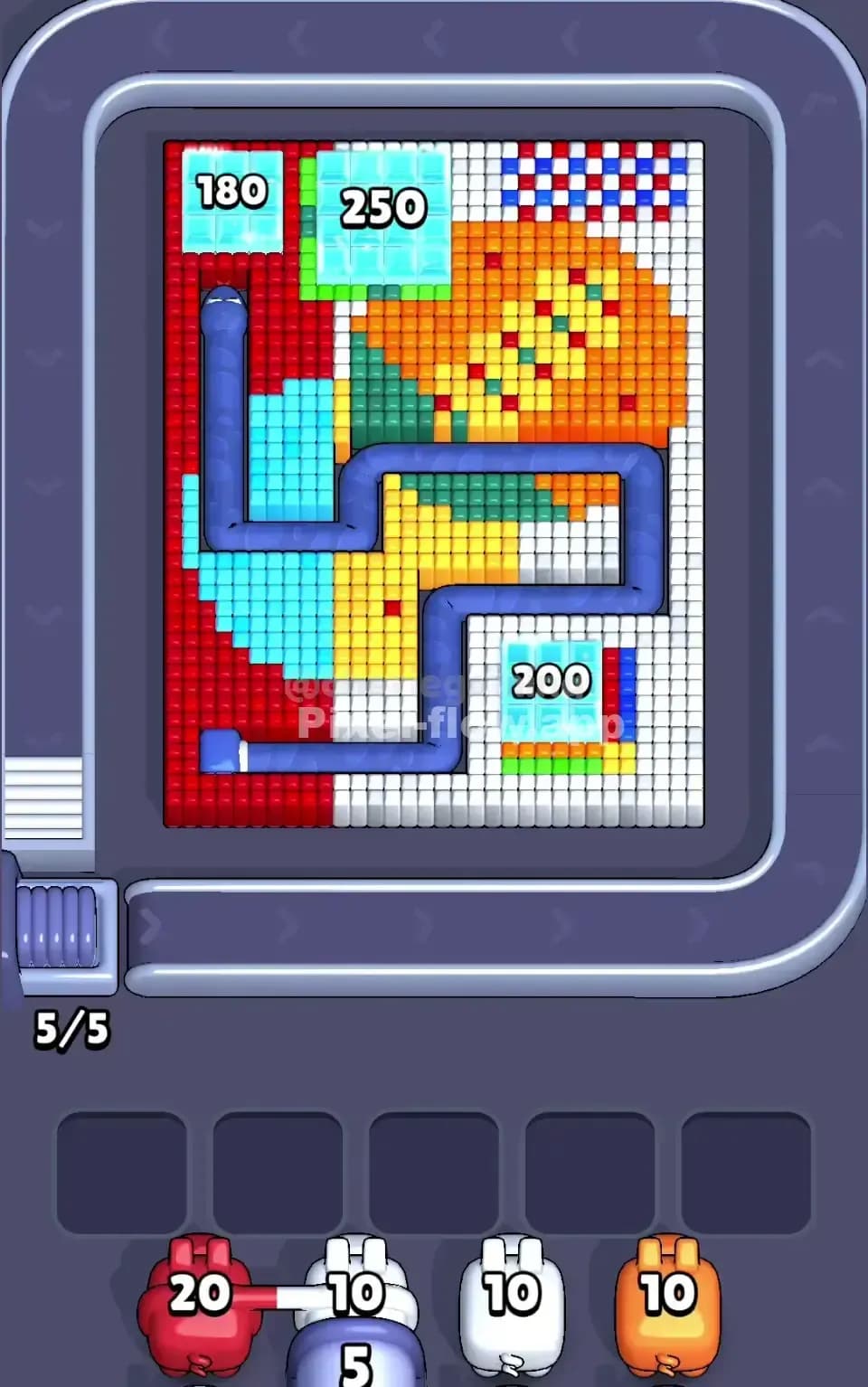
Pixel Flow Level 350 presents you with a vibrant, multi-layered voxel puzzle that demands careful sequencing from the very first move. The board showcases a striking landscape of dominant reds, cyans, whites, yellows, and oranges arranged in distinct regions and depth layers. You'll notice the red section occupies a substantial left-side territory, while cyan clusters appear in the upper-middle area alongside a bright yellow band that runs through the center. The upper right flaunts a checkerboard pattern of blue and red, and white cubes fill gaps throughout—essentially acting as filler that can obstruct your view of deeper colors if you're not strategic about the order you clear them.
What makes Pixel Flow Level 350 particularly interesting is how the colors aren't evenly distributed across the board. Some colors, like cyan, appear in multiple disconnected pockets, which means you'll need to cycle through pigs multiple times or carefully plan which pockets to expose first. The layout strongly suggests there are hidden layers beneath—areas where white cubes currently sit likely conceal additional colors once you clear them away. Understanding this three-dimensional nature of the puzzle is your first step toward a successful run.
Win Condition and Deterministic Nature
Your mission in Pixel Flow Level 350 is straightforward: eliminate every single cube on the board by matching pig colors to cube colors and exhausting each pig's ammo supply. You're currently sitting at 5/5 waiting slots filled, which means you have absolutely zero room for error—any stuck pig with remaining ammo will instantly trigger a failure. The beauty of Pixel Flow 350 lies in its complete determinism: your pig queue and each pig's ammo count never change between attempts. This means once you crack the puzzle, you'll know the exact sequence that works, and you can execute it flawlessly every single time.
Why Pixel Flow Level 350 Feels So Tricky
The Waiting Slot Crunch and Ammo Mismatch
Right from the start, Pixel Flow Level 350 punishes you for hasty decisions because all five waiting slots are already occupied. You're essentially working with zero buffer—the moment your current pig can't find a valid target, it drops into an open slot, and if there isn't one, game over. The real bottleneck emerges when you look at your pig queue: you've got a red pig with 20 ammo, a blue pig with 5 ammo, a white pig with 10 ammo, and an orange pig with 10 ammo. The red pig's 20 ammo is substantial, but only if there are actually 20 red cubes accessible on the board at the right moments. If you activate red too early and expose white cubes instead of more reds, that pig stalls out immediately—and boom, you're forced into a slot with ammo left over.
The cyan situation in Pixel Flow Level 350 is equally deceptive. You've got cyan scattered across multiple regions, and if your blue pig (which presumably targets cyan) runs out of targets before exhausting its 5 ammo, you've just locked up a waiting slot for no reason. This forces you to think backward: which colors must you expose first to ensure every subsequent pig has exactly enough matching cubes to spend its full ammo count?
The Hidden Layer Trap and White Cube Confusion
One of the nastiest gotchas in Pixel Flow Level 350 is the white cubes. They look harmless, almost like empty space, but they're physically blocking your path to whatever lies beneath. If you clear white too aggressively early on, you might expose colors that don't have pigs ready to handle them, leaving you stranded. Conversely, if you ignore white, it keeps jamming your view of the actual layers you need to target. The checkerboard pattern in the upper right is particularly sneaky—those cubes require both blue and red targeting, but only at the exact right moment in your sequence, or you'll find yourself with a half-spent pig and nowhere to dump it.
Personal Reaction and the "Aha" Moment
Honestly, Pixel Flow Level 350 frustrated me for quite a few attempts before everything clicked. I kept thinking "just blast through red first, it's the biggest color," but that naive approach left me with blue and white pigs that had nowhere to go. The level really clicked for me when I stopped looking at the current board state and started looking at what each pig actually needs to succeed. Once I realized that I had to work backward from the final pig, the strategy became crystal clear.
Step-by-Step Strategy to Clear Pixel Flow Level 350
Opening: Exposure Before Commitment
Your opening move in Pixel Flow Level 350 should be surgical and calculated. Start by targeting the red region on the left side, but not all of it—you're aiming to expose cyan cubes that sit beneath or adjacent to the red, because those cyan cubes need to be there for your blue pig to spend its ammo. Fire your red pig roughly 5–6 times to clear the leftmost red area and reveal the cyan pocket hidden underneath. This keeps your waiting slots at a manageable level (you'll have 4 empty slots now), and it sets up your blue pig for immediate success.
After red has taken its initial bite, allow your blue pig to activate and target the exposed cyan. Blue's 5 ammo should correspond to the cyan you've just revealed, so it should spend cleanly without jamming. Watch the queue carefully—if blue still has ammo remaining after the visible cyan is gone, you've made a sequencing error and will need to restart. The key insight for Pixel Flow Level 350 is that you're essentially solving a puzzle in reverse: plan which color must be last (usually the one that appears last on the board or in isolated pockets), then work backward to determine which pig must activate before it.
Mid-Game: Layering and Ammo Precision
Once you've cleared the initial red-cyan pairing, the white pig becomes your next priority. In Pixel Flow Level 350, white cubes act as both a barrier and a revealing layer—they hide deeper colors but must be cleared strategically. Target white aggressively now, using your 10 ammo to expose the yellow band and any additional color pockets beneath. You're aiming to fully expose the yellow region and any hidden orange before your orange pig arrives in the queue.
This is where the mid-game strategy hinges on ammo awareness. Count the yellow cubes visible after your white pig finishes—there should be approximately 10 of them (matching your next pig's ammo), or you've miscalculated and will need to restart. The orange pig should activate last or near-last in Pixel Flow Level 350, which means you're now entering the critical phase where slot management becomes life-or-death. If your white pig doesn't spend all 10 ammo, it parks itself in a slot, and you've got zero room left for safety.
End-Game: The Final Sequence and Slot Management
As you approach the closing stretch of Pixel Flow Level 350, your board should be almost completely cleared, with only isolated pockets of orange and maybe a few scattered whites remaining. Your orange pig's 10 ammo should align almost perfectly with the remaining orange cubes on the board. Fire deliberately and watch for any unexpected color behind the orange—sometimes there are final-layer surprises in Pixel Flow Level 350 that catch you off guard if you're not paying close attention.
The absolute final move in Pixel Flow Level 350 should leave you with zero cubes and zero ammo across all pigs. If any pig has ammo remaining when the board is clear, you've failed (it will drop into a slot, and since there's no room, instant game over). Conversely, if you clear all ammo and some cubes remain, you're also stuck. The victory condition for Pixel Flow Level 350 is razor-thin: all cubes gone, all ammo spent, simultaneous.
The Logic Behind This Pixel Flow Level 350 Plan
Exploiting Determinism and Queue Awareness
What makes this strategy for Pixel Flow Level 350 work is understanding that you're not fighting randomness—you're executing a predetermined sequence that was baked into the level from day one. Every pig has a fixed ammo count, and every cube is permanently placed. This means Pixel Flow Level 350 rewards planning over reflexes. By counting visible cubes of each color and mapping them to your pig queue, you transform the level from a chaotic scramble into a puzzle of pure logic.
The strategy leverages queue visibility: you can always see which pigs are coming next, so you can plan exposures that benefit future pigs. If you know your orange pig is third in queue, you deliberately avoid creating orange targets until the first two pigs have gone. This forward-planning mentality is what separates random button-mashing from a clean, calculated run through Pixel Flow Level 350.
Staying Calm and Counting Two Pigs Ahead
The pressure in Pixel Flow Level 350 stems from the ever-present threat of a jammed waiting slot, but that pressure dissolves the moment you adopt a two-pig-ahead mentality. Before you fire your current pig, ask yourself: "Will this activate the next pig successfully, and will the pig after that have targets ready?" This simple mental check prevents cascading failures. Watch your ammo counter closely—if your red pig has 8 ammo remaining but you only see 3 red cubes left, stop and reassess. You're about to create a jam.
Pixel Flow Level 350 ultimately tests your ability to stay composed, count accurately, and think in layers. Once you've internalized these principles, the level transforms from a frustrating roadblock into a satisfying logic puzzle, and you'll wonder why it ever felt difficult at all.