Pixel Flow Level 384 Solution | Pixel Flow 384 Walkthrough
How to beat Pixel Flow Level 384: Video solution & walkthrough. The fastest way to pass Pixel Flow 384.
Is this the wrong level layout?🤔
Pixel Flow randomizes levels for different players. Don't worry, just upload a screenshot of your board, and our AI will find the correct video instantly.
Pixel Flow Level 384 Walkthrough
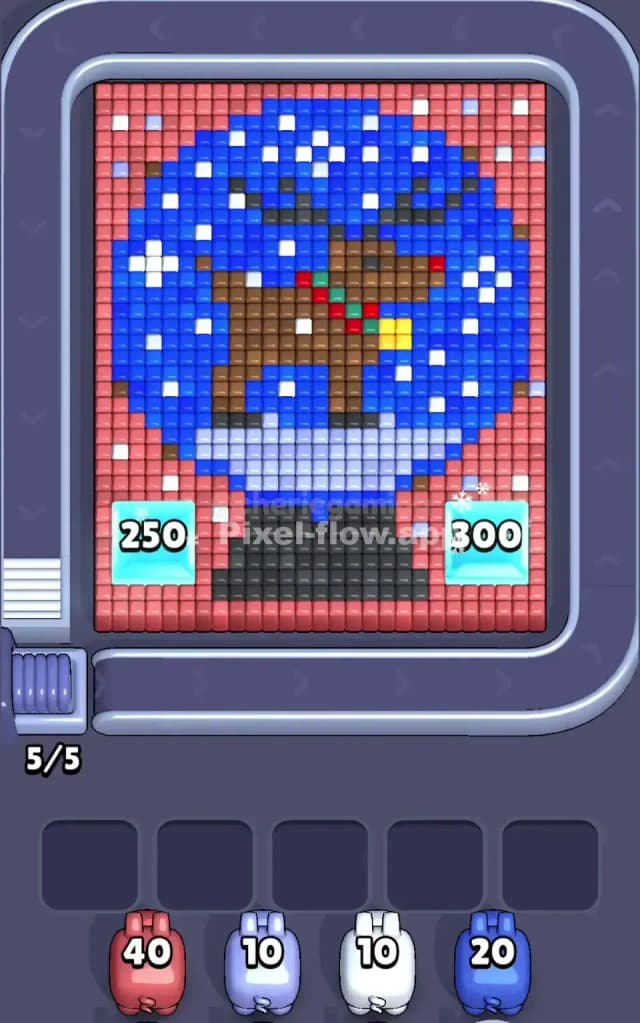
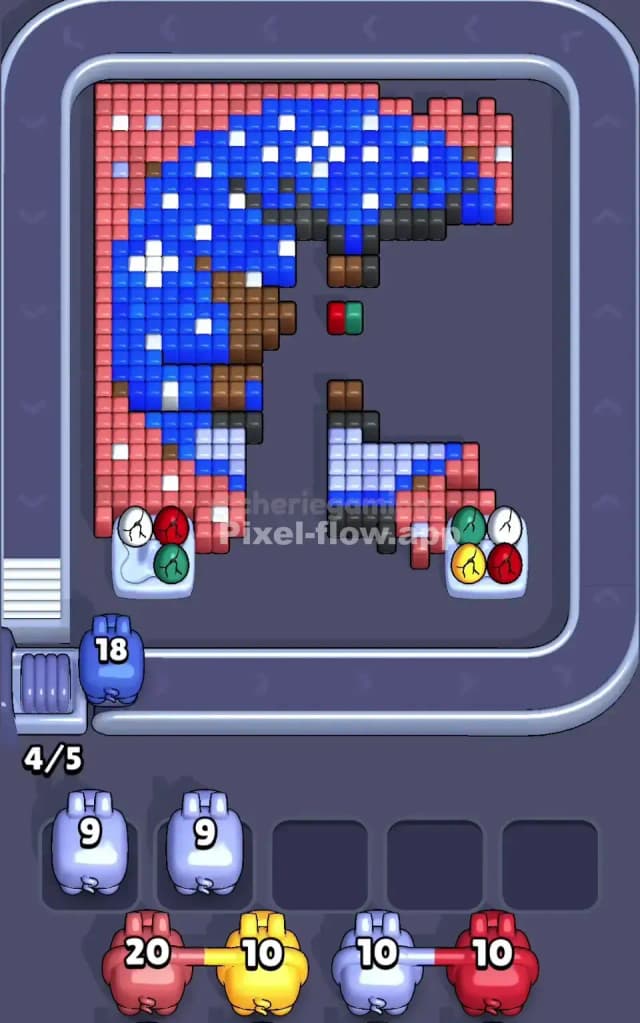
This level is a festive nightmare disguised as a snow globe. You are looking at a giant pixelated sphere containing a brown reindeer, set against a pinkish-red tiled wall. The globe itself is filled with blue "water" and scattered white "snow" voxels. At the bottom, you have a black and grey base, flanked by two massive ice blocks labeled 250 and 300.
Your goal is to strip away the pink wall and the blue water to reach the reindeer inside. Is this a hard level? Yes, it is very hard. The scattered white snow pixels are a logic trap that will clog your waiting slots faster than you can blink.
Pixel Flow Level 384 Overview
Imagine a holiday snow globe that someone shook way too hard. That’s the vibe here. The central character is a brown reindeer with a tiny red and green scarf, frozen in mid-prance. He is encased in a sphere of blue, but the blue is riddled with single white pixels representing snow.
This "noise" is your enemy. In Pixel Flow 384, you don't have clean, solid blocks of color inside the globe. You have a messy mix of Blue and White. The background, however, is a massive, solid field of Pink/Red tiles.
The asymmetry comes from the bottom corners. You have two large ice obstacles blocking the bottom left and right of the globe. These prevent you from getting clean shots at the base of the sphere early on. You are forced to work from the top down.
Step by step solution walkthrough for Pixel Flow Level 384
First Color Zone to Erase in Pixel Flow Level 384
Target the Pink/Red Background immediately. It is the only safe play.
Here is the logic: The pink tiles surrounding the globe are solid. They are not mixed with other colors. When you grab a Pink or Red pig, it will unload its entire ammo clip into that background wall, clearing itself from your board instantly. This keeps your slots empty.
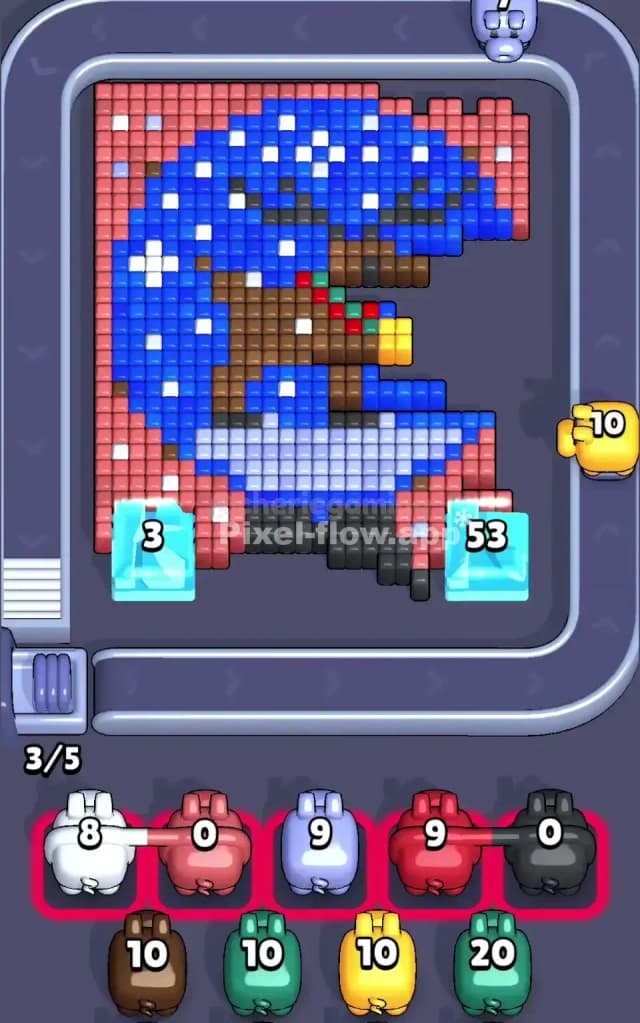
If you try to attack the Blue globe interior too early, you will hit the "Snow Trap." You might grab a Blue pig to clear some water, but that reveals a single White pixel. Then the conveyor belt gives you a White pig. You shoot that one pixel, but the pig still has 9 ammo left and nowhere to shoot. It sits in your slot, blocking traffic. Clear the Pink background first to widen your firing angles before you mess with the messy interior.
How to pass Pixel Flow Level 384 without power ups or boosters
Once the pink wall is down, the level looks half-destroyed, but this is the danger zone. You are left with the Blue sphere mixed with White specks.
- Manage the Snow (White Pixels): This is where you win or lose. Do not pick up a White pig unless you see at least 3-4 accessible white pixels exposed on the surface. If the belt forces a White pig on you and you have no targets, you must pray you have an open slot.
- Peel the Blue: Use Blue pigs aggressively to "shave" the sphere. Your goal isn't just to clear blue; it is to expose the white pixels buried underneath. You need to uncover enough white targets so that when a White pig arrives, it can actually empty its ammo and leave.
- Ignore the Bottom Corners: The ice blocks (250/300) are tanky. Don't obsess over them. Focus on the Reindeer's antlers and head. As you clear the top half of the globe, the game naturally feeds you shots that will eventually chip away at the bottom structures.
Last Details You Clean Up in Pixel Flow Level 384
The endgame of Pixel Flow 384 is usually a scramble to clear the reindeer's accessories and the globe's base.
- The Scarf and Bell: The reindeer has tiny clusters of Green, Red, and Yellow voxels on its neck. These are often buried until the very end. Save a slot for these specific colors.
- The Base Stripes: The stand of the snow globe is made of Black and Grey stripes. These are solid vertical lines. Unlike the snowy blue mess above, these are easy to clear. Once you break through the Blue/Brown layers, the Base is a quick cleanup job.
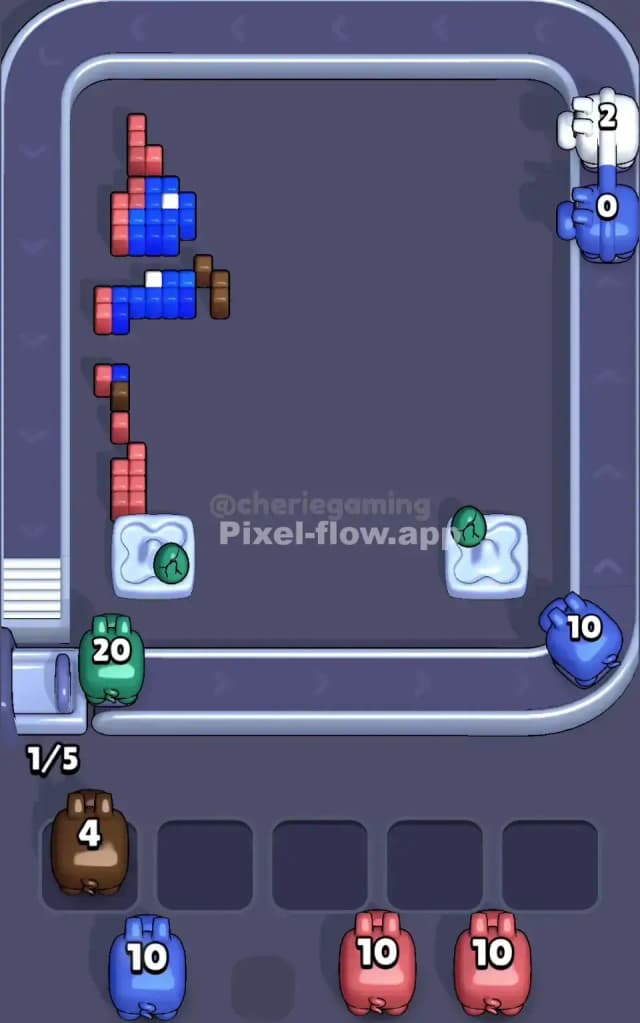
- The Ice Block Loot: Once the 250/300 blocks shatter, they reveal small nests (eggs). These are usually the final few clicks. Ensure you haven't clogged your slots with useless Blue pigs so you can grab the specific colors needed to crack these final eggs.