Pixel Flow Level 39 Solution | Pixel Flow 39 Walkthrough
How to beat Pixel Flow Level 39: Video solution & walkthrough. The fastest way to pass Pixel Flow 39.
Is this the wrong level layout?🤔
Pixel Flow randomizes levels for different players. Don't worry, just upload a screenshot of your board, and our AI will find the correct video instantly.


Pixel Flow Level 39 Walkthrough
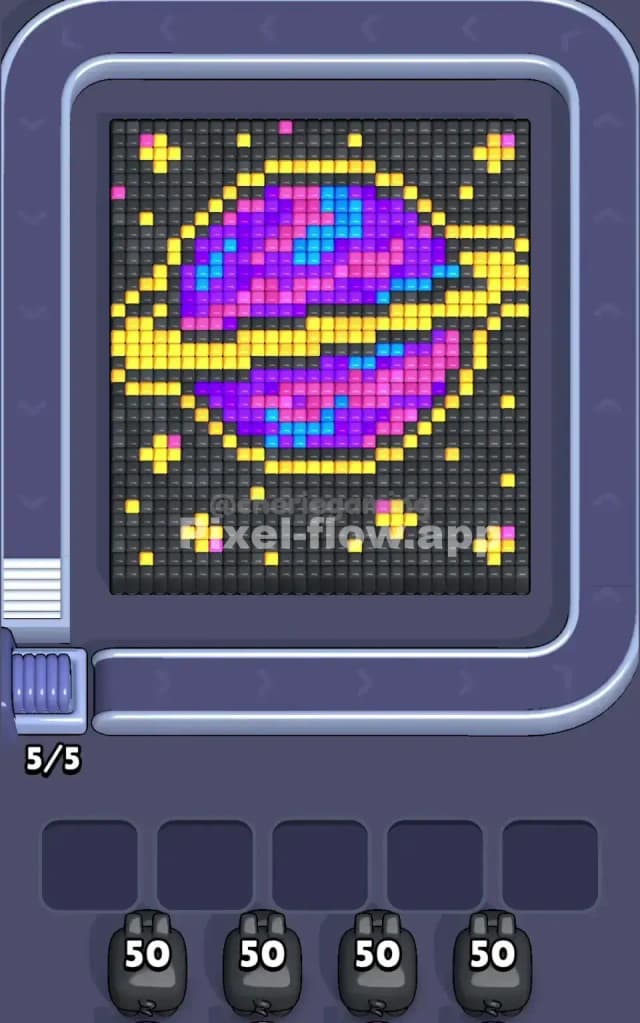
This level features a cosmic pixel art scene: a purple and blue ringed planet (like a stylized Saturn) floating in a sea of black space, sprinkled with yellow stars. The main colors you are fighting against are Black (the background), Yellow (the prominent rings and scattered stars), and a mix of Pink, Purple, and Blue that make up the planet's surface.
The rules are standard: color-coded pigs come down the conveyor belt. You tap them to shoot pixels of the matching color. If a pig runs out of ammo, it disappears. If it has ammo but nothing to shoot, it clogs one of your 5 waiting slots. If all slots fill up with useless pigs, game over.
Is Pixel Flow Level 39 hard? I'd classify it as very hard. The abundance of scattered yellow stars against a black background creates a "checkerboard" effect that makes it incredibly easy to strand a Yellow or Black pig in your waiting slots early on.
Pixel Flow Level 39 Overview
Think of this artwork as a layered planet.
- The Void (Black): The outermost layer is the black space background. It covers everything not part of the planet or stars.
- The Rings & Stars (Yellow): The bright yellow ring cuts horizontally across the middle, and little yellow "+" shaped stars are scattered in the corners.
- The Planet Core (Purple/Pink/Blue): The actual sphere is a messy mix of horizontal stripes in purple, pink, and bright blue.
The danger here is asymmetry in the "noise." The yellow isn't just one big block; it's the ring plus tiny, isolated stars. The black isn't just a border; it fills the gaps between those stars. This means you often need to clear a Black layer to reach a Yellow star, or clear a Yellow star to reveal more Black underneath. It's a trap. You will think you are done with Yellow, but a single pixel hidden under a black block will keep your Yellow pig stuck in the waiting slot.
Step by step solution walkthrough for Pixel Flow Level 39
First Color Zone to Erase in Pixel Flow Level 39
I start by focusing aggressively on the Black background.
Here is the logic: The black pixels are the "glue" holding the scattered yellow stars apart. If you try to clear the Yellow first, you will likely hit the main ring easily, but then your pig will get stuck because the isolated stars in the corners (top left, top right, bottom corners) are blocked by black pixels.
By prioritizing Black pigs whenever they appear, you expose the full layout of the Yellow stars. Do not tap a Yellow pig unless you see a massive clear shot at the main ring and several exposed stars. If you tap Yellow too early, that pig will sit in your slot waiting for you to clear the black pixels covering the corner stars.
How to pass Pixel Flow Level 39 without power ups or boosters
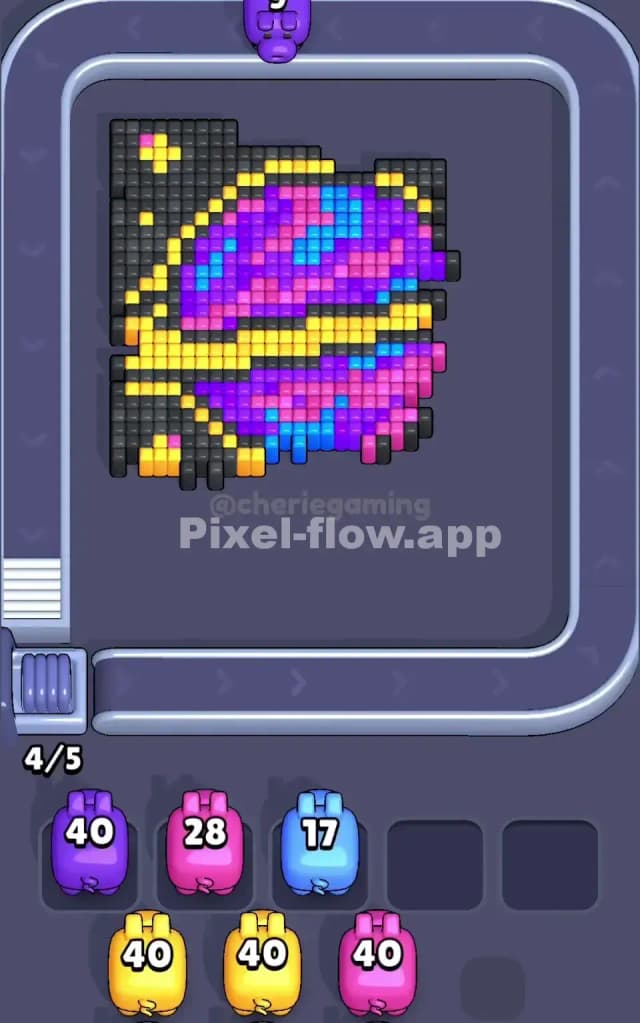
Midway through the level, you will likely have a strange jagged shape remaining. The black background is mostly gone, leaving the planet and a few floating yellow chunks.
At this stage, your biggest threat is the Blue and Pink striping on the planet itself.
- The Trap: The planet's texture is striped horizontally. You might see a lot of Purple, but underneath those purple lines are often Blue or Pink pixels.
- The Fix: Look closely at the "depth" of the remaining blocks. If you see a Purple pig and a Pink pig, check which color is on top. Usually, on the planet sphere, the darker Purple acts as the "shadow" or outer layer. Clear the Purple to reveal the Pink/Blue core.
If your slots are getting full (3 or 4 pigs waiting), stop tapping. Look at the conveyor belt. If a pig matches a color you already have in a slot, let it pass! Wait for the pig in the slot to clear its target. Only add a new color to the slots if you are absolutely sure it can hit at least 10-15 blocks immediately. In Pixel Flow Level 39, patience prevents the "traffic jam" that kills most runs.
Last Details You Clean Up in Pixel Flow Level 39
As you approach the end, the board usually looks like a floating, half-eaten jawbreaker. The rings are gone. The black space is gone. You are left with a few stubborn stripes of the planet's core.
Watch out for Blue. In the final layers, Blue pixels often hide deep inside the center of the planet sphere, underneath the Pink and Purple. You might think you are done with Blue, but suddenly a single blue voxel appears at the very bottom of the stack. Keep a Blue pig handy or available on the belt for this exact moment. Do not waste a slot holding a Blue pig too early, but don't let them all scroll past if you know the core is still untouched. The final move is usually clearing that last deep stripe of blue or pink to finish the sphere.