Pixel Flow Level 38 Solution Walkthrough | Pixel Flow 38
How to solve Pixel Flow level 38? Get instant solution for Pixel Flow 38 with our step by step solution & video walkthrough.


Pixel Flow Level 38 Overview
The Board Layout and Pixel Art Subject
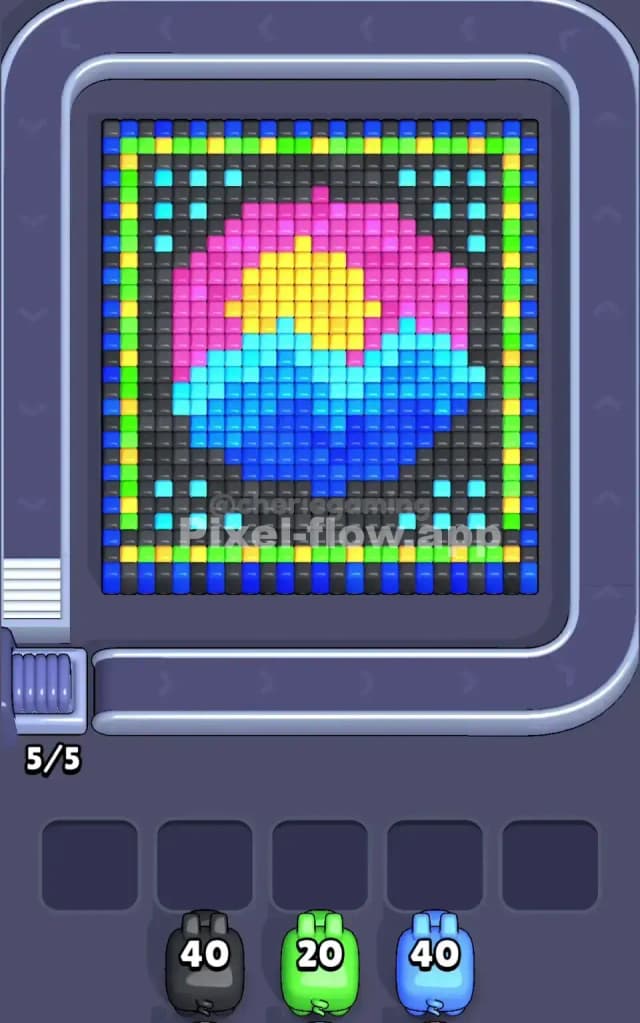
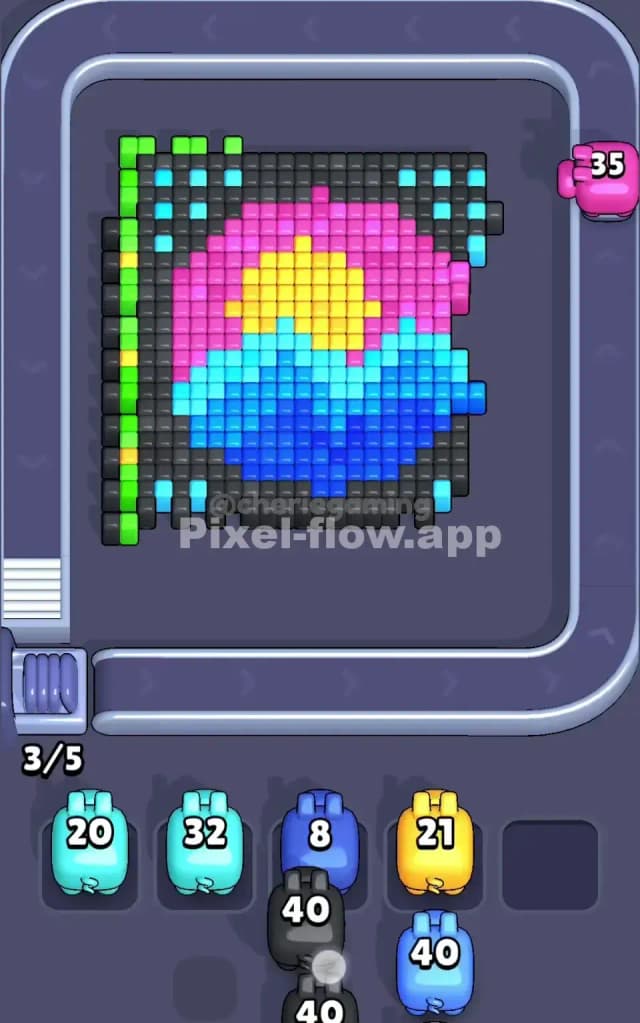
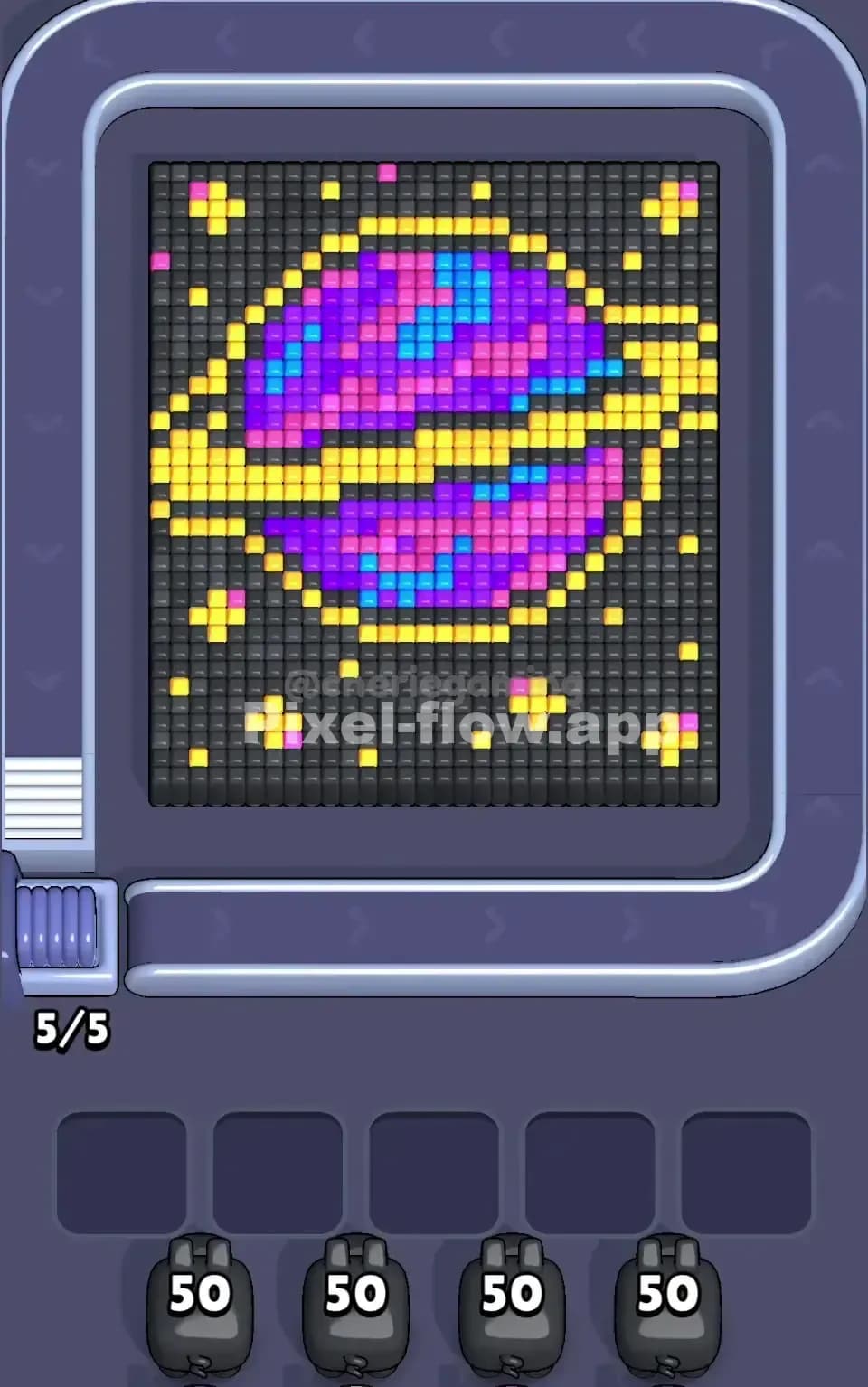
Pixel Flow Level 38 presents a gorgeous layered voxel image that looks like a stylized bird or phoenix in flight, created entirely from stacked colored cubes. The image is built with a clear color gradient: magenta and yellow occupy the central mass, cyan and light blue form the wings and body outline, while darker blue and navy anchor the lower half and shadows. The outer frame features green and yellow accent stripes, with blue and dark gray filling the negative space around the main subject. You're looking at a densely packed grid where colors overlap in distinct horizontal bands, and the darker gray cubes form a solid backing that'll need to be peeled away layer by layer.
Win Condition and Deterministic Mechanics
To clear Pixel Flow Level 38, you must destroy every single colored voxel cube on the board. Your three incoming pigs—one gray (40 ammo), one green (20 ammo), and one blue (40 ammo)—are locked in that exact sequence and will shoot cubes of their matching color automatically when selected. Every cube you destroy costs exactly one unit of ammo from the active pig. The magic of Pixel Flow 38 is that every move is deterministic: pig order never changes, ammo counts are fixed, and your only real choice is when to activate each pig. Win by sequencing them perfectly so that all cubes vanish and your waiting slots never overflow with stuck pigs.
Why Pixel Flow Level 38 Feels So Tricky
The Dark Gray Bottleneck
The biggest headache in Pixel Flow Level 38 is the sheer volume of dark gray cubes forming the background and negative space. Gray pigs never arrive in the initial queue—you'll see gray, green, and blue—so those gray cubes become invisible targets until you've already committed your other pigs. This creates a catch-22: you can't expose everything the gray pig needs until you've already burned through green and blue shots, but if you're not careful, you'll waste the gray pig's 40 ammo on scattered gray cubes and end up with leftover colored cubes you can't touch. The gray pig will feel like a blunt instrument, and a single mistake in sequencing can leave you staring at five stuck pigs and a board that's 90% clear but unwinnable.
Scattered Cyan Patches and Mid-Layer Traps
Cyan cubes appear in two problem zones: some sit near the wings where they're easily accessible, but others are buried deep within the magenta and blue layers, hiding in crevices. Cyan doesn't appear in the incoming pig roster either, so you're stuck waiting for it to become exposed or hoping that destroying nearby colors reveals it naturally. If you activate pigs out of order, you might destroy all visible cyan targets early while the cyan pig still sits in the queue, leaving it stranded with full ammo and no valid targets. That's an instant jam. Watch out for the narrow cyan columns running vertically through the center—they're easy to miss and deadly to forget.
The Green Pig's Modest Ammo Pool
Your green pig brings only 20 ammo to Pixel Flow Level 38, and the board shows maybe 25–30 visible green cubes spread across the top stripe and scattered throughout the mid-sections. The green pig will need to work perfectly; you can't waste a single shot on overlapping or redundant targets. More importantly, if you activate green too early before other colors have been destroyed, you'll blast away surface greens and leave the pig helpless when it encounters deeper green cubes you've now exposed. Timing green in the exact middle of your sequence, after some color clearing but before you're desperate, is key.
Personal Perspective: The "Click" Moment
I'll be honest—Pixel Flow Level 38 frustrated me for a solid dozen attempts. I kept activating pigs reactively, watching chunks disappear, and then realizing I'd painted myself into a corner with two waiting slots full and a sky-high ammo pig with nowhere to point. The turning point came when I stopped thinking "what can this pig destroy right now?" and started thinking "what does this pig need to destroy to keep the next pig alive?" Once I mapped out the gray cubes first, reserved the green pig for the mid-game, and saved blue for the final cleanup, the level suddenly unfolded. That moment of seeing a perfectly sequenced clear felt incredible.
Step-by-Step Strategy to Clear Pixel Flow Level 38
Opening: Establish Your First Move and Protect Waiting Slots
Start by activating your gray pig first, even though it feels counterintuitive. The gray pig's 40 ammo is your artillery, and Pixel Flow Level 38 is packed with gray cubes that form the structural backbone. Use these initial 15–20 shots to clear the obvious gray patches on the left and right edges, the top border, and any gray cubes separating the bird's wings from the body. Don't go crazy—aim for clarity in the visual layout rather than complete gray demolition. Leave at least 20 ammo in the gray pig's tank at this stage. The goal is to expose what's underneath without jamming your waiting slots; keep a minimum of two free slots throughout the opening phase. After your gray pig has done this work, let it drop into a waiting slot if it still has ammo but no valid targets. Now you've cleaned the frame and are ready for the colorful layers.
Mid-Game: Sequence Green and Blue to Expose Layers
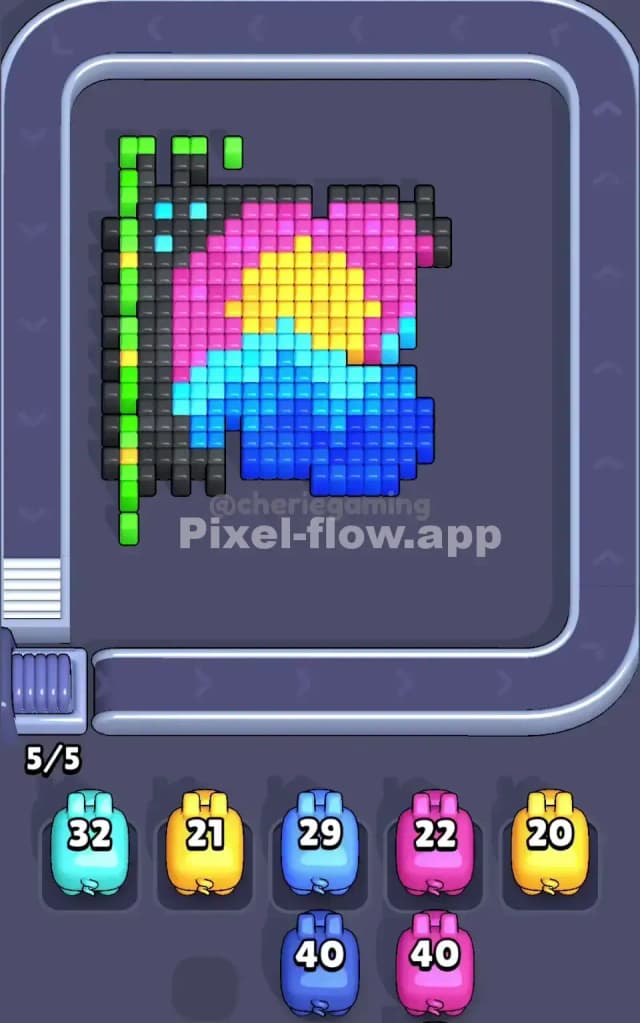
Next, bring in your green pig and target the upper stripe and any exposed green cubes in the magenta region. The green pig has only 20 ammo, so you're precision-firing here. Focus on clusters rather than isolated cubes; look for green pixels that, when destroyed, will open pathways to deeper colors. If the green pig runs out of ammo, stash it safely in a waiting slot—don't panic about incomplete greens yet. Now activate your blue pig, the second heavy hitter with 40 ammo. Blue is everywhere in Pixel Flow Level 38: it dominates the lower body, wings, and shadows. Your blue pig will have plenty of targets, so methodically clear the obvious blue patches. However, resist the urge to finish everything blue in one go. Instead, use your blue pig to expose cyan cubes hidden within the blue layers and to clear enough blue to see what magenta and yellow cubes remain beneath. This is where patience matters—you're creating a readable board, not a perfect board.
End-Game: Clean Up Magenta, Yellow, and Cyan Strategically
By this point, your gray and green pigs are waiting (hopefully with minimal ammo left), and you've got blue ammo to burn. If cyan cubes are still visible, and you have blue ammo, you cannot use blue on cyan targets—only the cyan pig can do that. So redirect blue focus to the magenta and yellow core of the bird, which should now be semi-exposed. Your goal is to destroy enough magenta and yellow that the remaining pigs in the queue—likely a second gray, green, or blue depending on your activation order—will have clear targets and can finish their ammo without jamming. As the board shrinks, you'll eventually need to carefully sequence any remaining cyan pig shots and finish with whatever ammo remains in your reserve pigs. The last few cubes should disappear cleanly, with all five waiting slots empty and the board completely clear.
The Logic Behind This Pixel Flow Level 38 Plan
Why This Sequence Works
The strategy for Pixel Flow Level 38 relies on understanding that pig order is fixed, but your timing determines success. By starting with gray, you're removing the structural clutter that would otherwise trap other colors. Green goes mid-game when the board is partially clear and green cubes are both exposed and findable—this prevents green from being stuck with wasted ammo. Blue goes late because it's the most abundant color and gives you the most flexibility to sculpt the board into a state where remaining pigs can finish clean. This isn't random; it's exploiting the deterministic nature of the game. You're not hoping pigs get lucky targets—you're engineering a board state where every pig's ammo is spoken for and every remaining cube is killable.
Staying Calm, Counting Ammo, and Planning Ahead
Pixel Flow Level 38 demands mental discipline. Before you activate each pig, spend five seconds scanning the board and counting how many cubes match that pig's color. If you see 18 magenta cubes and a magenta pig with 15 ammo coming up soon, you know you're in trouble and need to expose more magenta or sequence differently. Watch the waiting slots like a hawk—as soon as four pigs are waiting and one still has ammo, you're one bad move from a hard lock. Keep a mini-checklist: gray done? green positioned safely? blue reserves ready? cyan still visible or hidden? By staying two or three pigs ahead in your mind, you'll avoid panic-activating a pig and instantly regretting it. Pixel Flow Level 38 rewards foresight, not reflexes. Trust the plan, count your targets, and watch the board empty with satisfying precision.