Pixel Flow Level 399 Solution | Pixel Flow 399 Walkthrough
How to beat Pixel Flow Level 399: Video solution & walkthrough. The fastest way to pass Pixel Flow 399.
Is this the wrong level layout?🤔
Pixel Flow randomizes levels for different players. Don't worry, just upload a screenshot of your board, and our AI will find the correct video instantly.
Pixel Flow Level 399 Walkthrough
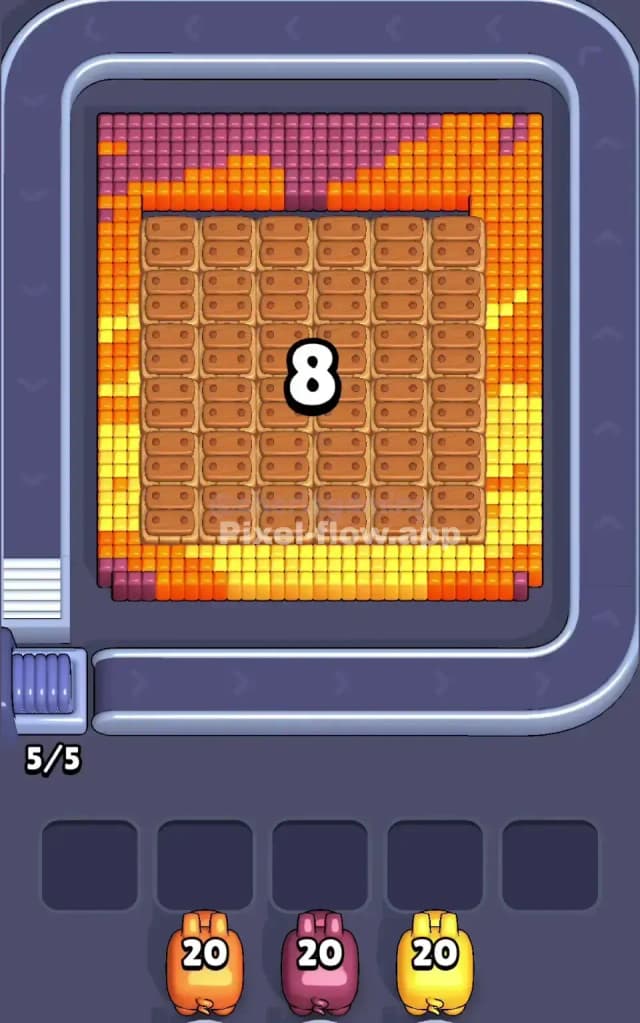
This level is a claustrophobic puzzle. You aren't just clearing pixels; you are unboxing a package. Pixel Flow Level 399 greets you with a massive, intimidating square of wooden crates right in the center of the board. These crates are dead zones. You cannot shoot through them initially. They force all your attention to the thick, colorful border surrounding them.
The setup is rigid. A heavy strip of Maroon (Purple) sits at the very top. The sides and bottom are a chaotic mix of Orange and Yellow pixels. Your goal is to strip away this outer "packing material" to reveal the character hiding beneath the wood. Is this a very hard level? Yes. The crates block 50% of your firing lines, meaning a single mistake with a waiting slot can kill your run instantly.
Pixel Flow Level 399 Overview
Think of this level as opening a crate to find a woodland creature. The starting board looks like a shipping manifest: a solid block of timber surrounded by vibrant packing peanuts. The top is dark and heavy with that purple hue, while the bottom feels like fire—bright oranges and yellows interlocked in a checkerboard pattern.
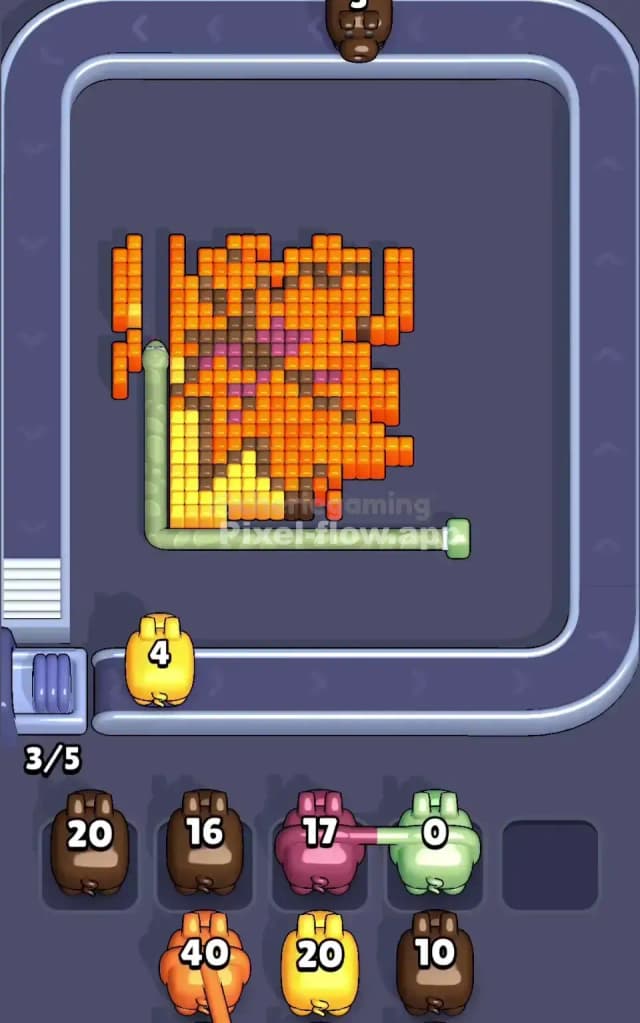
Once you manage to smash through the wood and the outer ring, the hidden picture reveals itself. It looks like a Fox or perhaps a Squirrel standing upright. This inner figure is much more organic than the boxy start. It uses earthy Browns, lighter Yellows for the belly, and mixed Oranges for the fur.
The asymmetry here is dangerous. The top of the board is almost entirely one solid color block (Maroon), while the sides are fragmented. This means a Maroon pig is easy to use, but Orange and Yellow pigs require precise timing because their targets are scattered.
Step by step solution walkthrough for Pixel Flow Level 399
First Color Zone to Erase in Pixel Flow Level 399
I start by attacking the Maroon (Purple) block at the very top. Narrative-wise, it’s like popping the lid off the box. Logically, it is the safest play.
The Maroon section is a dense, continuous chunk of pixels. When you get a Maroon pig, you don't have to hunt for a stray pixel; you can just dump it at the top and it will clear a huge swathe of ammo. This is crucial for early game survival. You want to empty pigs as fast as possible to keep your conveyor belt moving. If you try to focus on the messy Orange/Yellow sides first, you might find yourself with a pig that has 15 ammo left and no clear shot, clogging your slots. Clear the top. Open the lid.
How to pass Pixel Flow Level 399 without power ups or boosters
The mid-game of Pixel Flow Level 399 is the panic zone. At this point, you've likely cleared the outer Maroon and maybe half of the Orange border. The wooden crates should be breaking apart now, exposing the Brown pixels of the Fox inside.
Here is where you die if you aren't careful. You will start receiving Brown pigs. However, if the wooden crates aren't fully gone, or if the outer Orange ring is still shielding the center, you literally cannot hit the brown pixels.
To survive without items:
- Prioritize the Sides: You must clear the vertical columns of Orange/Yellow on the left and right. This gives your pigs lateral angles to shoot into the center.
- Slot Management: If a Brown pig arrives and you can't hit the center yet, put it in a slot. But if a second Brown pig arrives, you must stop everything and focus on clearing a path for them. Do not fill your waiting bench with Brown pigs while the outer wall is still standing.
- The Yellow Trap: Watch out for the Yellow pixels mixed into the Orange sections. They are often single pixels, not blocks. Use a Yellow pig immediately if you see a clear line of sight, even if it only hits 2-3 blocks. Don't hold onto it hoping for a "better shot."
Last Details You Clean Up in Pixel Flow Level 399
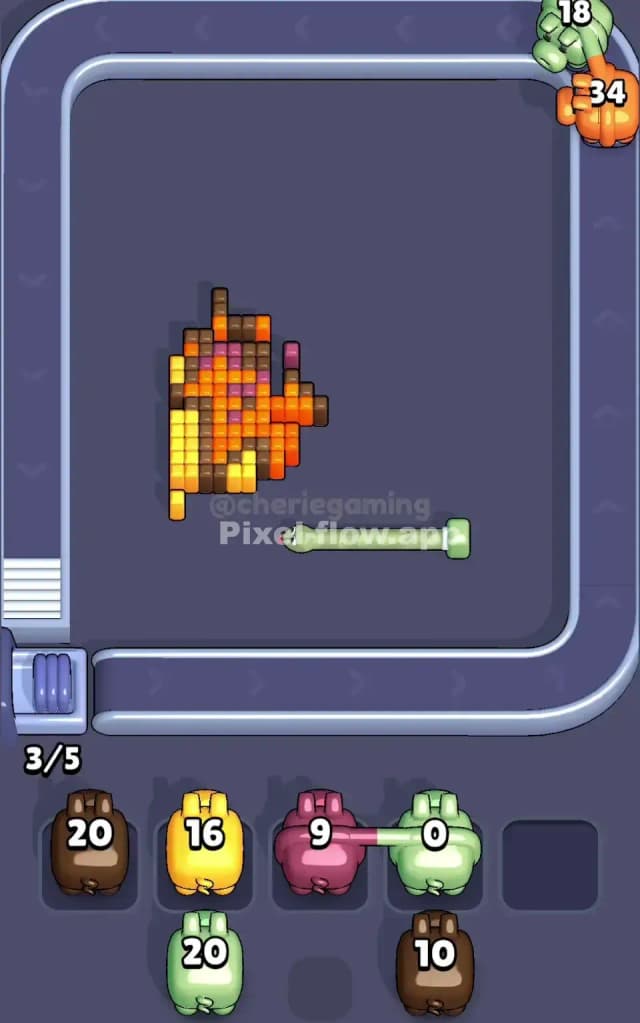
The final phase is delicate. The heavy wooden crates are history. The thick border is gone. All that remains is the core of the Fox.
You will likely be left with a few stubborn Brown pixels at the bottom (the feet) or mixed Orange/Yellow pixels near the tail. The danger here is the "overhang." Sometimes the head of the Fox blocks shots to the feet. Ensure you are clearing from the bottom-up whenever possible during the final 10 moves. A Brown pig with 20 ammo is useless if it can only hit the Fox's nose but needs to hit the toes. Keep your angles wide. Clear the feet first.