Pixel Flow Level 465 Solution Walkthrough | Pixel Flow 465
How to solve Pixel Flow level 465? Get instant solution for Pixel Flow 465 with our step by step solution & video walkthrough.


Pixel Flow Level 465 Overview
The Board Layout and Starting Colors
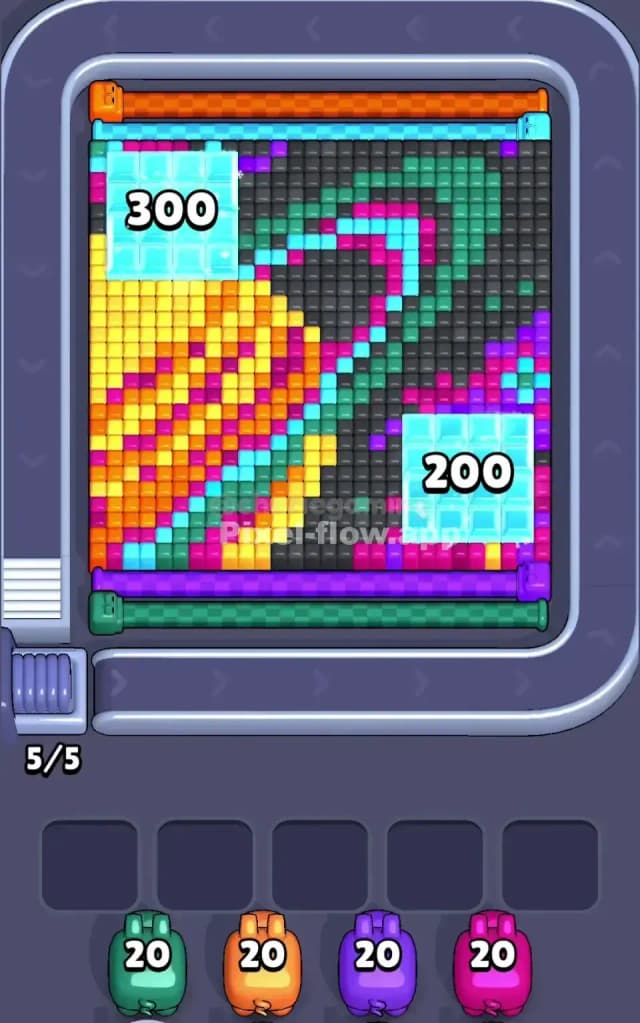
Pixel Flow Level 465 presents a vibrant, complex voxel landscape dominated by a sweeping diagonal gradient that flows from warm yellows and oranges in the lower left toward cool cyans and greens in the upper right, with pockets of magenta and purple scattered throughout. The main visual subject is a large, pixelated arrow or swoosh shape pointing upward and rightward, creating a sense of motion across the board. You'll notice the board is densely packed, meaning there's almost no breathing room—every cube matters, and wasted moves compound quickly. The color palette includes at least five primary colors: green, orange, purple, magenta, and cyan, with yellow serving as a transitional shade. The 300-point indicator and 200-point indicator visible on the board suggest significant color clusters that'll reward careful sequencing.
Win Condition and Deterministic Mechanics
To win Pixel Flow Level 465, you must clear every single cube from the board. The game doesn't ask for a specific score threshold; it demands total clearance. Here's the critical part: your pig lineup is fully deterministic. The four pigs waiting in the queue (green with 20 ammo, orange with 20 ammo, purple with 20 ammo, and magenta with 20 ammo) will always arrive in that exact order, and their ammo counts never change. This means Pixel Flow Level 465 isn't about luck—it's pure logic. You control the order in which you deploy pigs by deciding which color to expose or prioritize. Understanding this upfront transforms how you approach the level from reactive button-mashing into deliberate strategic planning.
Why Pixel Flow Level 465 Feels So Tricky
The Waiting Slot Bottleneck
The moment I started Pixel Flow Level 465, I realized the five waiting slots are your lifeline and your prison. You have exactly five slots to hold pigs that either have no valid targets yet or are strategically parked for later deployment. The problem? You're feeding four pigs into those slots automatically, and if you're not careful about which cubes you destroy, you'll burn through all five slots with pigs that can't shoot anything. Once slots fill completely and a new pig arrives with no targets, you lose instantly. This creates a paradox: you can't just blast your way through Pixel Flow Level 465 by shooting every cube you see. You have to manage the queue like a traffic controller, ensuring at least one or two slots stay empty so you retain flexibility.
Color Pockets and Ammo Mismatches
Pixel Flow Level 465 hides several nasty surprises. For instance, there are isolated pockets of cyan and magenta that don't become visible until you've cleared overlying layers. If a pig with 20 ammo reaches the board but can't find any of its color, it immediately drops into waiting and blocks a slot. I found this especially frustrating with the purple pig early on—there aren't enough exposed purple cubes at the start to spend all 20 ammo, so it gets parked while you're trying to expose the purple regions deeper in the board. Similarly, the diagonal structure of the arrow means some colors are clustered unevenly; you might find thirty orange cubes in the lower-left quarter but only five scattered elsewhere. This forces you to think in layers: which colors do I expose first to enable the pigs behind them?
The Personal Frustration Point
I'll be honest: my first ten attempts at Pixel Flow Level 465 were ugly. I'd get halfway through, fill all five waiting slots with pigs that had 8–12 ammo remaining with no targets, and watch the game end in failure. The moment that clicked for me was when I stopped trying to clear every cube as quickly as possible and instead started asking, "Which pig should I let sit in waiting right now, and why?" That mindset shift unlocked the level. Pixel Flow Level 465 demands patience and forward-thinking; rushing leads to catastrophe.
Step-by-Step Strategy to Clear Pixel Flow Level 465
Opening: Establish Free Lanes
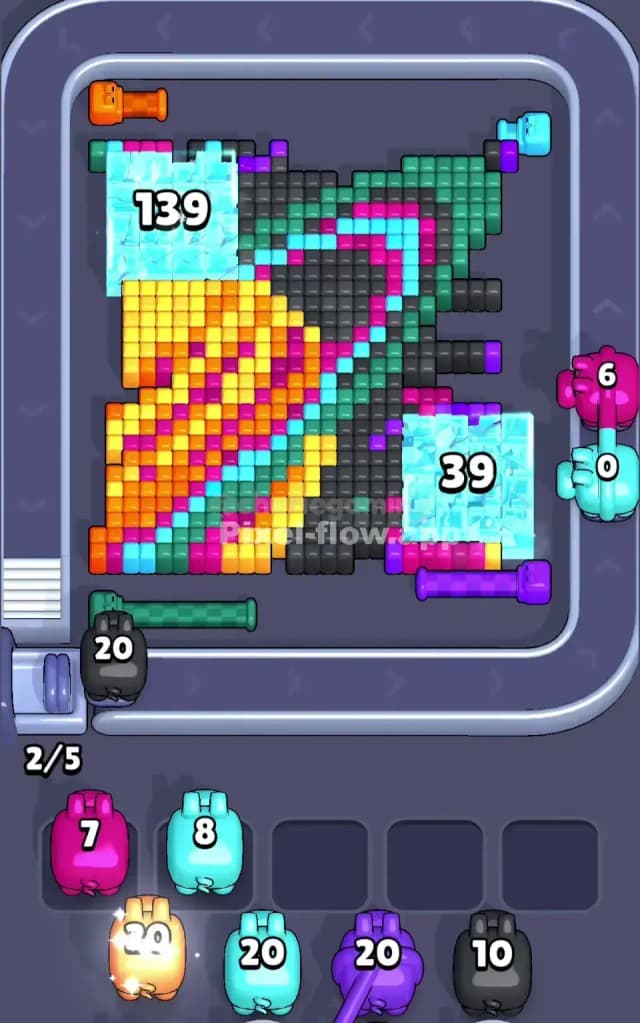
Start Pixel Flow Level 465 by deploying your green pig first, but don't burn all 20 ammo immediately. Instead, target only the exposed green cubes in the upper-right and center regions—maybe 8 to 12 shots. This accomplishes two things: it opens sightlines into the cyan layer beneath (cyan is plentiful in Pixel Flow Level 465), and it keeps your waiting slots mostly empty. After the green pig is deployed, the orange pig enters. Orange dominates the lower-left diagonal, so let orange run wild here, emptying 15–18 of its 20 ammo on that gradient zone. You're essentially clearing out the shallowest, most accessible layer and exposing deeper colors simultaneously. The key is watching your waiting slots; if you complete a color entirely with one pig, the next pig still comes and will need a home. Keep at least two slots perpetually open during the opening phase.
Mid-Game: Sequencing and Layering Exposure
Once green and orange have created openings, the purple and magenta pigs become your precision tools. Here's where Pixel Flow Level 465 really tests your planning. Before you deploy purple, spend a moment identifying where all the purple cubes live. You might have fifteen scattered across the board, but they're hidden in different depths. The purple pig will spend ammo on whatever purple is exposed first, which might leave deeper purple cubes untouched if you don't sequence correctly. My strategy: use the exposed purple cubes to pave a path toward the hidden ones. Shoot the surface purple, watch the magenta cubes beneath emerge, and let the purple pig wait in one of your slots while you deploy magenta to clear those newly exposed chunks. Then call the purple pig back up to finish the hidden purple in the lower-right corner. This "park and recall" technique is essential for Pixel Flow Level 465. You're not trying to complete each color in isolation; you're using pig sequences to choreograph layer-by-layer revelation.
End-Game: The Buffer Clean-Up
By the time you're in the final stretch of Pixel Flow Level 465, you should have one, maybe two pigs still in waiting. These last pigs need to account for the stubborn remaining cubes—the ones that stubbornly hide in corners or are surrounded by other colors. This is where ammo counting becomes critical. If you've got one magenta pig in waiting with 12 ammo left and only eight magenta cubes visible, you have a problem: that pig will shoot eight times, sit idle with 4 ammo wasted, and clog a slot while other colors finish. To prevent this, ensure you've fully exposed every final cube before deploying the last pig. Use prior pigs' remaining ammo (if they have any) to chip away at obstructing colors, making room for that final pig to burn every last round. The winning feeling in Pixel Flow Level 465 comes when the last pig shoots its final cube and the board turns empty in one smooth, satisfying cascade.
The Logic Behind This Pixel Flow Level 465 Plan
Ammo Economy and Slot Management
This strategy works because it respects the core economy of Pixel Flow Level 465: ammo is finite, slots are finite, and pigs arrive in a locked order. Instead of fighting the system, you exploit it. By deliberately under-deploying pigs early (shooting 15 out of 20 ammo), you keep waiting slots available and you create "ammo reserves" in pig form—a parked pig with five shots left is like a battery you can tap into later when you need to clear obstructing colors. Pixel Flow Level 465 becomes a puzzle of alignment: matching the right pig to the right board state so that its ammo and the exposed cubes align perfectly. This isn't intuition; it's accounting.
Staying Calm and Planning Ahead
The hardest part of Pixel Flow Level 465 isn't understanding the rules—it's resisting the urge to mash buttons. Every time you fire, you change the board and shift the waiting queue. I learned to pause between deployments and ask three questions: (1) How many unspent ammo does this pig have? (2) Which waiting slots are occupied, and can I afford to fill another? (3) What colors will become exposed once this pig finishes, and will the next pig in queue have anything to shoot? That two-second pause before each pig deployment is the difference between clearing Pixel Flow Level 465 and losing to a locked buffer. You're not just playing the game; you're orchestrating it.