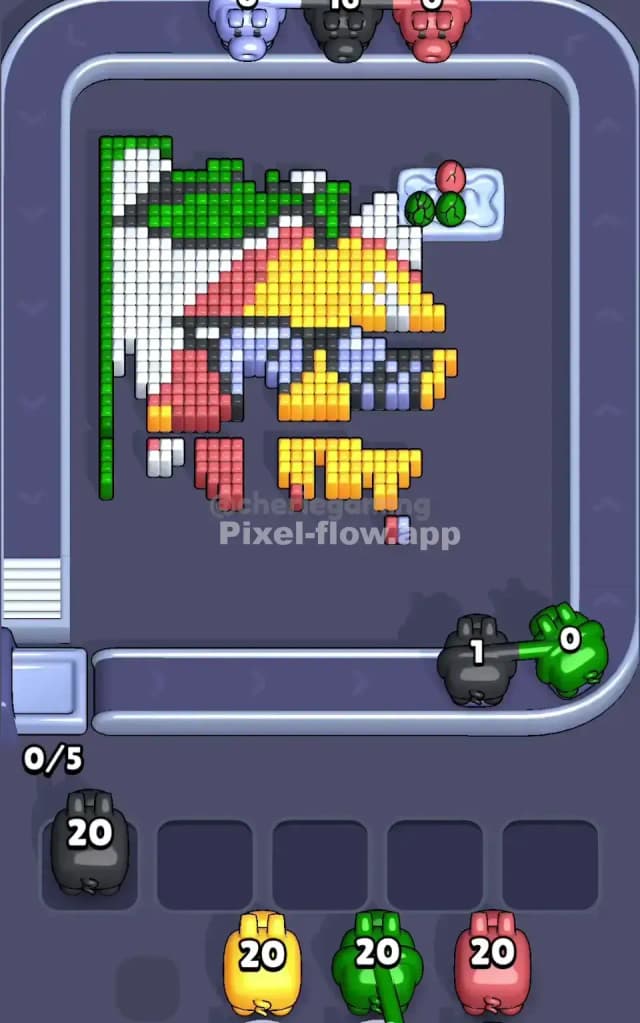
Pixel Flow Level 495 Solution Walkthrough | Pixel Flow 495

How to solve Pixel Flow level 495? Get instant solution for Pixel Flow 495 with our step by step solution & video walkthrough.

Share Pixel Flow Level 495 Guide:
Pixel Flow Level 495 Gameplay

Pixel Flow Level 495 Overview

The Board Layout and Key Colors

Pixel Flow Level 495 presents a layered voxel landscape dominated by purple, magenta, white, and black cubes, with strategic pockets of cyan, orange, and pink scattered throughout. At first glance, you're looking at what appears to be a stylized character or abstract figure rendered in pixels, with a white silhouette forming the centerpiece surrounded by darker and brighter accent colors. The board feels dense—there's almost no wasted space, and every color zone interconnects with others, meaning you can't simply bulldoze one section without understanding how it affects the rest.

The starting queue shows three incoming pigs: a dark-colored pig with 20 ammo, a purple pig with 20 ammo, and a white pig with 10 ammo. You'll also notice that your waiting slots are currently full (5/5), so your very first move is critical. Unlike easier levels, Pixel Flow Level 495 doesn't give you breathing room to experiment; you need a plan before you launch the first pig down the conveyor.

Understanding the Win Condition

Your goal in Pixel Flow Level 495 is straightforward: clear every single voxel cube from the board. The twist is that you can only do this by leveraging the deterministic pig order and ammo counts. Each pig automatically shoots cubes of its own color, and each hit costs one ammo. If a pig runs out of visible targets before exhausting its ammo, it'll drop into a waiting slot, taking up valuable real estate. Fill all five slots with stuck pigs, and you'll have no way to spend their remaining ammo—instant failure. This tension between pig availability and ammo management is what makes Pixel Flow Level 495 both challenging and rewarding once you crack the sequence.

Why Pixel Flow Level 495 Feels So Tricky

The Waiting-Slot Bottleneck

The biggest threat in Pixel Flow Level 495 is that you start with a full buffer. All five waiting slots are occupied, which means you have zero margin for error on your first move. If you send down a pig and it doesn't find enough targets, it'll overflow the queue immediately and you've already lost. The purple and magenta zones are deceptively large, and at first it's tempting to send the purple pig first—but that same pig might clear its targets too quickly and jam up your slots before you've exposed the inner white or cyan layers. I found myself restarting several times before realizing that the order really matters here, and "first pig" doesn't mean "strongest pig."

Awkward Color Patches and Hidden Depths

Another tricky aspect of Pixel Flow Level 495 is the way colors are layered. The white cubes in the center are gorgeous to look at, but they're also a trap: you can't access them easily from the current angle without clearing the darker cubes around them first. Similarly, the cyan and orange pigs have limited visibility—their target cubes are scattered around the edges and in the lower sections, making it easy to misjudge ammo efficiency. I watched a cyan pig clear six cubes and still have 14 ammo left, with no more cyan targets in sight, forcing it into a waiting slot. That's the kind of asymmetry that catches you off guard in Pixel Flow Level 495.

The Personal "Aha" Moment

Honestly, I felt frustrated with Pixel Flow Level 495 after my first five attempts. The board looked solvable, but every sequence I tried ended in a pile-up around move three or four. The turning point came when I stopped thinking of the pigs as independent units and started mapping out which pig's ammo would land perfectly because of what the previous pig cleared. Once I realized that the dark pig's 20 ammo could clear almost all the black cubes while simultaneously exposing white targets for the white pig, everything clicked. Suddenly Pixel Flow Level 495 went from frustrating to brilliantly designed.

Step-by-Step Strategy to Clear Pixel Flow Level 495

Opening: Clearing the Black Perimeter Safely

Start by sending down the dark pig with 20 ammo. Don't second-guess this choice—the dark pig is your workhorse for Pixel Flow Level 495, and it'll demolish the black cubes that form the structural frame around the white center. The black cubes aren't just decoration; they're blocking access to deeper layers. As the dark pig fires, it'll clear roughly 15–18 black cubes, depending on positioning. Crucially, this also exposes several white cubes that were previously hidden behind the dark sections.

When the dark pig drops into a waiting slot (it will, because there won't be enough remaining black targets), you're still sitting at 5/5 slots, but now the board is significantly more open. The white silhouette in the middle is starting to reveal itself, and you've bought room to maneuver. This first move sets up everything that follows in Pixel Flow Level 495—don't rush it.

Mid-Game: Sequencing and Layer Exposure

Next, send the white pig down. With 10 ammo, it'll target the newly exposed white cubes and clean up most of the interior. You'll see the purple and magenta zones become more prominent as the white retreats, and you might have 2–3 ammo left on the white pig before it also slots in. That's acceptable; you're building momentum, and Pixel Flow Level 495 rewards players who accept partial completion from each pig.

Now comes the purple pig with 20 ammo—this is your second major clearing phase. Purple is everywhere on this board: framing the edges, filling sections of the mid-layer, and creating visual noise. The purple pig will chew through roughly 18–20 purple cubes, but here's the key: purple cubes are distributed unevenly, so the pig will shoot horizontally and vertically across the board, exposing magenta, orange, and cyan patches as it works. By the time the purple pig jams (around move 3), you've carved out enough space that the waiting slots might actually start to empty as new pigs cycle in.

The magenta and pink zones require careful management. They're smaller than the big color blocks, but they're interspersed in ways that can trap you. If you haven't cleared the surrounding black and purple yet, magenta pigs will get stuck fast. Timing is everything in Pixel Flow Level 495—send the magenta-eating pig too early, and it wastes ammo on unreachable targets; send it too late, and you've already clogged your buffer.

End-Game: Finishing the Remaining Colors Cleanly

By move 4 or 5, you should see a significant clearing. The orange pigs (which appear right-aligned on the board) will handle the orange cubes along the right edge and scattered interior patches. Cyan will mop up the remaining cyan cubes, likely in the lower-left area. The pink pig handles the final pink section, typically in the lower-right corner.

The trick to avoiding a last-second jam is to never let more than two pigs occupy the waiting slots at once during the end-game. Once you're down to single-digit cube counts per color, you have enough leverage to ensure each incoming pig finds at least a few targets. Count your remaining cubes actively: as you watch the board, mentally tally how many orange cubes you see, how many cyan, and so on. If you're running low, you might need to manually stall an incoming pig by not tapping it immediately—yes, you can pause and regroup in Pixel Flow Level 495. Use that power to avoid panic moves.

The Logic Behind This Pixel Flow Level 495 Plan

Why Determinism Beats Randomness

Pixel Flow Level 495 is solvable because the pig order and ammo counts never change. The dark pig will always have 20 ammo, the purple pig will always come second in the queue, and the white pig will always have exactly 10. Instead of treating these as constraints, savvy players treat them as a puzzle's pieces. You're not hoping the right pig shows up; you're planning for the specific pig that's already queued. This shifts your mindset from reactive to proactive, and that's the core insight that makes Pixel Flow Level 495 manageable.

The waiting slots are equally deterministic. If a pig will definitely get stuck, that's not a failure—that's a resource. A stuck pig with 8 remaining ammo sits in slot 3 and waits for the board to open up. By move 6 or 7, when the board is sparse, that pig might suddenly find its targets and empty out, freeing your buffer. In Pixel Flow Level 495, patience and counting are more valuable than speed.

Staying Calm and Planning Ahead

Here's what separates success from frustration in Pixel Flow Level 495: keep a running mental count of your waiting slots and glance at the incoming queue. Every pig that slides onto the conveyor is telegraphed; you see it coming. Before you tap the current pig to launch it, ask yourself: "If this pig clears what I expect, will the next pig have targets?" That two-move-ahead thinking is what defuses the bottleneck in Pixel Flow Level 495. You're not reacting to jam-ups; you're preventing them by planning the sequence strategically.

Take a breath between moves. Pixel Flow Level 495 isn't a speed-run; it's a logic puzzle. The waiting slots are your safety net, not your enemy. Use them wisely, count your ammo, and trust the process. Once you internalize the deterministic nature of the game and stop treating pig order as random chaos, Pixel Flow Level 495 transforms from a frustrating wall into a satisfying tactical challenge—one that absolutely rewards careful, patient play.