Pixel Flow Level 5 Solution | Pixel Flow 5 Walkthrough
How to beat Pixel Flow Level 5: Video solution & walkthrough. The fastest way to pass Pixel Flow 5.
Is this the wrong level layout?🤔
Pixel Flow randomizes levels for different players. Don't worry, just upload a screenshot of your board, and our AI will find the correct video instantly.

Pixel Flow Level 5 Walkthrough
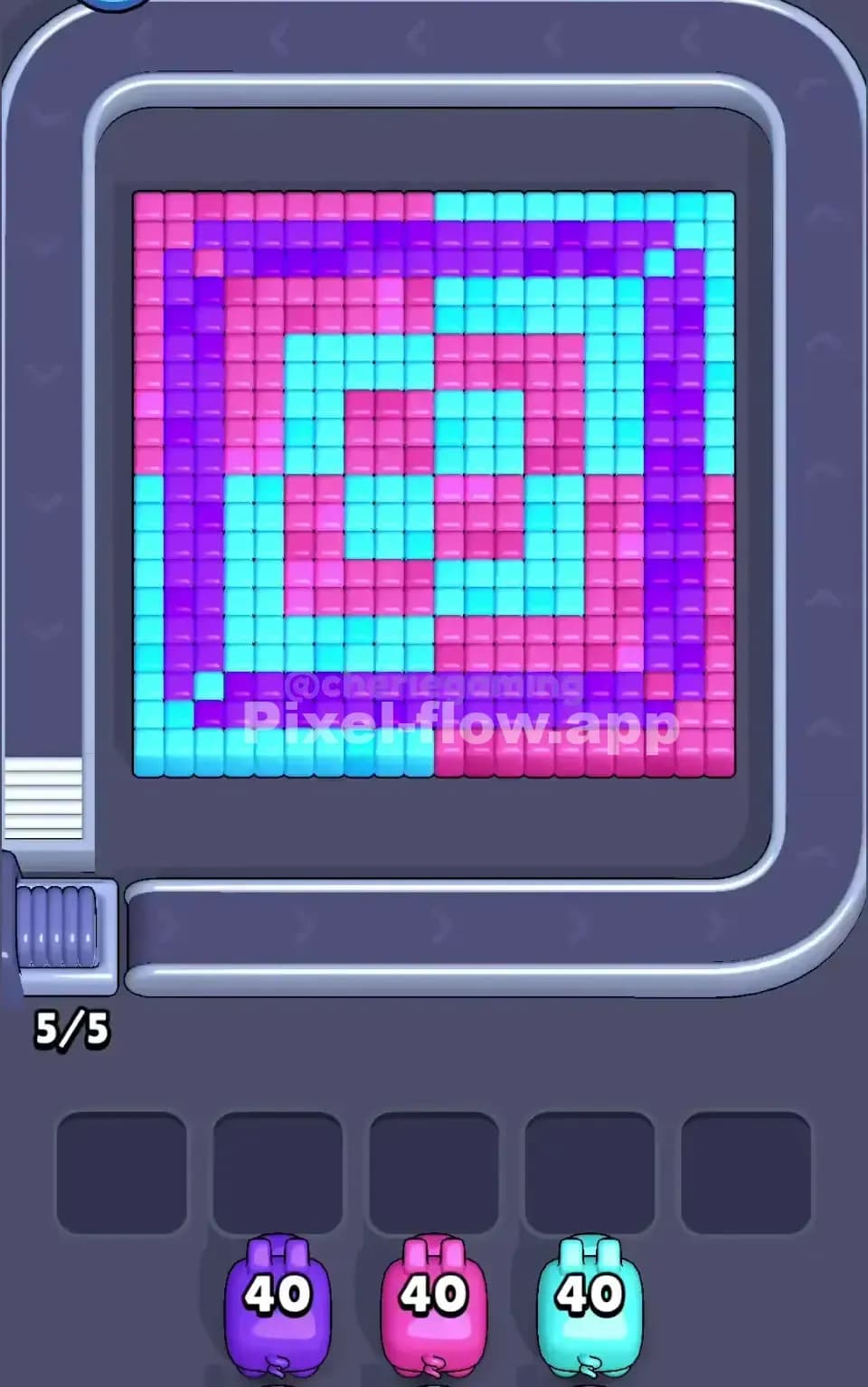
Pixel Flow Level 5 looks like a retro rug design or perhaps a bizarre, square archery target. It is a strictly geometric puzzle consisting of concentric rectangular rings. You are looking at a large board where the layers are stacked strictly from the outside in. You have a thick Orange border, followed by a Green inner rectangle, then a Purple core, and finally a tiny Orange bullseye right in the center.
The rule set here is standard but dangerous because of the high ammo counts. You have pigs loaded with 30 or 40 shots. If you deploy a pig and he only finds two matching blocks, he sits in your waiting slots with 38 ammo clogging the lane. If you fill all five slots at the bottom with high-ammo pigs that can’t shoot, you lose. You must peel this onion layer by layer.
Is this a difficult stage? No. It is not a very hard level, provided you don't panic when the colors mix. It tests your patience, not your reflexes.
Pixel Flow Level 5 Overview
Imagine looking down at a flat pyramid made of lego bricks. That is the vibe of Pixel Flow Level 5. The artwork isn't a cat or a car; it's pure abstraction.
The outermost perimeter is a solid, heavy wall of Orange voxels. This wall is roughly two pixels thick in most places, acting as a guard rail for everything inside. However, there is a tiny interruption. At the very top center and bottom center of this Orange wall, there are single Purple blocks inserted like keystones.
Move one layer inward, and you hit the Green zone. This is a bright, lime-green rectangle that acts as a moat between the outer shell and the inner core. Just like the outer wall, this green layer has interruptions: on the far left and far right sides, single Purple blocks break the green line.
Inside the green moat sits the heavy Purple rectangle. This is a thick, dark band of color. Finally, the "pupil" of this square eye is a vertical block of Orange sitting dead center.
The board is perfectly symmetrical. Top matches bottom, left matches right. This symmetry is your friend. It means the pigs will generally clear the board in a predictable, even way, unlike asymmetric levels where one side clears faster than the other, causing logic jams.
Step by step solution walkthrough for Pixel Flow Level 5
First Color Zone to Erase in Pixel Flow Level 5
Your primary target must be the Orange outer rim. Look at your queue in the screenshot context (internal logic): You have an Orange Pig (40), a Purple Pig (30), and another Orange Pig (40).
I start by launching the first Orange Pig. The outer rim is huge. A standard rectangular perimeter of this size contains way more than 40 blocks. This pig will march out, spray 40 cubes into that orange wall, and exhaust his ammo completely. He will vanish. This is the perfect opening move. It thins the herd without clogging a slot.
However, you cannot fully clear the orange yet. The first pig will leave gaps. Now you are faced with the Purple Pig. This is the trap of Pixel Flow Level 5.
How to pass Pixel Flow Level 5 without power ups or boosters
The mid-game here gets messy because of those tiny "keystone" blocks I mentioned in the overview.
After your first orange wave, you still have some orange border left. The next pig is Purple. You might think, "I'll save him." But you can't reorder the conveyor belt without boosters. You have to let him play.
Here is what happens: The Purple Pig will come out. Because there are two tiny Purple blocks embedded in the top and bottom of the outer ring, he will shoot those immediately. That costs him 2 ammo. He now has 28 ammo left. He cannot hit the inner purple ring yet because the Green moat is blocking his line of sight.
He will drop into one of your five waiting slots at the bottom. Let him sit there. Do not panic. Do not use a bomb to clear him. He is essentially banking his ammo for later.
Next, the second Orange Pig (40) comes down the belt. He is your MVP. He will finish off the remains of the outer orange border. Once that border is gone, the Green layer is fully exposed.
At this point, the picture looks stripped. The orange frame is gone. You are staring at a green box with a purple center. You must wait for a Green Pig to appear on the belt (which usually follows the initial trio). Once the Green Pig clears that lime-colored moat, the logic shifts. The moment the green blocks vanish, the inner Purple ring is exposed.
Remember that Purple Pig sitting in your slot with 28 ammo? He wakes up now. He will automatically target the newly exposed purple ring and unload his clip. This is the "cascade" effect you want. You passed the hardest part of the level by simply tolerating a clogged slot for a minute.
Last Details You Clean Up in Pixel Flow Level 5
The end game is quiet. You have smashed the outer orange, dissolved the green moat, and shattered the purple inner wall.
All that remains is the tiny Orange island in the center. It’s a vertical rectangle, maybe 6 to 8 blocks total.
You likely have an Orange Pig in your slots or coming down the belt with leftover ammo. Since the target is so small, you don't need a fresh 40-ammo pig. Any leftover orange unit will snap this up in seconds.
The only risk in the final moments of Pixel Flow Level 5 is over-saturation. If you have 4 pigs in your slots because you played carelessly, and a mismatched color comes down the pipe, you die. But because the layers here are so distinct (Orange -> Green -> Purple -> Orange), as long as you clear them in order from outside-in, the slots naturally empty themselves. Watch that final center block pop, and you're done.