Pixel Flow Level 517 Solution Walkthrough | Pixel Flow 517
How to solve Pixel Flow level 517? Get instant solution for Pixel Flow 517 with our step by step solution & video walkthrough.

Pixel Flow Level 517 Overview
The Cute Caterpillar Canvas
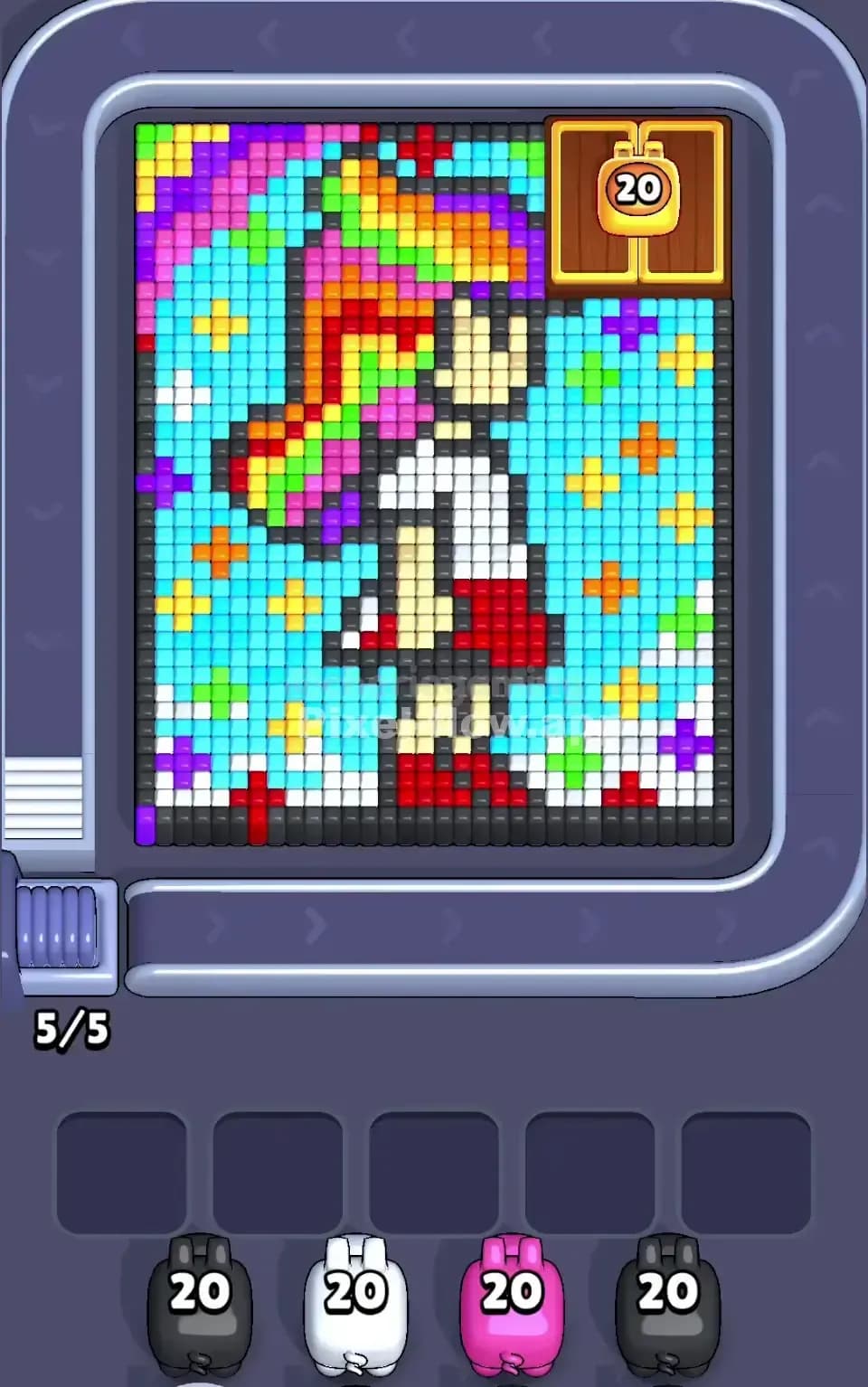
When you first load Pixel Flow Level 517, you're greeted with an adorable pixelated caterpillar made almost entirely of bright green cubes. The creature's round face dominates the board, with a cheerful expression formed by brown eyes and magenta accents around its mouth and segments. The background is layered with cream, tan, and brown tones that frame the main subject, while white cubes peek through strategic spots in the design. It's a deceptively charming visual—but don't let the cute factor fool you. This level hides some serious puzzle complexity underneath that friendly exterior.
You can see three pigs waiting in the queue at the bottom: a cyan pig with 10 ammo, a brown pig with 10 ammo, and an orange pig with 10 ammo. These three will be your primary tools for clearing the board. The waiting slots below show "2/5," meaning you've already filled two slots with previous pigs (likely from an earlier attempt or the level design). Your job is to clear every single voxel cube by using these pigs strategically, exposing the layers beneath, and ensuring you never jam all five waiting slots with stuck pigs.
Understanding the Win Condition
Winning Pixel Flow Level 517 means clearing every colored cube on the board—no leftovers, no blocked layers, nothing. Each pig shoots only its matching color, so the cyan pig destroys cyan cubes, the brown pig destroys brown cubes, and the orange pig destroys orange cubes. You cannot destroy a cube with a mismatched pig. This means your pigs' ammo counts and the cube distribution must align perfectly, or you'll hit a dead end. The sequence in which you release pigs from the queue is entirely under your control, so planning ahead isn't just helpful—it's absolutely essential.
Why Pixel Flow Level 517 Feels So Tricky
The Overwhelming Green Majority
The first thing that makes Pixel Flow 517 challenging is the sheer dominance of green cubes. The caterpillar's body is almost entirely lime green, and you won't see a green pig in your current queue. That means the green is blocking access to the deeper colors underneath. You need to clear away other colors first to reveal new pigs or to trigger the conditions that let you proceed. Without a green pig active right now, you must rely on your cyan, brown, and orange reserves to chip away at the visible non-green cubes and hope that doing so exposes a green pig further down the line.
The Magenta Bottleneck and Waiting Slot Pressure
Magenta appears in two thin horizontal stripes running through the caterpillar's face—one for each eye area. These magenta cubes are relatively few in number, but they're positioned in a way that makes them hard to target without careful planning. If you don't have a magenta pig available when you need it, you'll hit a stalemate: the magenta cubes stay put, blocking progression, and your current pig runs out of matching targets. It then drops into a waiting slot, taking up precious real estate. With only five waiting slots total and two already occupied, you're down to three free slots. One or two bad moves here could completely jam you.
The Cream and White Confusion
The cream-colored background cubes and the white accent cubes form a second subtle obstacle. White appears in small clusters, mostly in the upper regions. Cream is even rarer, appearing mainly as background framing. If your first pig runs out of targets before you've cleared enough of the foreground, it'll drop into a waiting slot. Then the next pig might also run dry before the board state shifts. Suddenly, you've lost two slots and haven't made real progress toward exposing new colors.
My "Click" Moment
Honestly, my first few attempts at Pixel Flow 517 felt chaotic. I'd send in the cyan pig, watch it burn through ammo, and then feel stuck. I'd get frustrated, thinking I was doomed. But then I realized something: I was thinking about this backward. Instead of reacting to what's visible, I needed to predict what would happen when I send each pig and plan the exact sequence three or four moves ahead. Once I started mapping out which colors would be exposed after cyan cleared its section, and which pig would benefit most from that exposure, the level went from frustrating to satisfying. That mental shift—from reactive to proactive—is what makes Pixel Flow Level 517 suddenly feel manageable.
Step-by-Step Strategy to Clear Pixel Flow Level 517
Opening: Clear the Cyan Strategically
Launch the cyan pig first. Cyan cubes appear scattered around the board, particularly in the upper areas and along the edges. The cyan pig should have 10 ammo, so it can remove 10 cyan cubes. As it shoots, it'll open up sightlines to the layers beneath. Watch carefully: once cyan finishes its work, it should have cleared enough space that you expose either more brown, more orange, or—ideally—a green pig in the queue. Don't panic if the cyan pig runs out of ammo before the board looks dramatically different; that's normal. The key is keeping at least two waiting slots free as you do this. If the cyan pig empties completely without jam, great. If it has one or two ammo left but no cyan targets, it'll drop into a waiting slot (say, slot 3). That's acceptable—you're now using slot 3 of 5.
Mid-Game: The Brown and Orange Shuffle
Next, release the brown pig. Brown forms much of the border and layering on Pixel Flow Level 517. The brown pig with 10 ammo should target the brown cubes exposed or newly visible after cyan's work. Brown's job is twofold: remove its own color and, more importantly, expose the green and magenta layers trapped underneath. After brown fires, you should start seeing more of the caterpillar's face structure—those magenta stripes and the brown eye details should become clearer. If brown finishes without jam, you're in great shape. If it drops into a waiting slot, that's slot 4 of 5. You now have one free slot left, so your next move is critical.
Before releasing orange, pause and assess. How many magenta cubes are visible? How many green cubes still dominate? Orange cubes should be visible in small amounts—likely as accents on the right side or as part of the frame. The orange pig's 10 ammo should align neatly with the orange targets you see. Fire the orange pig, let it clear its territory, and watch for exposure of magenta and green cubes. If orange runs dry and drops into waiting slot 5, you're now full—no more pigs can enter the buffer. From this point forward, every pig must find a valid match, or you lose.
End-Game: The Magenta and Green Finale
Here's where you need nerves of steel. You've now exposed most of the magenta cubes (the pink eye accents) and the overwhelming green bulk of the caterpillar's body. Your next pig in the queue should be either magenta or green. Fire magenta to clear those thin stripes running through the face. Magenta should have enough ammo to finish its cubes. Once magenta is done, green becomes your final target. The green pig (or pigs, if multiple are queued) will have the job of clearing the massive sea of lime green. With 10 ammo per green pig and a large green area, you might need two green pigs, but the level design should ensure they arrive in the right order with the right ammo counts. Focus on completing each color fully before moving to the next. A half-finished green layer is useless if you can't access a new pig to continue.
The Logic Behind This Pixel Flow Level 517 Plan
Deterministic Order Beats Chaos
Pixel Flow Level 517 isn't random; it's a puzzle with a single correct solution path. The pigs arrive in a fixed sequence, each with a fixed ammo count. Your job is to recognize that sequence and respect it. By sending pigs in a deliberate order—cyan, brown, orange, then magenta and green—you're matching the natural exposure of colors on the board. Each pig clears its section, revealing the next, like peeling an onion. This isn't luck; it's logic. Once you embrace the determinism, you can plan ahead instead of reacting.
Watching Your Waiting Slots Like a Hawk
Every move in Pixel Flow 517 is a calculation of waiting slot occupancy. You have five slots; two are already used. That leaves three free slots for your current pig queue. By the time you've sent in cyan, brown, and orange, you'll have filled most or all of those slots. From that moment, every pig you release must find a valid target, or you jam. This isn't a punishment—it's a design constraint that forces you to think carefully. Count your visible targets before firing a pig. If you see 8 cyan cubes and the cyan pig has 10 ammo, it'll stick around after clearing all cyan and take up a slot. That's a cost you need to account for. By respecting this arithmetic, you avoid sudden, unexpected losses.
Two or Three Moves Ahead
The difference between struggling at Pixel Flow Level 517 and cruising through it is vision. Don't just think about what happens when you fire the current pig. Think about what it exposes and whether the next pig in the queue can use that exposure productively. If cyan is about to finish, will brown have valid targets? If brown will clear the frame, will magenta cubes become visible? This forward-thinking transforms the level from a guessing game into a solvable puzzle. Spend thirty seconds before each move to trace the chain of events. It's time well spent.
Stay calm, trust the sequence, and remember: Pixel Flow Level 517 is beatable once you see the pattern. You've got this!