Pixel Flow Level 524 Solution Walkthrough | Pixel Flow 524

How to solve Pixel Flow level 524? Get instant solution for Pixel Flow 524 with our step by step solution & video walkthrough.

Share Pixel Flow Level 524 Guide:
Pixel Flow Level 524 Gameplay

Pixel Flow Level 524 Overview

The Board Layout and Visual Challenge

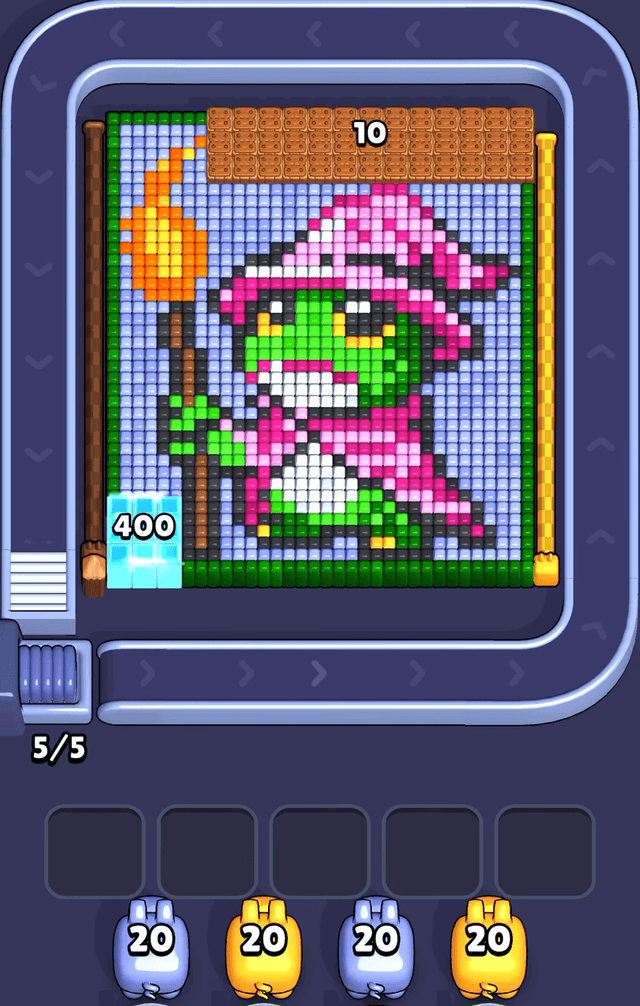
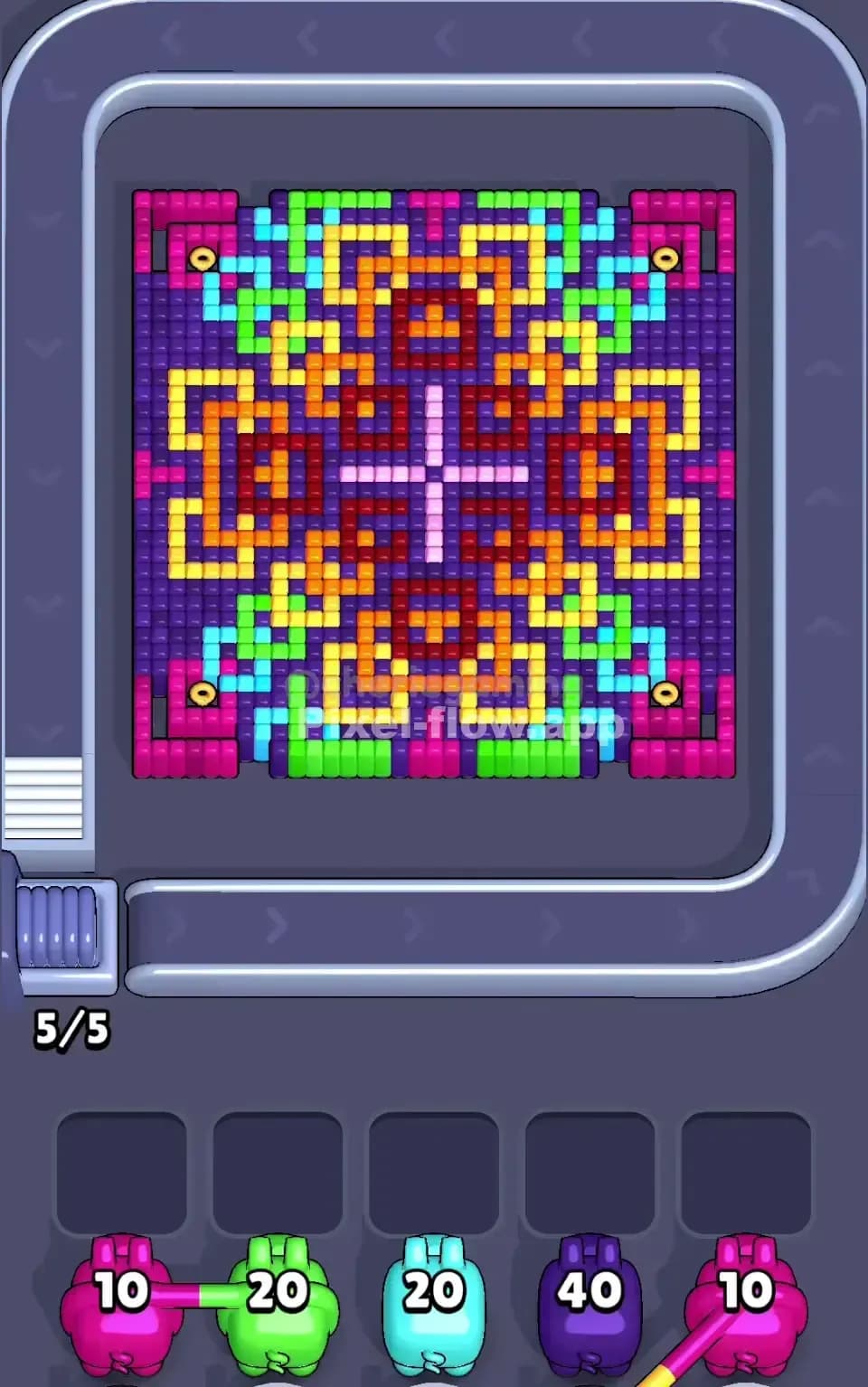
Pixel Flow Level 524 presents you with a detailed pixel-art character—a charming creature with a distinctive silhouette that immediately catches your eye. The design spans multiple color layers, with cyan forming a thick background frame, brown creating the body's main mass, and white, green, orange, and purple accents filling in facial features, clothing, and decorative details. You'll notice the board is densely packed with cubes, making it feel like a true test of planning and patience. The character's symmetrical design means you'll encounter matching color patches on both the left and right sides, which creates strategic opportunities if you handle them correctly. There are also deeper layers hidden beneath the surface colors—dark greens and forest tones that only become visible once you've cleared enough of the overlying structure. This layered composition is what makes Pixel Flow Level 524 feel so rewarding once you finally crack the sequence.

Win Condition and Deterministic Mechanics

Your goal in Pixel Flow Level 524 is straightforward: clear every single cube from the board. What makes this challenging isn't luck—it's pure logic. You'll have three green pigs queued up at the bottom, each carrying exactly 20 ammo shots. Since every cube destroyed costs one ammo, and pig order never changes, Pixel Flow Level 524 becomes a puzzle of sequencing and exposure. You can't swap pigs or generate new ones; you can only decide when to fire each pig and hope the colors they need are visible and vulnerable. The waiting slots below (five total) are your safety buffer. If you jam all five slots with pigs that have nowhere to spend their ammo, you'll fail immediately. This deterministic structure means there's always a solution—you just have to find it.

Why Pixel Flow Level 524 Feels So Tricky

The Green Bottleneck Problem

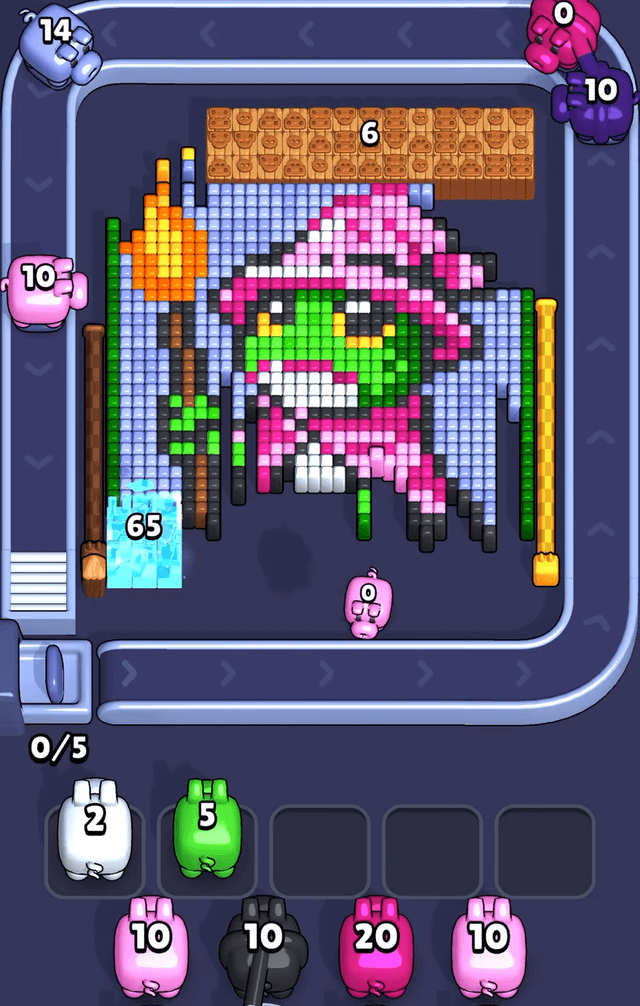
Here's where Pixel Flow Level 524 tests your resolve: green is everywhere. You've got green in the upper shoulders, green accents in the torso, green patches scattered across the lower section, and those mysterious deep forest greens hiding in the layers underneath. With three pigs each carrying 20 ammo, you're looking at 60 total green shots. Counting the visible green cubes, you're probably near that number—but "near" isn't good enough. If you start firing green too early and don't expose all the hidden deep greens, you'll eventually lock a green pig in a waiting slot with ammo still loaded and nowhere to spend it. That's an instant loss. The trick is resisting the urge to clear surface greens blindly and instead strategically positioning other colors first to peel back the layers and reveal what's underneath.

Awkward Color Pockets and Hidden Depths

Cyan looks simple at first—it's the background, right? But Pixel Flow Level 524 hides cyan cubes within the character's outline too, especially around the edges and in the negative space between arms and body. You can't just fire cyan willy-nilly and expect it to vanish cleanly. Similarly, orange appears in the mouth area and scattered along the bottom, but the distribution is uneven. White cubes form the eyes and outline details, but they're not uniformly stacked—some are isolated, some are clustered. If you hit one white pig too early and it lands in a waiting slot, you might not have access to its remaining targets until much later. Purple is perhaps the trickiest: it's sparse, it's decorative, and its cubes are positioned in ways that aren't always obvious from the board's current state. Pixel Flow Level 524 deliberately mixes these awkward pockets to force you to think layers ahead.

The Moment It Clicked for Me

I'll be honest: my first ten attempts at Pixel Flow Level 524 felt chaotic. I was firing pigs like I was playing whack-a-mole, hoping something would land. Around attempt fifteen, I stopped and actually counted cubes by color and traced the layers with my eyes. That's when the stress melted into focus. I realized the level isn't punishing you for playing—it's rewarding you for planning. Once I accepted that I needed to sacrifice clearing some surface colors early to expose the architecture beneath, Pixel Flow Level 524 suddenly became manageable. There's a satisfying moment near the end when the final pig's last few ammo shots line up perfectly with the last remaining cubes, and you see the board clear with an elegant click-click-click. That feeling makes the mental effort worth it.

Step-by-Step Strategy to Clear Pixel Flow Level 524

Opening: Establishing Board Control and Keeping Slots Free

Your first move in Pixel Flow Level 524 should be to carefully assess which color will give you the most breathing room. Don't fire at green immediately, even though it's abundant—that's falling into the trap. Instead, start with cyan. Fire your first pig strategically to clear the frame and background layers, but be selective. You're not trying to empty cyan completely; you're trying to peel back just enough to expose what's underneath. Watch your waiting slots carefully—after the first pig finishes, you should have at least three slots still empty. This gives you room to maneuver. If the first pig uses all 20 ammo and you still see cyan cubes, that's actually fine; just let it wait in a slot and move to the next color. The psychological trick here is accepting that waiting slots aren't failures—they're holding patterns. Once you've fired cyan and cleared some background, you'll suddenly see deeper colors and white details that were hidden before.

Mid-Game: Sequencing Pigs and Exposing Layers

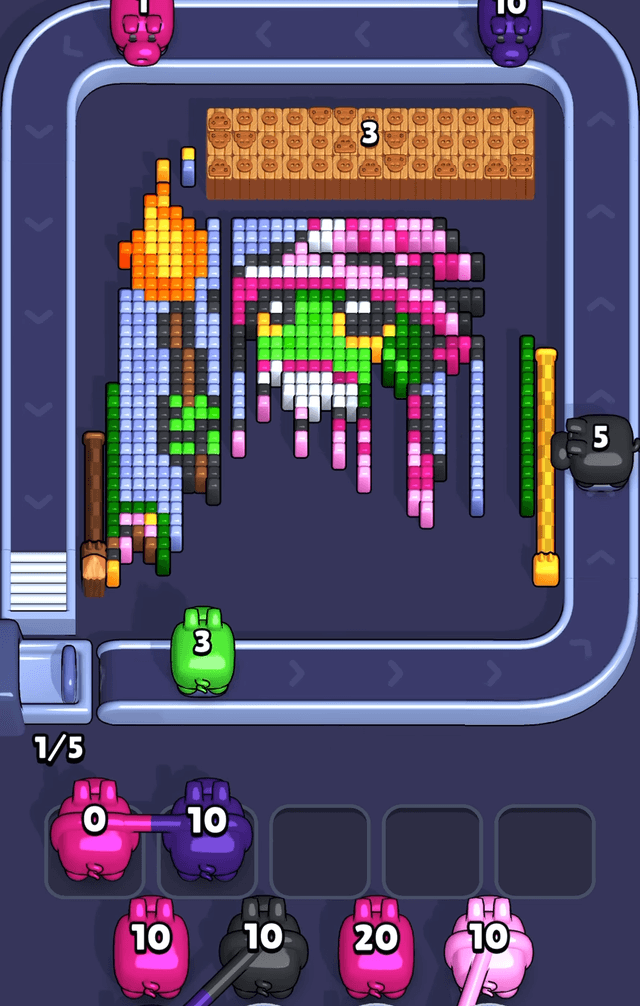
Now comes the strategic dance in Pixel Flow Level 524. Your next two green pigs are critical. Before you fire the first green pig, look at the board and identify which green cubes are truly accessible and which might be buried. Fire conservatively—aim to hit green clusters that will expose orange, white, or purple underneath. You might use only 12 or 15 ammo on the first green pig and let it land in a waiting slot. This sounds wasteful, but it's actually brilliant: you're preserving the second green pig's full ammo pool for the second wave of greens that will appear once other colors thin out. Between green pigs, fire white if you see a clear path through the eye and outline areas. White is usually straightforward because it's on the surface and visible. Orange comes next—hit it wherever it clusters, especially in the mouth region and bottom accents. After orange, you'll notice purple becoming more accessible. Pixel Flow Level 524's mid-game is all about this rhythm: fire, observe, plan the next pig, repeat. Don't rush waiting slots; let pigs stack if they need to, as long as you have a vision for how to unblock them later.

End-Game: Finishing Cleanly and Avoiding Last-Second Jams

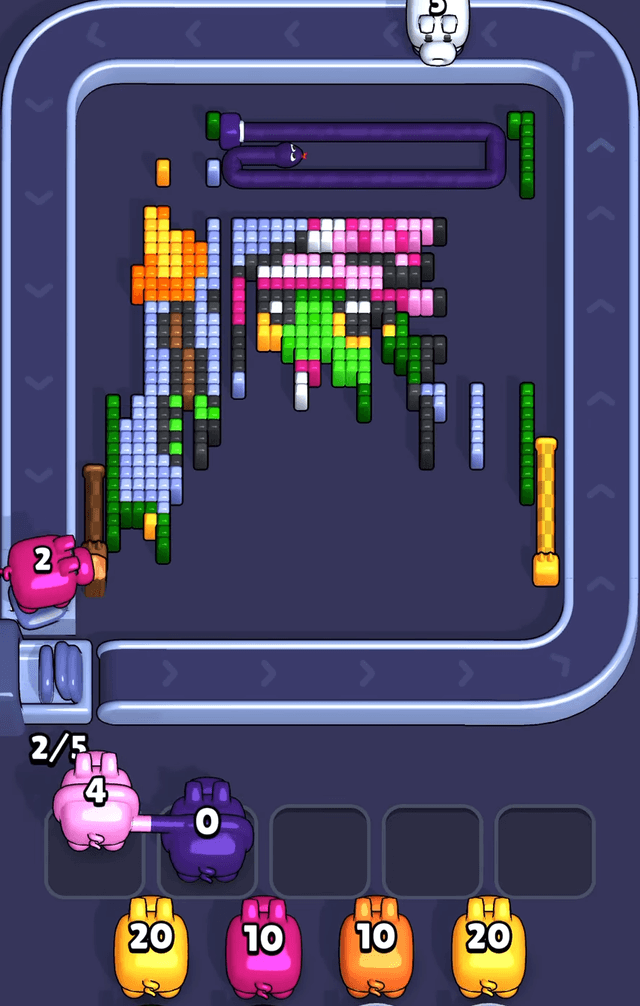
By the time you're approaching the end of Pixel Flow Level 524, your waiting slots might be moderately full, and you might be firing your last green pig. This is where precision matters most. Before you fire that final green pig, study every visible green cube on the board. Count them. If there are 12 green cubes visible and the pig has 20 ammo, fire it and expect it to consume all 12 and drop into a waiting slot with 8 ammo remaining. Now, here's the crucial part: what's the last color standing? Is it cyan lurking in the corners? Is it a pocket of white? Make absolutely sure that as you fire each remaining pig, you're moving toward a board state where the final color can be eliminated in one shot. Pixel Flow Level 524 will punish you if you leave two colors visible simultaneously with only one pig left, because that pig can only fire one color. Plan to finish with a single-color endgame: all board cubes should be one color by the time your last pig fires. When you see the final cubes clear and the board light up in victory, you'll know you've mastered the sequencing that makes Pixel Flow Level 524 so special.

The Logic Behind This Pixel Flow Level 524 Plan

Why This Strategy Works: Exploiting Structure Over Reaction

The strategy for Pixel Flow Level 524 works because it respects the game's deterministic nature. You can't control what colors your pigs shoot—they're fixed. You can't generate new pigs or ammo. But you can control the order, and that's everything. By firing cyan first, you're not wasting ammo; you're buying information. Each shot reveals the board's internal structure, showing you where greens and oranges truly lie. By spacing out green pig usage, you're ensuring that when deeper greens emerge mid-game, you have ammo reserves ready to handle them. Waiting slots aren't your enemy; they're your staging area. A pig sitting in a waiting slot is a pig you could have fired at the wrong moment—so be grateful it's parked safely, waiting for the moment when all its ammo targets become visible. Pixel Flow Level 524 rewards this kind of forward-thinking because it means you're playing with the game's logic rather than against it.

Staying Calm: Watch, Count, Plan Ahead

The final ingredient for conquering Pixel Flow Level 524 is patience and observation. Before you fire a pig, pause and look at the board. Count the visible cubes of that color. Check your waiting slots—if three are full, you need this pig to spend most or all of its ammo. Mentally trace the layers: what colors are behind the ones currently visible? If you're about to fire the second green pig, imagine what the board will look like after it finishes. Will that expose more white? If so, great—that's your signal to have confidence in the sequence. Pixel Flow Level 524 teaches you to think two or three pigs ahead, and that's not intimidating once you embrace it. You'll find yourself naturally scanning the board and asking, "If I clear this, does that unlock that?" That's the skill the level is building. Keep your mind engaged, stay ahead of the conveyor belt, and you'll realize that Pixel Flow Level 524 is less about luck and more about the satisfaction of executing a plan you've carefully constructed. Trust the process, trust the sequence, and watch the board clear with elegant inevitability.