Pixel Flow Level 73 Solution Walkthrough | Pixel Flow 73

How to solve Pixel Flow level 73? Get instant solution for Pixel Flow 73 with our step by step solution & video walkthrough.

Share Pixel Flow Level 73 Guide:
Pixel Flow Level 73 Gameplay
Pixel Flow Level 73 Solution 1
Pixel Flow Level 73 Solution 2
Pixel Flow Level 73 Solution 3

Pixel Flow Level 73 Overview

The Board Layout and Visual Challenge

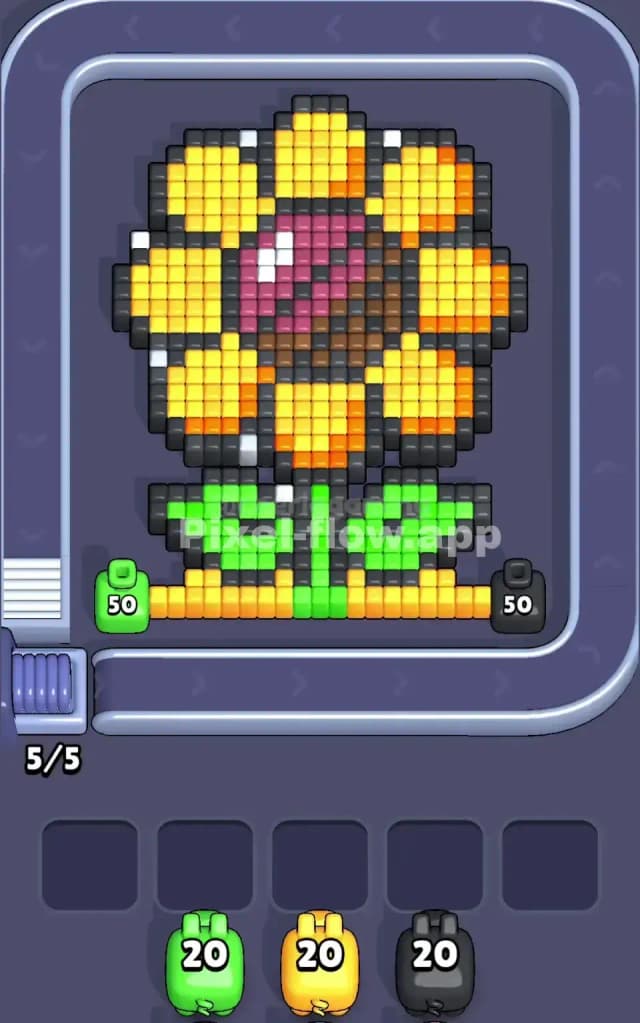
Pixel Flow Level 73 presents you with a charming pixel-art character that dominates the board—think bright, cheerful colors layered in a structured pattern. The top half of the board features an expressive face composed primarily of yellow, orange, white, and dark gray cubes, creating a warm, almost sunlit appearance. Below that sits a green section that forms what looks like clothing or a body, and beneath everything runs a yellow foundation strip that anchors the entire composition. What makes Pixel Flow 73 particularly interesting is how the colors are strategically interlocked; you'll notice that yellow appears almost everywhere, acting as both a prominent foreground color and a hidden layer waiting to be exposed once other colors fall away.

The ammo system here is beautifully balanced but deceptive. You'll start with a green pig carrying 20 ammo, a yellow pig with 20 ammo, and a dark gray pig with 20 ammo. On the conveyor belt, you've got two pigs holding 50 ammo each—one green and one gray—ready to join the action. This setup means you've got a total of 150 ammo across five pigs to spend strategically, and every single cube on the board must be cleared to win. There's no margin for error; you can't afford to waste ammo on colors that have no visible targets, because doing so will lock those pigs into the waiting slots permanently.

The Win Condition and Deterministic Puzzle

Your goal in Pixel Flow Level 73 is straightforward: clear every single voxel cube from the board. However, what makes this level tick is understanding that every pig's action is deterministic. You know exactly how much ammo each pig carries, you know the order they'll arrive on the conveyor belt, and you know which colors they'll fire. There's no randomness hiding here—it's pure logic and sequencing. The five waiting slots below the board act as your buffer zone, and if you mismanage them, you'll find yourself with four or five pigs sitting idle with ammo still in their magazines and nowhere to spend it. That's a loss, plain and simple. So Pixel Flow Level 73 rewards players who think ahead, count carefully, and respect the constraints of both their ammo counts and their waiting slot capacity.


Why Pixel Flow Level 73 Feels So Tricky

The Yellow Color Trap

If I'm being honest, the biggest headache in Pixel Flow Level 73 is managing yellow. Yellow is everywhere—it's in the face, it's in the hair details, it's in the foundation strip, and it's likely hiding in deeper layers you can't even see yet. Your yellow pig arrives early with just 20 ammo, but by the time it hits the conveyor, you might have exposed dozens of yellow cubes scattered across the board. The trap is this: if you fire your yellow pig too early, you'll only chip away at a fraction of the visible yellow, and then you'll have a half-spent pig sitting in a waiting slot, consuming precious buffer space while more pigs stack up behind it. Conversely, if you hold off on yellow for too long, you'll jam your queue because other colors finish before yellow is ready to fire, leaving you no room to maneuver.

The Gray and Orange Chokepoints

Gray acts as a strange middle-ground color in Pixel Flow Level 73. It appears in patches around the face, likely as shading or detail work, but it's not as abundant as yellow or orange. However, gray's limited presence means you can't afford to miss—every gray cube must be clearable when your gray pig fires, or you'll lose control of the situation. Orange is similarly tricky because it shows up in the upper face region and seems to blend with the yellow in ways that make it hard to count at a glance. I've found myself miscounting orange multiple times, assuming there were fewer cubes than there actually were, which left my orange pig with unspent ammo and nowhere to put it.

The Personal Frustration Point

I'll admit that Pixel Flow Level 73 stumped me for a solid attempt or two because I kept treating it like a reflex game when it's actually a pure planning puzzle. I'd fire pigs almost randomly, watching them chip away at colors, and then suddenly I'd have three full pigs in my waiting slots with no valid targets left. The moment it clicked was when I actually paused and counted every single cube by color before making my first move. Once I saw the true distribution—roughly 50+ yellows, 30+ oranges, 20+ grays, plus the greens and whites—the strategy crystallized. It's a level that punishes impatience and rewards cold, methodical thinking.


Step-by-Step Strategy to Clear Pixel Flow Level 73

Opening: Starting with Green and Avoiding the Slot Jam

Your opening moves in Pixel Flow Level 73 should prioritize clearing green, and here's why: green is the least visually complex color on the board, appearing mainly in the lower body section and in small accent spots. Fire your first green pig (the one with 20 ammo) immediately. This pig should dispatch the green layer relatively cleanly, and because green is visually isolated, you won't have the awkward situation of unspent ammo left over. After that green pig lands, you'll have exposed the yellow foundation below, and now your waiting slots are at 1/5 capacity. This gives you breathing room.

Next, don't immediately fire yellow. Instead, fire your dark gray pig (20 ammo) second. Gray is concentrated enough that 20 ammo should handle most or all of it without waste. The reason for this sequencing is that you want to expose as many different color regions as possible before committing your big hitters. After gray falls into the waiting slot, you're at 2/5 capacity with two pigs sitting idle but satisfied—they've spent their ammo and are done. Now the board looks different: green is gone, gray is gone, and you can see where white and brown details live.

Mid-Game: Yellow Pig and Exposing Inner Layers

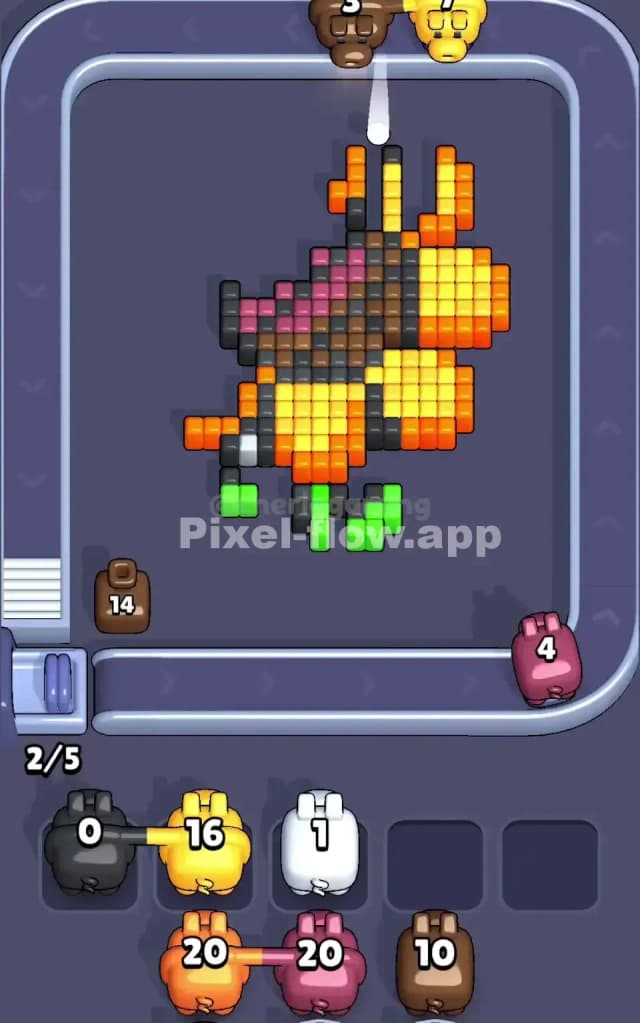
This is where Pixel Flow Level 73 gets intense. You've got your yellow pig queued, and you know there are dozens of yellow cubes scattered across the board. Here's the key: fire your first yellow pig (20 ammo) third, even though it won't clear all yellow. That pig will make a significant dent in the upper yellow areas and the border yellows, leaving the foundation strip mostly intact. When yellow pig lands in slot 3, it still has ammo—and that's fine, because you're now going to bring the second yellow pig from the conveyor, which carries 50 ammo.

Between yellow pig #1 and yellow pig #2, insert your orange pig (if it hasn't naturally arrived yet). Orange should have enough ammo in your lineup to handle all visible orange, and by firing it now, you're clearing the face details and exposing any hidden layers beneath orange. This is crucial in Pixel Flow Level 73 because every color you clear opens up new targets for the pigs that follow.

Once yellow pig #2 (50 ammo) hits the board, it should mop up the foundation strip and any remaining yellows from the upper regions. The sheer ammo count means you've got a safety net; even if you miscounted, that pig will have flexibility. After it lands, your waiting slots should be around 4/5 capacity, with only one slot remaining.

End-Game: The Final Pig and a Clean Finish

Your final pig is the dark gray one with 50 ammo, and it's arriving as everything else nears completion. By this point in Pixel Flow Level 73, the board should consist almost entirely of white and maybe a handful of stray gray or orange cubes you couldn't reach earlier. That final gray pig with 50 ammo is overkill, yes, but it's a safety valve. Fire it last, and let it sweep up whatever remains. Because you've been careful about slot management throughout the mid-game, this final pig will land cleanly in slot 5, fire its ammo into the last remnants, and the board will clear.

The beauty of this sequence is that you're not scrambling at the end. You're not watching the waiting slots fill up while desperately hoping the next pig can solve everything. Instead, you've orchestrated a careful cascade where each pig solves its color zone, and the last pig mops up the incidental pieces.


The Logic Behind This Pixel Flow Level 73 Plan

Respecting Ammo Counts and Deterministic Flow

The strategy for Pixel Flow Level 73 isn't about luck or reflexes; it's about understanding that every action is deterministic and exploiting that fact. You know your green pig has exactly 20 ammo, and you know the board has roughly 20 green cubes. That's not a coincidence—the level designer built it that way. Similarly, your 50-ammo pigs exist as safety nets for colors that appear in multiple regions or at different depths. By planning your pig sequence ahead of time, you're essentially solving an equation: pig order + ammo counts + cube distribution = victory.

This mindset changes how you approach Pixel Flow Level 73 entirely. Instead of reacting to what you see, you're proactively positioning your pigs so they hit the board in a sequence that systematically exposes new layers. When you fire green first, you're not just clearing green—you're removing an obstacle that's hiding the yellow beneath. When you fire gray early, you're removing the shading that makes it hard to see where yellow truly ends. Every pig is a tool, and you're using them in an order that maximizes the board's clarity as you go.

Staying Calm and Counting Two Pigs Ahead

The psychological component of Pixel Flow Level 73 is just as important as the tactical one. The most common failure mode is panic. You see a waiting slot fill up, you get nervous, and you fire the next pig reactively instead of following your plan. That's when things fall apart. Instead, before you even fire your first pig, count the cubes by color. Write them down if you have to. Know that you need roughly 50 yellows cleared, 20 grays, 20 greens, and so on. Then commit to a sequence of five moves and execute it methodically.

As you play through Pixel Flow Level 73, stay one or two pigs ahead in your planning. When your gray pig is firing, you should already be thinking about which color comes next and whether the exposed board will give that pig valid targets. Watch the queue on the left side of the screen; know what's coming. Count ammo on active pigs and estimate how much they'll spend. This kind of lookahead prevents the situation where you fire a pig blindly, it drops into a waiting slot, and suddenly you realize it's stuck because there are no more targets of its color. That's a failure in Pixel Flow Level 73, and it's 100% preventable with foresight.

The moment you treat Pixel Flow Level 73 as a logic puzzle rather than an action game, you'll clear it. Take a breath, plan your five pigs, and execute with confidence. You've got the ammo, you've got the waiting slots, and you've got the knowledge. Now go clear that board.