Pixel Flow Level 72 Solution | Pixel Flow 72 Walkthrough
How to beat Pixel Flow Level 72: Video solution & walkthrough. The fastest way to pass Pixel Flow 72.
Is this the wrong level layout?🤔
Pixel Flow randomizes levels for different players. Don't worry, just upload a screenshot of your board, and our AI will find the correct video instantly.
Pixel Flow Level 72 Walkthrough
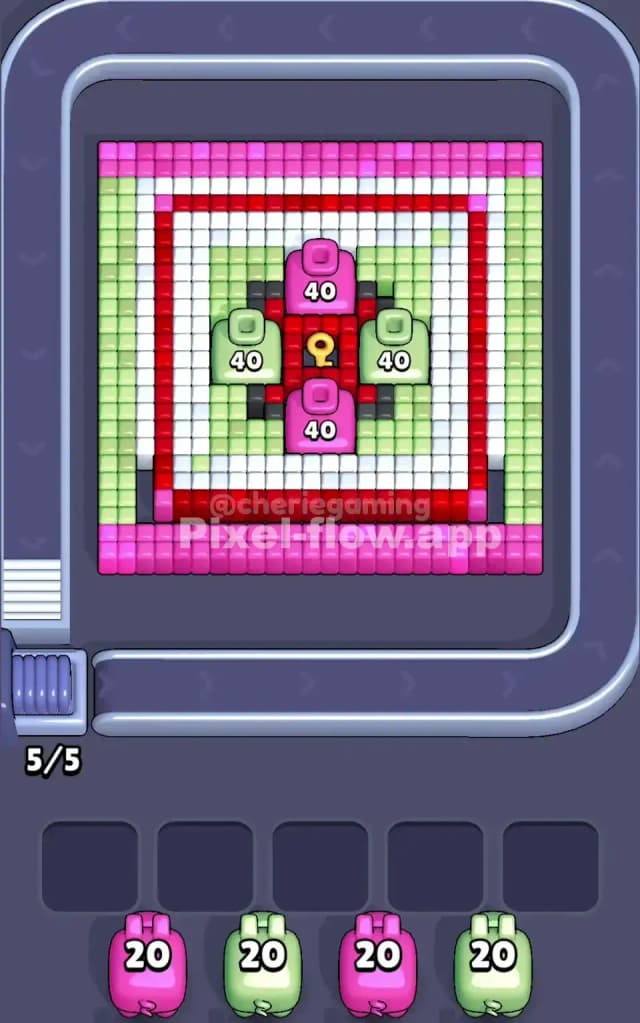
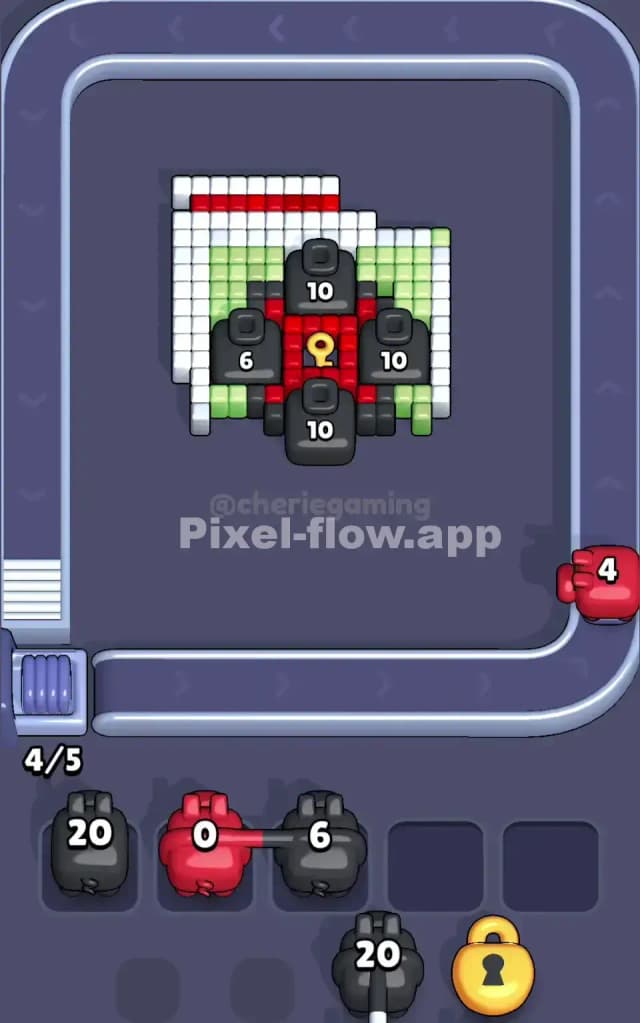
This level looks like a high-security vault floor or an intricate tile rug. You are staring at a perfectly symmetrical square design protected by four massive "security blocks" in the center. The top and bottom borders are Pink, the left and right columns are Green, and they sandwich layers of White and Red closer to the middle.
The defining feature of Pixel Flow Level 72 is the intimidation factor: those four large blocks in the center (two Pink, two Green) start with a massive 40 HP each. This is a stamina battle. You have to chip away at those massive numbers while simultaneously clearing the rest of the board. Because of this high ammo requirement and the strict layering, I judge this to be a very hard level.
Pixel Flow Level 72 Overview
Imagine a fortress seen from above. On the outer perimeter, you have the "walls": thick rows of Pink cubes at the North and South, and columns of Green cubes at the East and West.
Inside that perimeter is a "moat" of White cubes. Deeper still is a Red ring. Finally, in the dead center, sitting on a Red background, is a Black cross shape guarding a golden key.
But sitting heavily on top of this whole scene are the four "Security Blocks."
- Top & Bottom Blocks: Pink (40 HP).
- Left & Right Blocks: Green (40 HP).
These blocks are huge ammo sponges. They match the colors of the outer border, which creates a tactical conflict: do you spend your Pink/Green ammo on the border to reveal new layers, or do you dump it into the 40-HP sponges in the middle?
Step by step solution walkthrough for Pixel Flow Level 72
First Color Zone to Erase in Pixel Flow Level 72
Focus immediately on the outer Pink and Green borders. Ignore the massive 40-HP blocks in the center for a moment.
Here is the logic: The game will not give you White or Red pigs until you have cleared enough space or destroyed enough of the current colors to justify it. If you spend all your time shooting the center blocks, the outer rim remains intact, blocking the White layer underneath.
Place your Pink pigs on the far edges or the wide open slots where they can strafe the top and bottom rows. Do the same with the Green pigs to shave off the vertical side columns. You want to peel this fruit from the outside in. The 40-HP blocks are distractions right now. Only shoot them if you have no other valid target for that color.
How to pass Pixel Flow Level 72 without power ups or boosters
The mid-game of Pixel Flow Level 72 is where most players lose because the "Waiting Slots" get clogged.
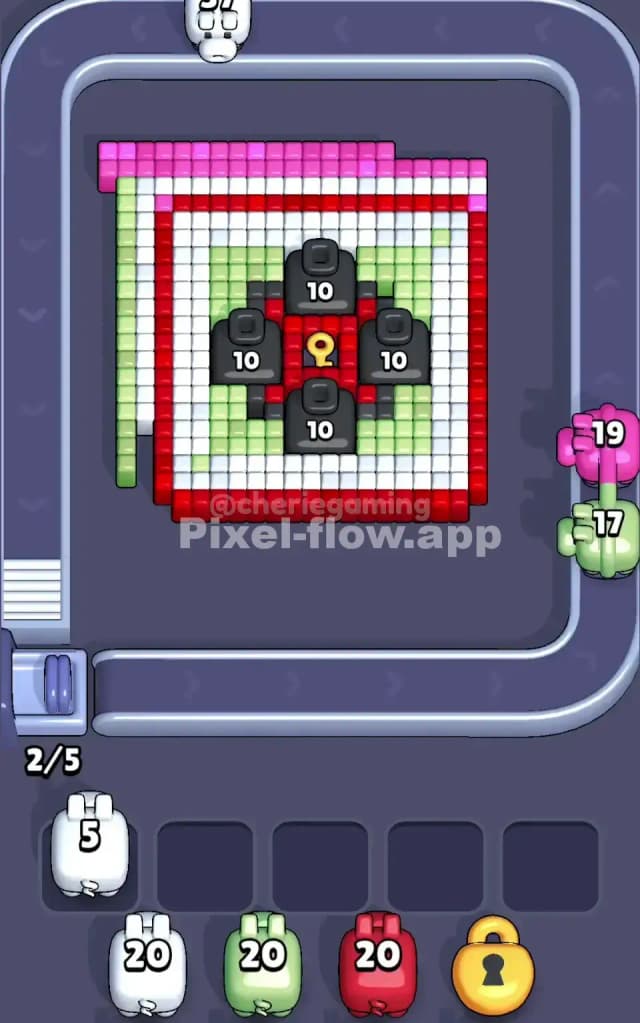
Once the outer Pink/Green rim is gone, you will start seeing White pigs. This is the danger zone. You likely still have those massive Pink and Green blocks in the center (maybe down to 20 or 15 HP now), but the game is handing you White pigs to clear the intermediate square.
If you refuse to use power-ups, you must play conservatively:
- Prioritize the White Layer: If you have a White pig, play it immediately. The White layer is the largest surface area remaining. Clearing it exposes the Red layer.
- The Ammo Dump: When you draw a Pink or Green pig in this phase, you no longer have rows to shoot. You only have the central blocks. This is good. Now you can dump 20 ammo straight into those 40-HP blocks without guilt.
- Don't Hoard: Do not hold onto a pig hoping for a better shot. If a Pink pig can do 5 damage to a block, send it. You need to cycle through your deck to get to the Red and Black pigs hiding in the queue.
Last Details You Clean Up in Pixel Flow Level 72
As you enter the final phase, the board looks messy. The 40-HP shells should be shattered, likely revealing the Black layer underneath or the Red ring fully exposed.
You will see Black pigs now. The center cross is made of stubborn dark blocks (sometimes with their own smaller HP counters, like 6 or 10).
- The Red Ring: This usually clears fast because it’s a simple square.
- The Center Cross: This is the final hurdle. Be careful with your aim here. These blocks are often clustered tightly around the key.
Ensure you don't accidentally strand a color. If the only thing left is one black block and you have a hand full of Red pigs, you are dead. Keep your waiting slots empty as you snipe the final pixels surrounding the key.