Pixel Flow Level 75 Solution | Pixel Flow 75 Walkthrough
How to beat Pixel Flow Level 75: Video solution & walkthrough. The fastest way to pass Pixel Flow 75.
Is this the wrong level layout?🤔
Pixel Flow randomizes levels for different players. Don't worry, just upload a screenshot of your board, and our AI will find the correct video instantly.
Pixel Flow Level 75 Overview
The Board Layout and Pixel Art Challenge
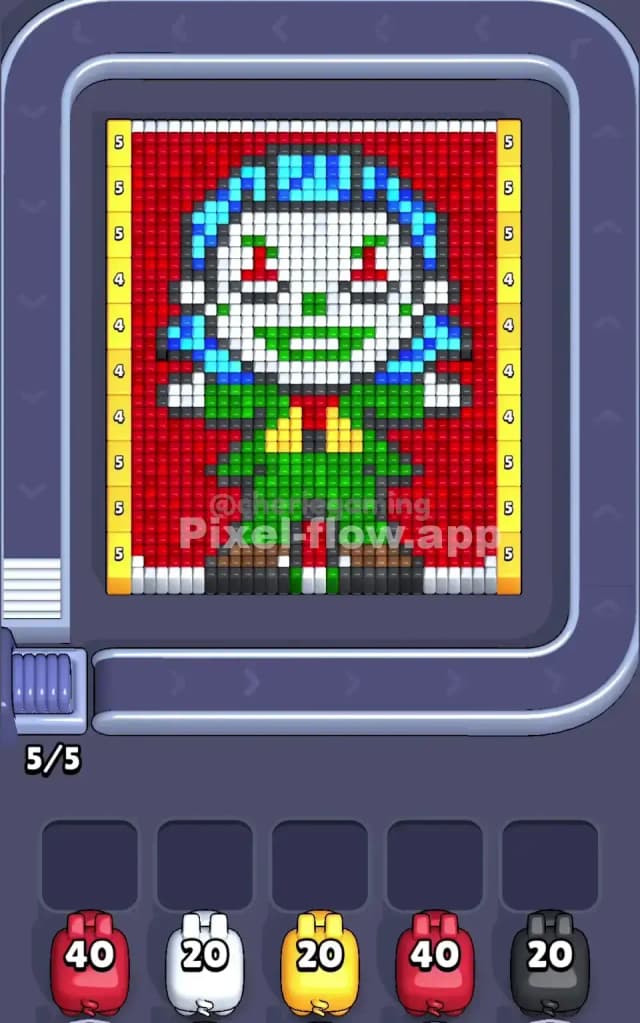
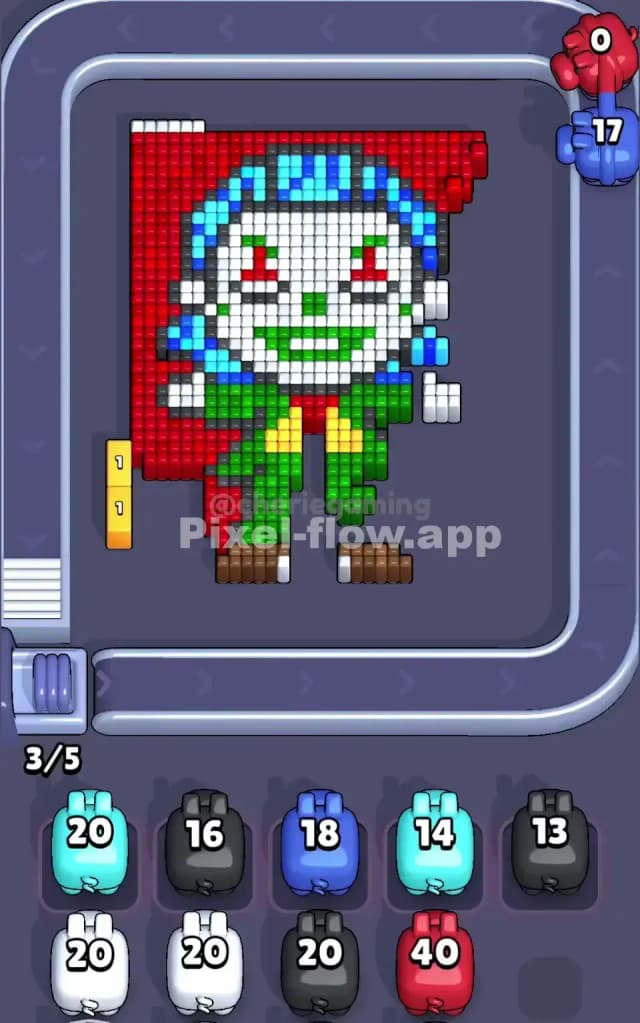
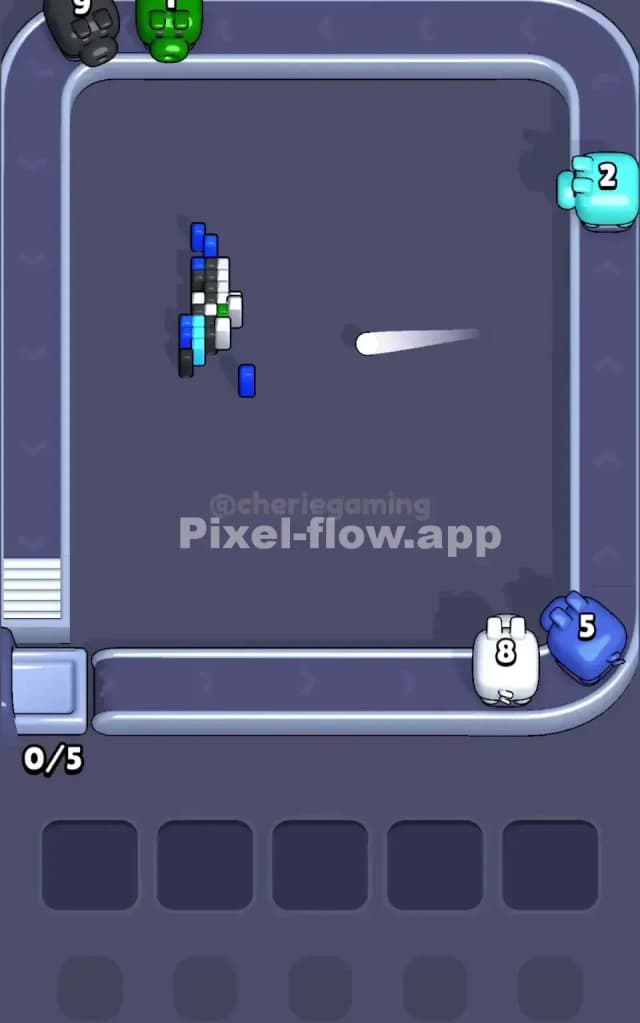
Pixel Flow Level 75 presents you with a charming pixel-art character—a cute robot or creature with a round face, expressive features, and a colorful body. The board is dominated by red cubes forming the background and bulk of the image, with intricate layers of white, green, cyan, blue, dark gray, yellow, and brown creating the character's facial details and clothing. The white section around the face and upper torso is particularly dense, and the green lower body contrasts sharply against the red surround. You're working with a fully deterministic queue of five pigs: two red pigs with 40 ammo each, two white pigs with 20 ammo each, one yellow pig with 20 ammo, and one black pig with 20 ammo. Your waiting slots (the five dark areas at the bottom of the screen) are your safety net, but they're also your primary constraint.
The win condition is straightforward: clear every single voxel cube on the board by strategically firing each pig at matching colors. Every ammo point you spend must destroy exactly one cube of the pig's color, and you have no buffer—waste a single shot, and you'll jam the waiting slots with a stuck pig that has nowhere else to target.
Understanding Ammo and Queue Pressure
In Pixel Flow Level 75, your pigs arrive in a fixed sequence, and their ammo counts are immutable. The two red pigs alone bring 80 shots, and red absolutely dominates the visible board. The two white pigs (20 each) handle the face details, while the yellow and black pigs clean up smaller accent regions. You'll notice the waiting slots indicator shows "5/5" at the bottom left—meaning all five slots are available at the start. The moment a pig runs out of targets and still has ammo remaining, it drops into a waiting slot and locks up that space. If all five slots fill before you've cleared enough cubes to expose new targets, you're stuck, and the level fails.
Why Pixel Flow Level 75 Feels So Tricky
The Red Ammo Bottleneck
The biggest threat in Pixel Flow Level 75 is red. With 80 total red cubes to destroy and red pigs arriving early and carrying huge ammo reserves, you'd think you'd have it easy—but that's exactly where the trap lies. The red background is so massive that after you've burned through one red pig's ammo on the outer edge, the second red pig might arrive before you've exposed enough inner red layers. If that happens, your second red pig will quickly exhaust its 40 shots on the remaining visible red, then drop into the waiting slots with zero targets left. You'll have wasted waiting-slot space on a pig that's already done nothing, and when cyan or blue cubes suddenly appear and you need to call in a different color pig, you're out of room.
Awkward Color Patches and Hidden Layers
Pixel Flow Level 75 hides several nasty surprises beneath its cheerful surface. The white region around the face is dense and requires both white pigs to fully clear, but the cubes aren't evenly distributed—some white areas are shallow (easy to reach early), while others are buried behind multiple color layers. The cyan and blue accents forming the character's cheeks and eyes are sandwiched between red outer layers and white inner layers, meaning you can't efficiently target them until red is partially cleared. Yellow and black are relegated to tiny accent spots, and if you fire a yellow or black pig before those cubes are visible, you're instantly jamming a waiting slot with a pig that has full ammo and zero valid targets.
The Frustration Point and the "Click"
I'll be honest: the first time I tackled Pixel Flow Level 75, I fired my first red pig too aggressively and filled two waiting slots by the time I realized I couldn't see the white face details yet. It felt like the board was punishing me for moving too fast. The breakthrough came when I stopped thinking of the queue as a race and started treating it as a puzzle where pig order is a constraint, not a suggestion. Once I accepted that I needed to deliberately pause and let pigs sit in the waiting slots while I planned three or four moves ahead, the level suddenly became manageable. The key insight? You're not trying to fire every pig; you're trying to fire the right sequence of pigs in a way that exposes layers and prevents jams.
Step-by-Step Strategy to Clear Pixel Flow Level 75
Opening: Set Your Foundation
Start Pixel Flow Level 75 by firing your first red pig, but do it strategically. Don't spray ammo everywhere—target the red cubes on the outer edges and corners first, aiming to expose the cyan, blue, and white layers underneath. Your goal in the opening is to expose at least three different colors clearly so that subsequent pigs have targets waiting for them. Fire roughly 15–20 of your first red pig's 40 ammo, leaving it in the waiting slots with 20–25 ammo remaining. Yes, you're intentionally leaving a pig half-spent; this is not a waste, it's a buffer.
Next, bring in a white pig and target the visible white cubes around the face. The white is confined and visible, so you'll burn through maybe 10–12 ammo here. Leave this pig in the waiting slots as well. You should now have three empty slots and two pigs in reserve, each with ammo left over. This breathing room is crucial because it lets you see which colors emerge next without panic.
Mid-Game: Expose Layers and Manage the Queue
Once you've created some space, fire your yellow pig at the small yellow accent cubes (they're bundled tightly, so you'll finish this pig quickly—probably around 8–10 ammo total). Yellow doesn't have many cubes in Pixel Flow Level 75, so expect this pig to complete its job and enter the waiting slots fully spent. That's fine; it's not taking up a slot for long because you've got a plan.
Now return to your first red pig (still sitting in the waiting slots with leftover ammo) and resume firing at newly exposed red cubes. You should be seeing deeper reds and possibly some dark gray or brown cubes emerging in the lower body section. Spend another 15–20 ammo here, making sure you're pushing toward the green bottom layer. If you do this right, the first red pig will be completely empty before your second red pig ever enters the board.
Fire your cyan and blue pig (if you have one—in Pixel Flow Level 75, cyan and blue are mixed in the cheek and eye region) by targeting the exposed cyan first, then blue. These colors are fewer in number, so you'll finish both within one pig's ammo budget. Again, let this pig sit in the waiting slots if needed.
End-Game: The Final Clearing and Zero-Jam Exit
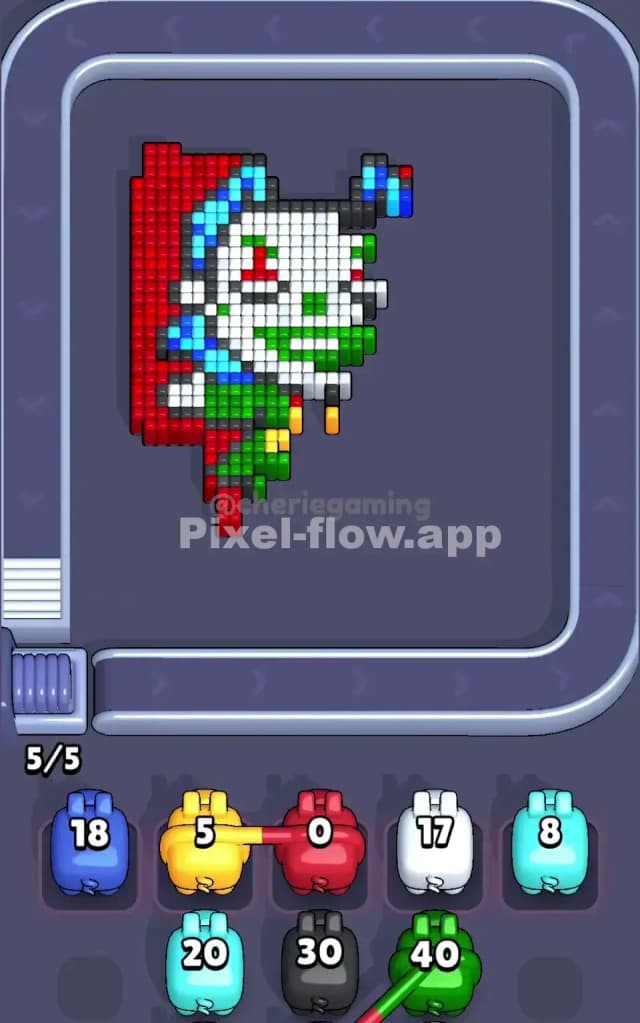
By the time you're halfway through, red should be mostly clear, white should be clean, and cyan/blue should be gone. Your remaining cubes are primarily green (the large lower section) and any residual dark gray or brown. Bring in your black pig if you have dark gray or black cubes, or switch to the second white pig if additional white surfaces are exposed. Fire methodically, counting your remaining targets on the board.
In the final stretch of Pixel Flow Level 75, you want to ensure that no pig enters the waiting slots with ammo remaining. To avoid this, count your targets before you fire. If your black pig has 20 ammo and you see exactly 18 dark gray cubes, fire it confidently—it will empty and leave no jam. If you miscounted and there are only 15 dark gray cubes visible, don't fire that pig yet; use another color pig first to expose more dark gray, or finish a different color entirely.
End with green, which should be your largest remaining color block. Fire your second red pig (if it hasn't entered the board yet) or whichever pig has the most ammo, targeting green cubes until the board is completely clear. The final pig fired should have its ammo precisely match the remaining cubes, leaving all five waiting slots empty when you hit the victory screen.
The Logic Behind This Pixel Flow Level 75 Plan
Why Sequencing Beats Reaction
The strategy for Pixel Flow Level 75 works because it treats the pig queue as a fixed resource, not a random blessing. You're not reacting to what appears on the board; you're planning which colors you'll expose and in what order, then sequencing pigs to match that exposure. By intentionally leaving pigs half-spent in the waiting slots, you create a safety valve: if a layer doesn't expose as expected, you have a fallback pig with ammo remaining to adjust course. This is far more robust than firing every pig the moment it arrives and hoping the board cooperates.
Staying Calm and Counting Ahead
The mental discipline required for Pixel Flow Level 75 is simple but powerful. Before you fire each pig, glance at your waiting slots (how many are occupied?) and count the visible cubes of that pig's color on the board. If you have only two empty slots and you're about to fire a pig that you suspect won't fully clear its color, pause and use a different pig first. Watch the queue at the bottom: you'll see the next three to four pigs coming. Plan your moves around them. By the time your second red pig arrives, you should already know whether you need it for deep red layers or whether red will be done by then. This foresight transforms Pixel Flow Level 75 from a frustrating slot-jammer into a satisfying puzzle where every move feels intentional and earned.