Pixel Flow Level 76 Solution Walkthrough | Pixel Flow 76
How to solve Pixel Flow level 76? Get instant solution for Pixel Flow 76 with our step by step solution & video walkthrough.


Pixel Flow Level 76 Overview
The Board Layout and Starting Colors
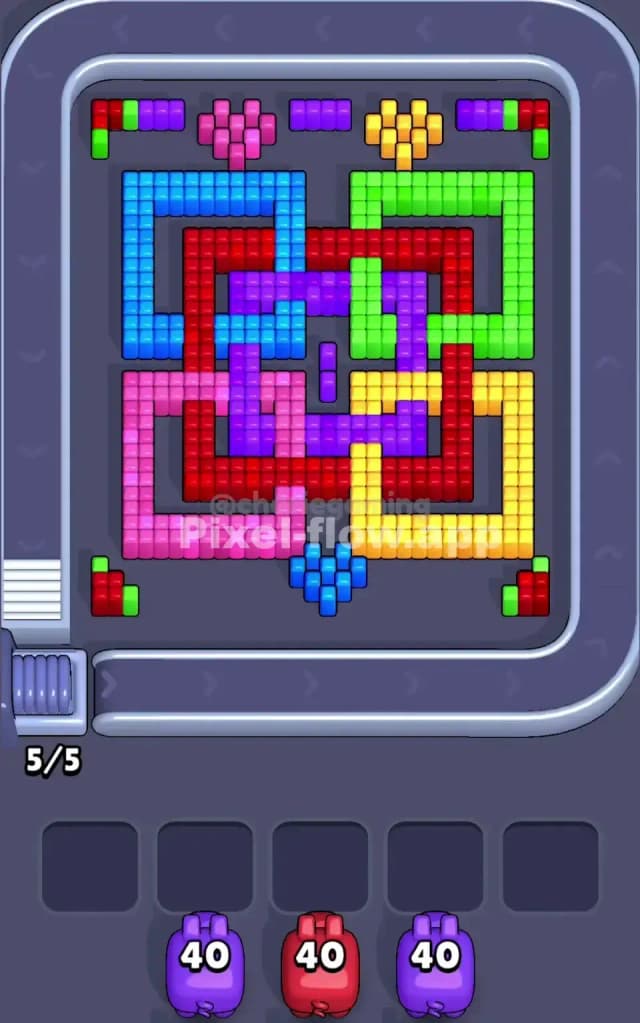
Pixel Flow Level 76 is a dense, multi-layered puzzle that'll test your planning skills. The board features a rich tapestry of color-coded voxel cubes arranged in concentric rectangular frames. You're looking at a vibrant composition with red dominating the center and mid-layers, cyan forming a thick outer border on the left side, bright lime-green anchoring the right half, and magenta-pink sprawling across the lower section. Yellow sits snugly in the lower-right corner, while purple threads through the middle regions like connective tissue. The initial pig queue shows you're starting with a purple pig (40 ammo), followed by a red pig (40 ammo), then another purple pig (40 ammo)—a total of 120 shots distributed across three pigs. These numbers matter because they're fixed; every cube you destroy costs exactly one ammo, and planning around that constraint is what separates success from a frustrating jam.
The Win Condition and Deterministic Nature
To beat Pixel Flow Level 76, you need to clear every single cube on the board. There's no partial credit—the level won't end until the board is completely empty. The beauty of Pixel Flow 76 is that it's fully deterministic: the pig order never changes, ammo counts are locked in, and the cube positions are unchanging. This means there's one optimal (or at least a handful of near-optimal) solution path waiting for you. Your job isn't to guess or pray for lucky shots; it's to reverse-engineer which pigs to activate and in what sequence so their ammo tallies perfectly match the cubes available to shoot. Miss this optimization, and you'll end up with pigs sitting in your five waiting slots, unable to fire at anything, while the board still holds unclearable cubes.
Why Pixel Flow Level 76 Feels So Tricky
The Red Cube Bottleneck
Here's where Pixel Flow Level 76 kicks you in the teeth: red cubes are absolutely everywhere, and they're threaded through multiple layers. You can count roughly 60+ red voxels scattered across the board—in the center, forming the backbone of the middle layer, and even hiding behind other colors. Your red pig has exactly 40 ammo, which means red alone won't clear all visible red cubes on the first pass. This creates a nasty bottleneck because if you deploy your red pig too early, it'll burn through its 40 shots and drop into a waiting slot while the remaining red cubes sit there, inaccessible, mocking you. Worse yet, those unreachable reds might be pinning down other colors you need to expose. This is the core tension of Pixel Flow Level 76: red is too plentiful to ignore, but too scarce (in terms of ammo) to solve directly.
The Purple-Pink Layering Problem
Purple appears in two distinct zones on Pixel Flow Level 76, and magenta-pink occupies a huge swath of the lower board. The tricky part? Some purple cubes sit behind the pink layer, and you can't shoot purple until those pinks move out of the way. This means you can't just fire your purple pigs whenever you feel like it. You have to sequence things so that pink gets cleared first, exposing the hidden purple beneath. But pink and purple are different colors, so purple ammo won't help with pink removal. This creates a dependency chain that, if you get wrong, leaves you with a purple pig sitting in your buffer with nowhere to aim—a dead pig that wastes a waiting slot and potentially locks you out of victory.
The Cyan-Green Edge Frames
The outer blue (cyan) frame and lime-green right border are solid, monolithic regions. Cyan especially seems innocent until you realize that clearing it without a plan wastes ammo on cubes that could've been handled by other colors. Additionally, the cyan and green both interact with the central red mass; you need to time your clearing of these outer colors so you're exposing the right inner layers at the right moment. Mess this up, and you'll find yourself with a cyan pig in the buffer and the board still holding unclearable cyan cubes that are somehow blocked off by inner layers you cleared too early.
The Personal "Aha" Moment
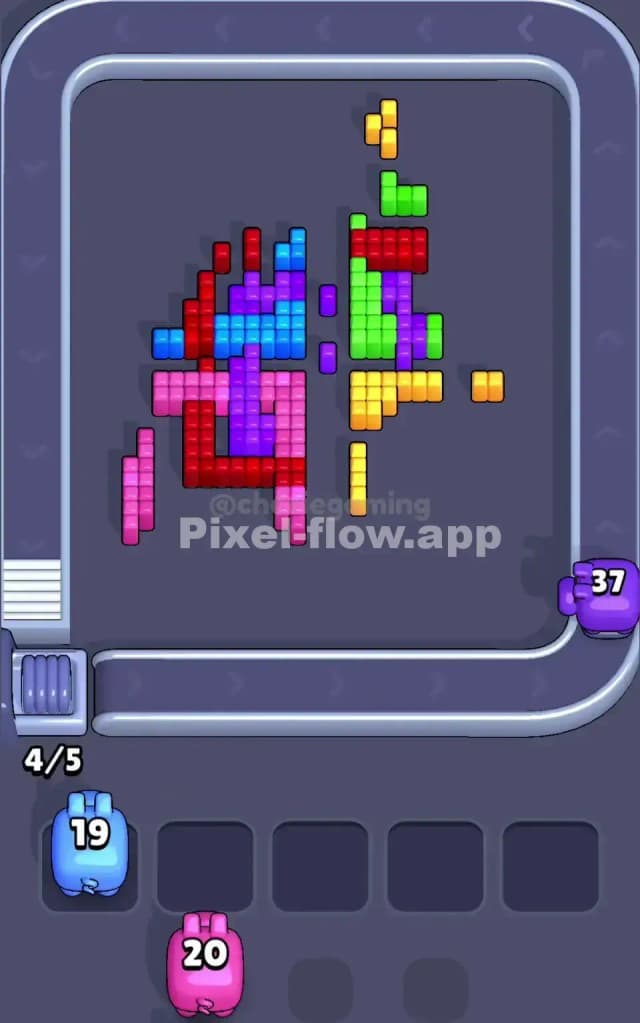
Honestly, when I first attempted Pixel Flow Level 76, I got frustrated fast. I'd activate pigs in the order they appeared and watched helplessly as the third pig (another purple) dropped into waiting with 30+ ammo left, unable to hit anything because I'd already exposed all the visible purple. The board was maybe 60% clear, and I was locked. The real breakthrough came when I stepped back and counted: I had 40 red, and the board had way more red cubes than that. This meant red needed to be a tool to expose other colors, not the goal itself. Once I started thinking about pig order as a deliberate sequencing problem—not "use this pig now" but "when do I need this pig active so it clears the right cubes at the right moment?"—Pixel Flow Level 76 went from impossible to solvable.
Step-by-Step Strategy to Clear Pixel Flow Level 76
Opening: Breaking the Cyan Frame and Exposing Red
Start by holding your pigs. Don't rush. Your first move should be to activate the purple pig, but only to clear specific purple cubes—not all of them. Wait, what? Here's the thing: that opening purple pig has 40 ammo, and there are some purple cubes visible in the central region that, if cleared, expose more red and start breaking up the interconnected red mass. Fire your first purple pig and aim for the purple cubes clustered in the center-top and center-right areas. This should take roughly 10–15 shots, leaving your purple pig with 25–30 ammo remaining. Now you'll need to carefully manage the waiting slots: that partial purple pig will drop into slot one, but that's okay because you still have three empty slots for other pigs. This conservative opening keeps your options open and prevents the early jam that catches most players.
Mid-Game: The Red Deconstruction and Layer Exposure
Once purple has softened the board and exposed some inner red, it's time to bring in your red pig. This is the critical juncture of Pixel Flow Level 76. Your red pig has 40 ammo and roughly 60 visible red cubes. Don't shoot every red cube in sight; instead, focus on red cubes that, when cleared, expose cyan or green cubes hiding beneath. The red cubes forming the "frame" or "perimeter" of inner layers are your priority. Shoot red strategically: target the edges and junction points that separate layers. As you clear red methodarily, cyan will start appearing in the freed spaces. Once your red pig depletes its 40 ammo (and it will, because there's just too much red), it'll drop into a waiting slot. Now you have your half-spent purple pig in slot one and your fully-spent red pig in slot two. You've got room.
Next, activate the remaining purple pig. This one should be dedicated to clearing the purple cubes you didn't hit in the opening, plus any newly exposed purple from the red clearing. By now, the layering should be clearer: you'll see cyan cubes freed from the red frame, green cubes on the right side, and magenta-pink still occupying the lower board. Fire this purple pig until it's dry (roughly 40 ammo), targeting the remaining purples and any purple-adjacent positions that unlock the next layer.
End-Game: Cyan, Green, Yellow, and Pink in Sequence
With reds and purples mostly exhausted, you're left with three major color patches: cyan (left outer), green (right outer), lime-yellow (lower-right), and the expansive magenta-pink (lower half). Here's where Pixel Flow Level 76 demands precision. You probably don't have additional pigs waiting, so you're relying on your initial three pigs to have done the heavy lifting. However, if the puzzle is designed well (and Pixel Flow Level 76 is), you should have exactly enough ammo distributed across those colors to clear the remaining cubes. Inspect the board: count the remaining cyan, green, yellow, and pink cubes. If cyan is still visible and uncleared, you likely need to save some ammo or you miscounted earlier. Ideally, by the end-game, cyan and green should be mostly gone, leaving only yellow and magenta-pink, which are typically simpler to manage because they're more visually isolated. Finish the board by clearing the final patches, and watch the board turn empty.
The Logic Behind This Pixel Flow Level 76 Plan
Why Order and Ammo Count Are Everything
Pixel Flow Level 76 succeeds because its pig sequence and ammo distribution are locked. You can't change which pig comes next, and you can't give a pig extra ammo. This constraint is actually your friend because it means the puzzle has a hidden logic: the designers intended a specific ammo-to-cube ratio. If you have 120 total ammo and the board has exactly 120 cubes (or close to it), then the puzzle is solvable, and solvability comes down to order. By activating pigs strategically and letting them deplete in a particular sequence, you're essentially solving a sorting problem. Each pig should empty its ammo on cubes that, collectively, expose the next layers and leave the final colors accessible. The red pig doesn't need to kill every red cube; it needs to kill the right red cubes that unblock cyan and green. This subtle shift from "clear your color" to "clear cubes that enable the next pig" is what turns Pixel Flow Level 76 from a frustrating guessing game into a solvable logic puzzle.
Staying Calm: Counting, Observing, and Planning Ahead
Winning Pixel Flow Level 76 requires discipline. Before activating any pig, pause and count. How many cyan cubes are visible? How many red cubes stand between cyan and the pig that can shoot them? If you can't articulate a reason for activating a pig right now, don't. Watch the queue: know which pig is coming next and what they're armed with. If your next pig is purple, ask yourself whether the visible purples are clearable with purple ammo, or whether they're blocked behind another color. Keep two or three mental moves ahead. "I'll fire purple now to expose red; then I'll fire red to expose cyan; then cyan will be clearable because the red blocking it will be gone." This forward-thinking approach prevents the last-second jams that make Pixel Flow Level 76 feel unfair. It's not unfair—you just need to plan like a chess player, not a reflex gamer. Count ammo, count cubes, count waiting slots, and only then pull the trigger.