Pixel Flow Level 77 Solution | Pixel Flow 77 Walkthrough
How to beat Pixel Flow Level 77: Video solution & walkthrough. The fastest way to pass Pixel Flow 77.
Is this the wrong level layout?🤔
Pixel Flow randomizes levels for different players. Don't worry, just upload a screenshot of your board, and our AI will find the correct video instantly.


Pixel Flow Level 77 Walkthrough
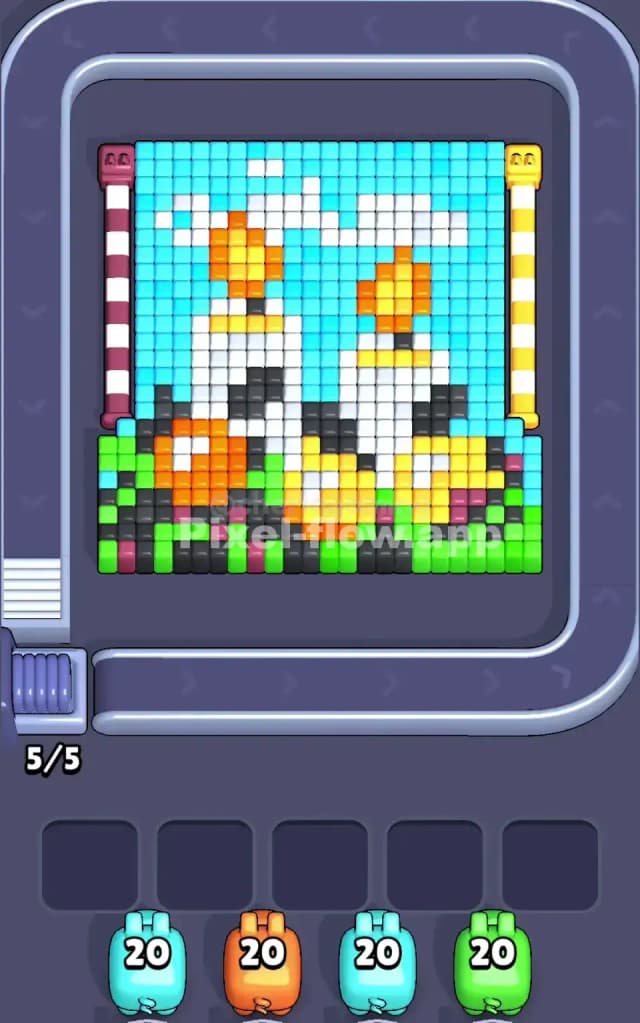
This level features a surprisingly festive scene: two large white candles with bright orange flames, set against a bright cyan sky. The candles sit on a bed of green grass, and the entire picture is framed by two tall, distinct columns on the far left and right. It looks cheerful, but don’t let the bright colors fool you. Because of the heavy layering between the white clouds, the white candles, and the background sky, Pixel Flow Level 77 is a very hard level.
You need to strip this image down from the outside in. The primary rule here is depth management. You have multiple layers of white (clouds vs. candles) and multiple layers of orange (flame tips vs. flame cores). If you pick a color that is buried deep inside the image before clearing the outer shell, your pig will have no targets. It will drop into your bottom slots, clogging up your board. Clog all five slots, and it’s game over.
Pixel Flow Level 77 Overview
Think of this artwork as a framed portrait. In the center, you have two thick, white wax candles. They have black eyes or shading spots on them, giving them a bit of character. Atop each candle sits a two-toned flame—bright orange on the outside, yellow in the center.
The background is a solid wall of cyan blue, simulating a daytime sky. Floating in this blue sky are scattered white pixels representing clouds. This is where the level gets tricky. The white of the clouds is the same color code as the white of the candles, but they exist on different depth layers.
The framing is asymmetric, which is a key visual cue for your strategy.
- The Left Flank: A tall, maroon column stands here. It’s dark and distinct from the rest of the bright palette.
- The Right Flank: A bright yellow column stands here. It blends in slightly more with the flames but is a separate structural element.
- The Base: A thick, messy patch of green pixels serves as the grass. It covers the bottom of the candles and the base of the columns.
Understanding this layout is critical because you cannot clear the bottom of the candles until that green grass is gone. Likewise, you cannot clear the tops of the candles until the blue sky and the white clouds are removed.
Step by step solution walkthrough for Pixel Flow Level 77
First Color Zone to Erase in Pixel Flow Level 77
I start by aggressively targeting the Cyan Sky.
Narratively, the sky is the "wrapper" for the top half of the image. Looking at your starting pigs, you likely have at least one or two Cyan pigs with 20 ammo each. This is the safest, most high-volume opening move. The cyan blocks are on the outermost layer. They are not blocked by anything. By clearing the sky first, you expose the edges of the white clouds, the tips of the orange flames, and the tops of the pillars.
If you don't have a Cyan pig immediately available, go for Green. The green grass at the bottom functions similarly to the sky—it’s an outer wrapper for the lower half. Clearing the green strip is essential to expose the base of the maroon and yellow pillars. Do not touch the Orange or White pigs yet. The orange flames are likely buried behind blue sky pixels, and the white candle bodies are definitely behind the green grass or blocked by the sky. If you pick them now, they will just clog your slots.
How to pass Pixel Flow Level 77 without power ups or boosters
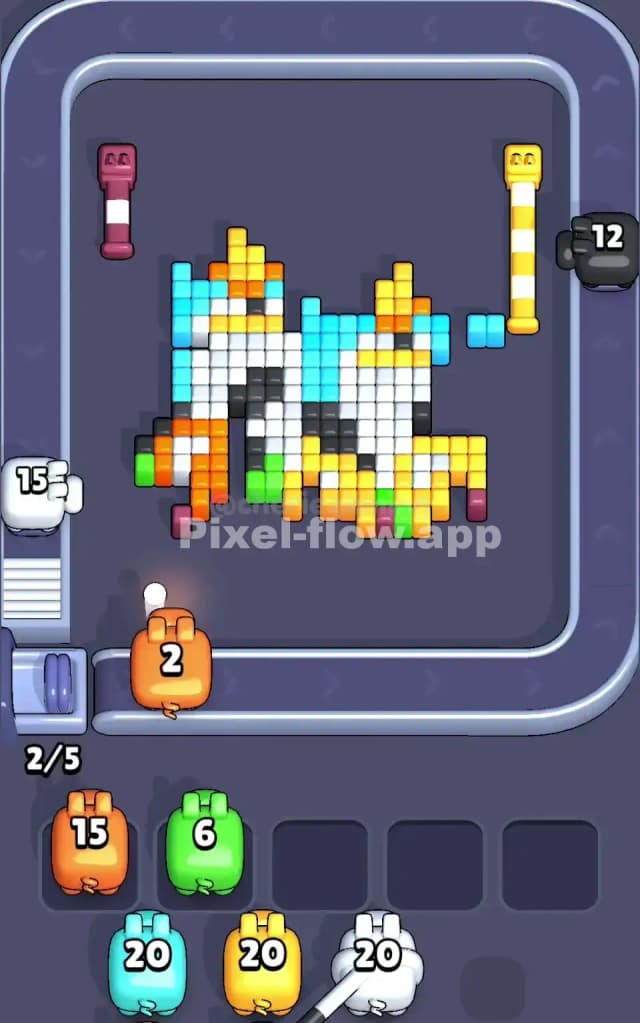
At the mid-point of Pixel Flow Level 77, the board usually looks like a floating skeleton. The blue background is gone. The green base is gone. What remains are the two pillars (Maroon and Yellow) standing in isolation, and the two candles floating in the middle.
Here is the specific trap to watch for: The White Pixel Conflict.
You now have exposed white pixels from the clouds and exposed white pixels from the candle bodies. However, parts of the candles might still be "behind" the orange flames or the black shading. When you see a White pig, verify that you have enough exposed white surface area to use up its ammo.
Prioritize clearing the Pillars (Maroon and Yellow) during this phase. Why? They are vertical blockers. Sometimes, the game logic considers the pixels behind these pillars as inaccessible until the pillars are removed. The maroon pillar on the left is usually a single solid block. Get rid of it. The yellow pillar on the right might share color with the yellow centers of the flames. Be careful. If you grab a Yellow pig to hit the pillar, make sure the pillar is actually exposed and not shielded by a stray blue pixel you missed earlier.
If you refuse to use power-ups, patience is your only weapon. You might see a huge block of Orange flames that looks tempting. But if those flames are surrounded by white cloud pixels, you must clear the White first. Follow the layers: Outer Sky > Outer Pillars > Clouds > Flames > Candle Body.
Last Details You Clean Up in Pixel Flow Level 77
In the final moments of Pixel Flow Level 77, you will be left with the "guts" of the candles. Usually, this means the Black pixels used for the eyes/shading and the final Yellow pixels inside the flames.
The board will look sparse. You might have one or two pigs clogging your slots from earlier mistakes. That’s fine, as long as you haven't hit five. The final few moves are usually:
- Orange: Clearing the main body of the flame.
- Yellow: Clearing the flame's core and the last of the right-side pillar.
- Black/Dark Grey: These are often the deepest layer, hidden right in the middle of the white wax.
Watch out for the very last single blocks. Sometimes a single green pixel hides at the very bottom corner, or a single cyan pixel hides between the two flames. Scan the empty space carefully before committing your final pigs. If you miss a "floater," it prevents the layer below it from opening up, forcing you to waste ammo on a layer you can't hit yet. Kill the floaters, expose the candle wicks, and the level is yours.