Pixel Flow Level 10 Solution Walkthrough | Pixel Flow 10
How to solve Pixel Flow level 10? Get instant solution for Pixel Flow 10 with our step by step solution & video walkthrough.


Pixel Flow Level 10 Overview
The Starting Board and Color Layout
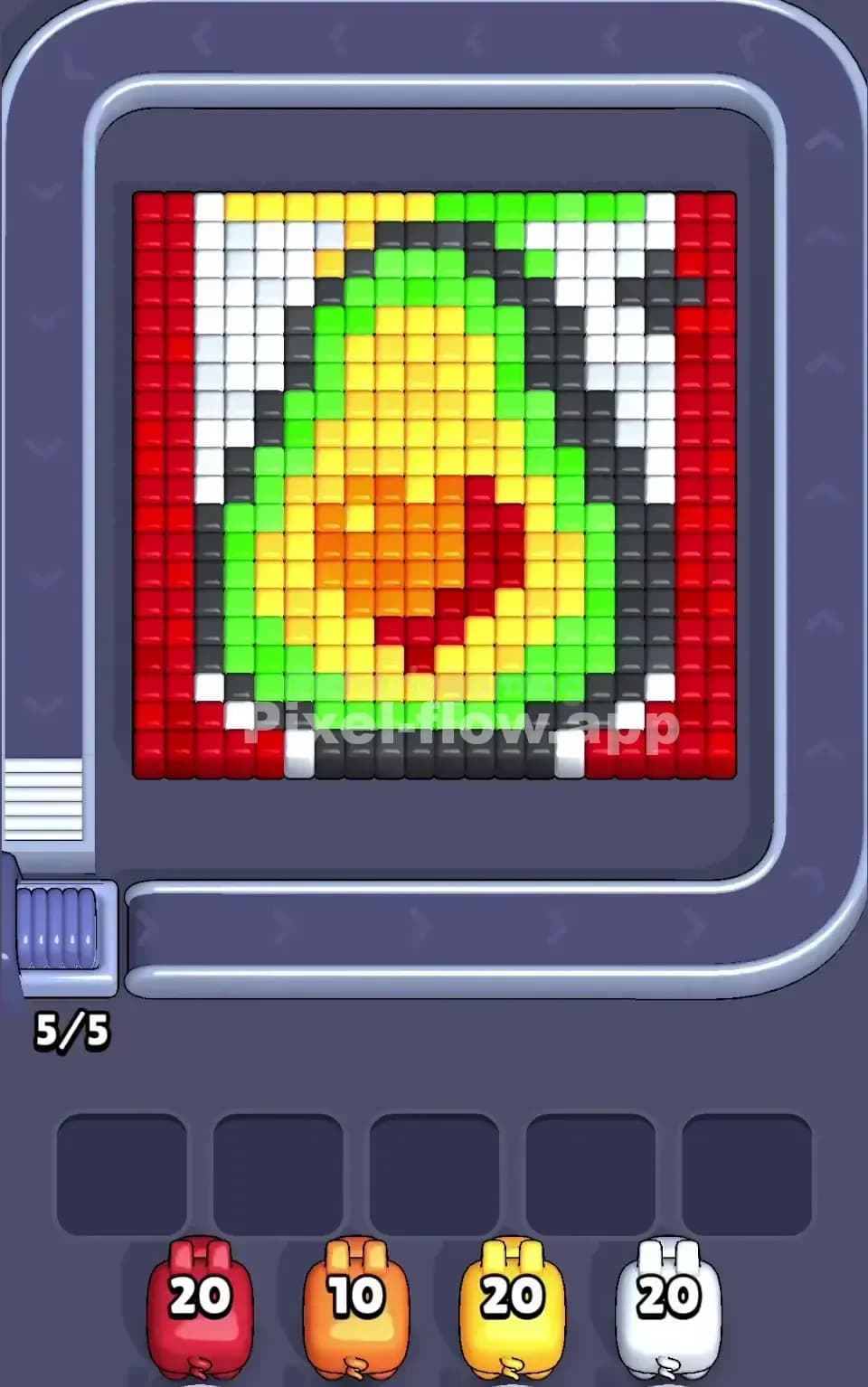
Pixel Flow Level 10 presents a retro-style robot or alien face as the central pixel art subject, rendered in a clever layered design that'll test your sequencing skills. The board features a dominant orange stripe running across the top, vibrant green columns framing both left and right edges, and a substantial red border hugging the outer perimeter. At the base, you'll find a band of blue cubes mixed with orange accents, creating a natural visual anchor. The centerpiece is a white and gray face with red details, surrounded by black accent cubes that add depth and complexity. What makes Pixel Flow Level 10 particularly tricky is that these colors aren't randomly scattered—they're stacked in layers, meaning you can't simply target every red cube first; you'll need to expose deeper colors by removing the overlying voxels strategically.
Win Condition and Deterministic Gameplay
Your goal in Pixel Flow Level 10 is straightforward: clear every single cube from the board. You're given three pigs with fixed ammo counts—a white pig with 10 shots, a red pig with 20 shots, and a black pig with 10 shots—and they'll roll down the conveyor belt in a predetermined order. Every time a pig shoots and destroys a matching-colored cube, it spends one ammo. The beauty (and challenge) of Pixel Flow Level 10 lies in its determinism: the pig sequence never changes, and your ammo is finite. This means there's no luck involved; success depends entirely on planning ahead and understanding which colors need to be targeted when.
Why Pixel Flow Level 10 Feels So Tricky
The Waiting Slot Bottleneck
The biggest threat in Pixel Flow Level 10 is the five waiting slots at the bottom of the screen. If a pig reaches the conveyor belt, shoots all its ammo (or runs out of valid targets), it drops into one of these slots and stays there until you cycle through enough pigs to free up space. Here's the catch: if all five slots fill up with "stuck" pigs that still have ammo but no matching cubes visible, you've essentially locked yourself into a failure state. In Pixel Flow Level 10, the red pig's 20-ammo arsenal is particularly dangerous because if you don't expose enough red cubes early on, you'll have a stranded red pig hogging a slot while your other pigs wait uselessly. Managing those waiting slots is literally the difference between victory and a frustrating restart.
Hidden Color Patches and Awkward Layering
Pixel Flow Level 10 hides several tricky color arrangements that can catch you off guard. The white cubes form a dense central cluster, and they're partially buried under black and gray voxels. If you're not careful about the order you clear these layers, you might expose the white cubes too late, leaving your white pig without targets at a critical moment. Additionally, the blue band at the base is isolated from the main structure, which means you need to plan for a moment when the blue pig (if one exists) or a secondary color can reach those cubes. The orange accents scattered throughout add another layer of complexity—some are part of the border, while others sit deeper in the pixel art. It's easy to misjudge how many orange cubes are actually available at any given step.
When the Level Clicked for Me
I'll be honest: Pixel Flow Level 10 frustrated me on my first five attempts because I kept treating it like a whack-a-mole game, randomly firing at whatever color seemed abundant. But then I realized I was ignoring the waiting slots entirely. Once I started paying attention to which pigs were getting stuck and why, the puzzle transformed. The "aha moment" came when I recognized that the red pig's massive 20-ammo count wasn't a problem—it was actually a gift, because it meant I could afford to be patient and clear the entire red perimeter before even touching the central face. That shift from reactive play to proactive sequencing is what makes Pixel Flow Level 10 so satisfying once you crack it.
Step-by-Step Strategy to Clear Pixel Flow Level 10
Opening: Establish Your Foundation
Start Pixel Flow Level 10 by letting the white pig fire first. You'll have plenty of white targets in the central face area, and blasting through most of its 10-ammo arsenal early ensures you're not stuck with a white pig clogging a waiting slot later. Target the outer edges of the white cluster and work inward—this exposes the red details that form the face's features. While the white pig is shooting, keep an eye on the waiting slots; you should maintain at least two empty slots at all times during the opening phase. After the white pig spends around 8–9 of its ammo, don't hesitate to let it drop into a waiting slot once it runs out of targets. The goal here is to establish a cleared foundation and expose the red cubes that lie beneath the surface.
Mid-Game: Sequence Pigs for Perfect Ammo Alignment
Once the white pig is parked, it's time for the red pig to shine. Pixel Flow Level 10's red pig carries 20 ammo, and you've now exposed a healthy number of red cubes from the white pig's work. Fire the red pig strategically: target the border reds, the face details, and the central red accents, but save some red cubes in hard-to-reach spots for later. This prevents the red pig from getting stuck with remaining ammo and nowhere to shoot. The red pig's 20 shots should consume most visible red cubes, but not all—leave a few sprinkled around to give yourself flexibility. After the red pig has spent 15–18 of its ammo, check the waiting slots again. If you're running low on free slots, it's fine to let the red pig sit in one temporarily; you'll have the black pig's 10 shots coming next. During the mid-game phase, you're also clearing away gray and black accent cubes, which reveals the deeper white-and-orange layers. This is when Pixel Flow Level 10 truly opens up—you're no longer just hitting surface colors; you're sculpting the board toward victory.
End-Game: The Clean Finish
The black pig's 10 ammo is your finisher in Pixel Flow Level 10. By this point, you should have only a few colors remaining: scattered blacks, any orange you've left standing, and potentially some stray reds or whites. Deploy the black pig to mop up all black cubes—there aren't too many, so this should take 7–9 shots. Once the black pig is done, you'll likely have one or two other colors left. Here's the critical part: don't let the black pig get stuck with 1–2 ammo and no targets. If it's clear there are no more black cubes, let it sit in a waiting slot. Now, you're essentially waiting for the board to naturally remove the last few cubes as they fall and shift. In Pixel Flow Level 10, the final stage often feels anticlimactic, but that's a sign you've planned correctly—there should be no desperate scrambling, just a clean cascade of the remaining voxels.
The Logic Behind This Pixel Flow Level 10 Plan
Exploitation of Determinism and Order
Pixel Flow Level 10 rewards you for treating the puzzle like a mathematical sequence rather than a real-time action game. The white, red, and black pigs always arrive in the same order with the same ammo counts. By mapping out which colors you'll target with each pig, you're essentially pre-solving the puzzle. The white pig's 10 shots perfectly clear the surface layer of white cubes and expose the depths. The red pig's 20 shots are overkill for pure red destruction, but that's the point—the surplus gives you buffer room for pigs that might miss a target or for colored cubes you've strategically left behind. The black pig's 10 shots finish the job without overshoot. This isn't random; it's designed. Your job in Pixel Flow Level 10 is to align your actions with that design instead of fighting it.
Staying Calm and Counting Ahead
The psychological element of Pixel Flow Level 10 can't be overlooked. When you see all five waiting slots full and a pig with 5 ammo remaining but no visible targets, panic sets in. But if you've been counting ammo and planning two or three pigs ahead, you'll realize you're actually fine because you knew this would happen and you've already accounted for it. Before you fire the white pig, take five seconds to mentally map out which colors are where and estimate how many shots each pig will need. Jot down a mental note if the order feels tight. Watch the queue—the conveyor belt shows you pigs waiting off-screen, so you know how many moves you have left. This deliberate, calm approach transforms Pixel Flow Level 10 from a chaotic shooter into a solvable puzzle. You're no longer reacting; you're executing a plan you've already verified will work.
Good luck clearing Pixel Flow Level 10—you've got this!